-
Auteur :
 TCF Canada
- Apr 20, 2026
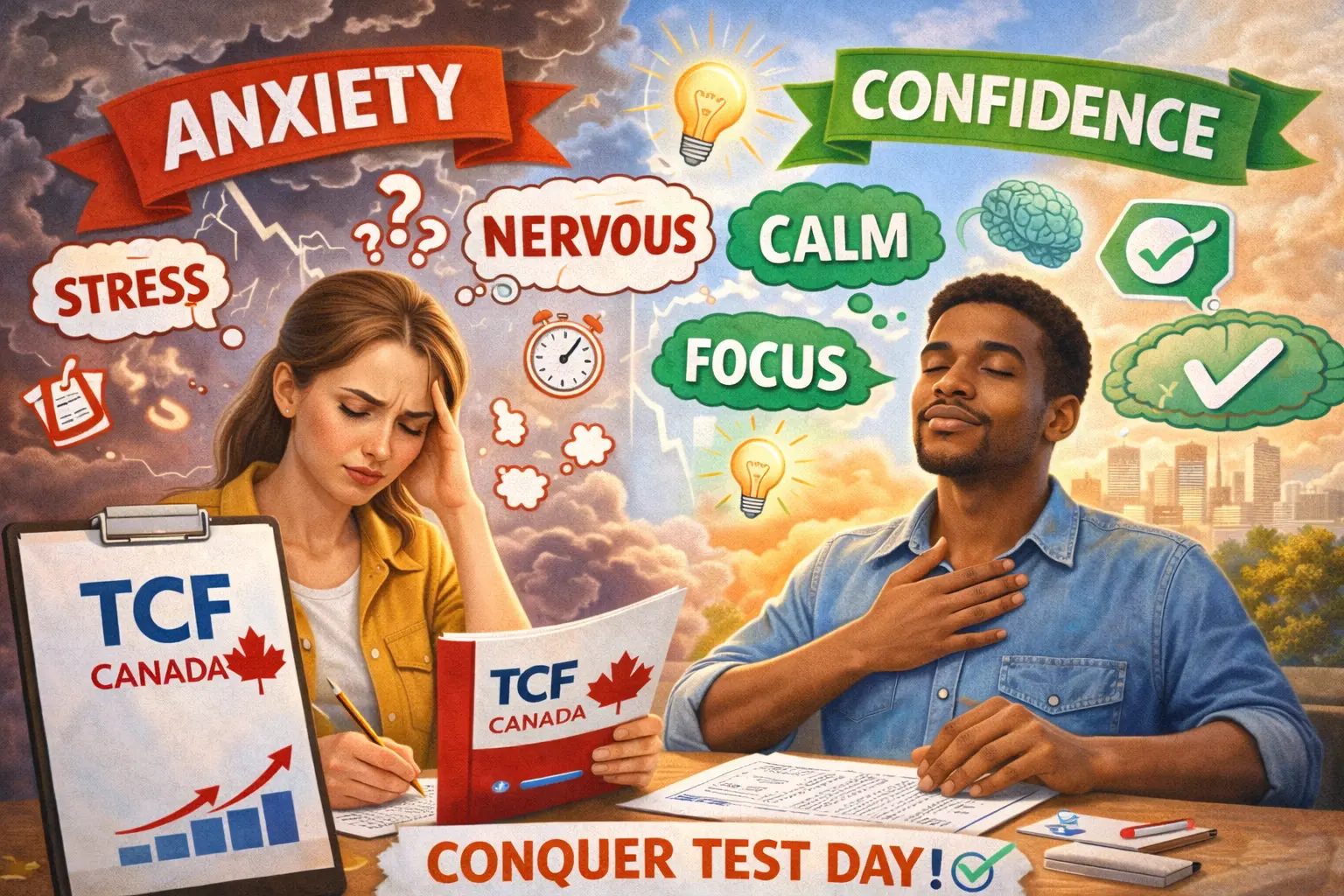
Mental Health & TCF Canada 2026 Preparation: Managing Stress, Anxiety, Burnout Risk, and Protecting Your Psychological Balance During Intensive Study
- Blog
- /
- Article

Mental Health & TCF Canada 2026 Preparation: Managing Stress, Anxiety, Burnout Risk, and Protecting Your Psychological Balance During Intensive Study
When Youssef, a 30-year-old cybersecurity analyst in Casablanca, began his TCF Canada preparation in January 2026 with a clear goal—CLB/NCLC 8+ to maximize his Express Entry profile—he followed what many candidates call the “serious plan.” He studied 4 hours every evening after a full workday, forced himself to wake at 5:30 a.m. for listening drills, and turned weekends into non-stop mock exams. Social life disappeared (“after the TCF”), meals became rushed, and sleep dropped to 5 hours (“I’ll rest after immigration”).
The first month felt like momentum: progress charts, new vocabulary, higher mock scores. Then the signs appeared—headaches, emotional irritability, foggy thinking at work, and a constant feeling of being “late” even when studying. He tried to push harder. By week six, his body and mind pushed back: intense fatigue, racing thoughts before practice tests, insomnia despite exhaustion, and a deep sense of panic about failure. He stopped studying entirely for several weeks and needed professional support to stabilize his routine and anxiety.
Months later, he restarted with a radically different strategy: shorter study blocks, protected sleep, planned breaks, and weekly mental check-ins. The result wasn’t just a better exam outcome—it was a healthier life. He reached his target level with steady progress, stronger concentration, and relationships intact. His conclusion was simple: a higher NCLC score is never worth trading your mental health for.
2026 Reality Check: Many candidates underestimate the mental load of combining immigration pressure, full-time work (or family responsibilities), and high-stakes testing. This guide addresses a topic people rarely discuss openly: TCF preparation can seriously harm mental health if the intensity is unmanaged—and the consequences can last far beyond exam day.
The Hidden Mental Health Burden in TCF Preparation: What Candidates Experience
Anonymous Candidate Snapshot (Informal Community Survey 2025, N≈2,800)
| Psychological / Physical Symptom | % Reporting It | Average Severity (1–10) | Typical Impact on TCF Performance |
|---|---|---|---|
| Moderate to severe stress | ~65–70% | 6.0–6.5 | Can be neutral if managed; chronic stress may reduce performance consistency |
| Performance anxiety (before/during practice tests) | ~50–55% | 7.0–7.5 | Mental blocks, rushed answers, lower speaking/writing fluency |
| Sleep disruption (insomnia / night awakenings) | ~45–50% | 6.5–7.0 | Reduced attention, weaker memory consolidation, lower listening/reading accuracy |
| Irritability / emotional reactivity | ~40% | 5.5–6.0 | Indirect: relationship stress adds additional cognitive load |
| Tension headaches / chronic muscle tightness | ~35–40% | 6.0–6.8 | Lower endurance during long practice sessions |
| Depressive symptoms (low mood, hopelessness) | ~25–30% | 7.5–8.0 | Drop in motivation, increased abandonment risk, weaker practice consistency |
| Panic-like episodes | ~15–20% | 8.5–9.0 | Severe disruption: speaking freezes, reading comprehension collapses |
| Full burnout (forced stop) | ~10–12% | 9.0–9.5 | Preparation interrupted; timeline shifts; confidence damage is common |
| Self-harm ideation | Low but critical | 10/10 | Medical emergency: stop immediately and seek urgent professional help |
Key takeaway: Burnout is not “rare.” A meaningful portion of candidates hit a point where continuing becomes impossible. The cost is not only academic—it can be physical, emotional, relational, and financial.
Burnout Risk Profiles (Who Should Be Extra Careful)
| Profile | Risk Level | Why It Happens | Recommended Prevention |
|---|---|---|---|
| Perfectionists aiming for NCLC 10 everywhere | Very High | Unrealistic standards, constant self-criticism, “never enough” mindset | Reframe success, use CBT-style thought checking, prioritize consistency over intensity |
| Full-time demanding job + intensive study | High | Double cognitive load, no recovery windows | Short daily sessions, weekly rest day, extend timeline if possible |
| Parents of young children | High | Sleep fragmentation + emotional labor | Negotiate support, accept slower progress, protect sleep first |
| History of anxiety or depression | Very High | Existing vulnerability amplified by immigration pressure | Plan mental-health support before starting; adjust intensity early |
| Social isolation (living alone / limited support) | Medium-High | Rumination increases; stress has no outlet | Study buddy, small weekly social activity, regular family check-in |
| Strong family pressure (“you must succeed”) | High | Fear of disappointing others fuels chronic anxiety | Communicate boundaries; define your own success criteria |
| Multiple failed attempts | Very High | Accumulated discouragement + identity threat | Structured break, rebuild confidence with smaller goals, change method (not just effort) |
The 7 Early Burnout Signals You Must Recognize Immediately
Phase 1: Early Signals (Weeks 1–3 of Intensive Preparation)
Physical signs:
- Persistent fatigue even after “enough” sleep
- Frequent tension headaches (especially after study sessions)
- Digestive stress symptoms (tight stomach, appetite drop)
- Muscle tension in shoulders, neck, jaw (including teeth clenching)
Cognitive signs:
- Concentration decline (re-reading simple sentences several times)
- Forgetting recent learning faster than usual
- Intrusive TCF thoughts during rest time (brain “won’t shut off”)
Recommended action (Phase 1): reduce study time by ~30% for one week and introduce one full day OFF.
Phase 2: Intermediate Signals (Weeks 4–6)
Emotional signs:
- Disproportionate irritability over small issues
- Motivation collapse and avoidance of study
- Anticipatory anxiety 30–60 minutes before practice
- Unexpected tearfulness or emotional hypersensitivity
Behavioral signs:
- Progressive social withdrawal (“I’ll see people after the exam”)
- Neglecting basics (food quality, hygiene, movement)
- Unhealthy coping (too much caffeine, compulsive snacking, alcohol as “relief”)
Recommended action (Phase 2): take a full reset week (no TCF study), and consider a medical / mental health check-in.
Phase 3: Established Burnout (Week 7+) — High Priority
Critical signs:
- Severe insomnia (short sleep + early awakenings)
- Major mood collapse (loss of interest, persistent low mood)
- Panic symptoms that disrupt functioning
- Catastrophic thinking loops (“If I fail, everything is over”)
- Physical deterioration (rapid weight loss, tremors, dizziness)
Absolute red lines (seek urgent help):
- Any self-harm thoughts or feeling unsafe
- Inability to function (cannot work, cannot get out of bed)
- Repeated panic episodes that keep escalating
- Rapid physical decline
- Using substances or medication to “push through”
Action: stop preparation immediately and contact a qualified professional as soon as possible.
Why the Brain “Breaks”: The Burnout Mechanism (Simple Neuroscience)
What Chronic Pressure Does to Learning
Intensive preparation is not only “hard work.” It’s a chronic stress system if recovery is missing. In the short term, stress can increase alertness. But over weeks, constant overload disrupts the exact functions you need to succeed: attention, memory, language retrieval, and emotional regulation.
- Short-term stress: can temporarily boost focus
- Chronic stress: increases mental fatigue, reduces working memory capacity, and makes anxiety responses easier to trigger
- Burnout stage: motivation collapses and cognitive “fog” makes language performance unstable
Core message: if your preparation method destroys sleep and recovery, it directly attacks your learning efficiency.
Evidence-Based Anti-Stress Strategies for TCF Candidates
Strategy #1: The 80/20 Rule for TCF Study (Stop Doing Low-ROI Work)
Principle: a small number of activities drive most of your score improvement. Your job is to identify them—and remove the rest.
| Activity | Typical Time Share | Real Score ROI | 80/20 Category |
|---|---|---|---|
| Timed mock tests + deep error analysis | 15–25% | Very High | ✅ Keep (Top 20%) |
| Teacher feedback on writing tasks | 5–15% | High | ✅ Keep (Top 20%) |
| Short daily speaking practice (20 minutes) | 5–10% | High | ✅ Keep (Top 20%) |
| Active listening with transcripts (not passive background) | 10–15% | Medium-High | ✅ Keep (Top 20%) |
| Passive grammar reading without application | 10–20% | Low | ❌ Reduce |
| Random “TCF tricks” videos without structure | 10–15% | Very Low | ❌ Remove |
| Messy vocabulary flashcards with no review system | 5–15% | Low | ❌ Fix or drop |
| Perfectionism (redoing what you already master) | — | Zero | ❌ Stop |
Want a clear structure for a sustainable plan? Use this: Strategic TCF Canada Planning: The Proven 3-Month Method That Delivers Results.
For fixing weak areas efficiently (without studying 6 hours/day), see: Targeted Improvement: Transform Your Weaknesses into Strengths.
Strategy #2: Mindfulness (15 Minutes/Day) for Exam Anxiety Control
Mindfulness is not “soft.” For candidates, it’s a training tool: it reduces rumination, improves emotional regulation, and strengthens attention control—exactly what you need for listening and speaking performance under pressure.
- Week 1–2: breathing focus (10–15 minutes)
- Week 3–4: body scan (15–20 minutes)
- Week 5+: “micro-mindfulness” breaks during study (2 minutes every 30 minutes)
Free guided options:
- Insight Timer (large free library)
- YouTube (quality varies, choose carefully)
Strategy #3: Sleep Protection Protocol (Your Secret Weapon for Memory)
Language learning is consolidated during sleep. If you cut sleep to add “more study,” you may actually learn less and perform worse.
| Time | Action | Why It Works |
|---|---|---|
| 20:30–21:00 | Screen stop (“digital sunset”) | Reduces stimulation and supports natural sleep rhythm |
| 21:00–22:00 | Wind-down routine (paper book, shower, calm music) | Signals safety and recovery to the nervous system |
| 22:00–06:00 | Protected sleep window | Improves recall, attention, emotional stability |
| Morning | Natural light exposure | Stabilizes circadian rhythm and daytime energy |
Strategy #4: Pomodoro for Language Study (Lower Fatigue, Higher Focus)
| Block | Duration | Activity |
|---|---|---|
| Pomodoro 1 | 25 min | Listening practice (active + notes) |
| Break | 5 min | Walk / stretch (no screens) |
| Pomodoro 2 | 25 min | Reading practice (questions + timing) |
| Break | 5 min | Breathing reset |
| Pomodoro 3 | 25 min | Writing task (plan + draft) |
| Break | 5 min | Water + light snack |
| Pomodoro 4 | 25 min | Speaking (record + self-review) |
| Long break | 20–30 min | Rest / outside / something enjoyable |
Result: you get ~100 minutes of deep study with far less mental exhaustion than “3 hours nonstop.”
Strategy #5: Daily Movement (Minimum 30 Minutes)
- Fast walk (easy + can pair with French audio)
- Short run (mood boost + stress reduction)
- Yoga (movement + breathing regulation)
Strategy #6: Scheduled Decompression Weeks (Non-Negotiable)
Instead of studying harder every week, plan recovery like an athlete. A simple system: 3 weeks on + 1 week downshift.
| Weeks | Mode | Goal |
|---|---|---|
| 1–3 | Focused study (1.5–2h/day) | Build skills |
| 4 | Downshift week (very light or none) | Recovery + consolidation |
| 5–7 | Focused study (2h/day) | Deepening + corrections |
| 8 | Downshift week | Prevent burnout + restore motivation |
| 9–11 | Simulation phase (mock exams) | Automation + timing |
| 12 | Pre-exam taper (max 1h/day) | Peak performance on exam day |
When (and How) to Seek Professional Support
Practical Consultation Criteria
| Symptom | Duration | Recommended Action | Urgency |
|---|---|---|---|
| Anxiety disrupts daily life | 2+ weeks | Psychologist (performance anxiety / CBT tools) | Moderate |
| Low mood / loss of interest | 2+ weeks | Psychologist or doctor evaluation | Moderate-High |
| Recurring panic symptoms | Multiple episodes | Medical evaluation + referral if needed | High |
| Severe insomnia | 3+ weeks | Medical check + CBT-I methods | Moderate |
| Any self-harm thoughts / feeling unsafe | Even once | Urgent professional help immediately | Critical |
A Full Candidate Story: From Collapse to Sustainable Success
Phase 1: “I Thought More Hours Would Solve Everything”
Youssef treated preparation like a sprint. He measured commitment by hours. The more pressure he felt, the more he cut sleep and social life. He didn’t notice that his learning efficiency was shrinking.
Phase 2: Rebuilding a Method That Protects the Mind
The turning point was accepting that the brain needs recovery to learn language. He used smaller daily sessions, structured feedback, decompression weeks, and consistent sleep. He also stopped “punishing himself” after a bad mock exam and started adjusting strategy instead.
Phase 3: The Real Win
He reached his target level with fewer study hours than before—because the hours were higher quality and his mind was stable. He describes it as “winning twice”: better performance and a healthier life.
Complete Mental Health + TCF Preparation Resources
Conclusion: Mental Health Is the Foundation of a Successful Immigration Journey
The pressure to reach NCLC 9–10 quickly is real—especially when candidates compare themselves to others or feel that a single score defines their future. But TCF preparation is a marathon. Sustainable routines beat extreme intensity. Your brain learns faster when it is safe, rested, and consistent.
The strategies in this guide—80/20 study selection, protected sleep, short focus blocks, movement, and scheduled decompression—are not optional “nice extras.” They are performance foundations. If you recognize yourself in Phase 2 or Phase 3 warning signs, pause and get support. The strongest candidates are not the ones who suffer the most—they are the ones who protect their stability.
* * *
Frequently Asked Questions
Yes. When preparation becomes chronically intense without recovery (reduced sleep, constant pressure, social isolation), it can increase stress, anxiety, sleep disruption, and burnout risk. These effects can also reduce learning efficiency and exam performance by harming attention, memory, and emotional regulation.
Early signs often appear within weeks 1–3: persistent fatigue even after sleep, tension headaches, appetite changes, jaw/neck/shoulder tension, declining concentration (re-reading a lot), faster forgetting, and intrusive exam thoughts during rest time. A smart response is to reduce study volume for a week and add a full day off.
Use a sustainable structure: prioritize high-ROI activities (timed mocks + error analysis, teacher feedback, short daily speaking), study in short focus blocks (Pomodoro), protect sleep, and add brief mindfulness daily. This approach often improves consistency and performance without extending the timeline dramatically.
Take a reset week (no TCF study), stabilize basics (sleep, meals, movement), reduce caffeine and other unhealthy coping, and consider a medical or mental-health check-in—especially if anxiety, insomnia, or low mood lasts more than two weeks.
Seek support if anxiety disrupts daily life for 2+ weeks, low mood/loss of interest lasts 2+ weeks, panic episodes recur, severe insomnia persists for 3+ weeks, or functioning drops. If you ever feel unsafe or overwhelmed to the point you can’t function, treat it as urgent and reach out to a qualified professional immediately.
Laissez un commentaire
Votreadresse email ne sera pas publie. Les champs obligatoires sont marque avec *


 TCF Canada Hub
0 Commentaires
aucun commentaire
Soyez le premier a partager votre avis !