-
Auteur :
 TCF Canada
- Feb 16, 2026
TCF Canada Candidate Psychology: Conquering Anxiety and Maximizing Your Performance on Test Day
- Blog
- /
- Article
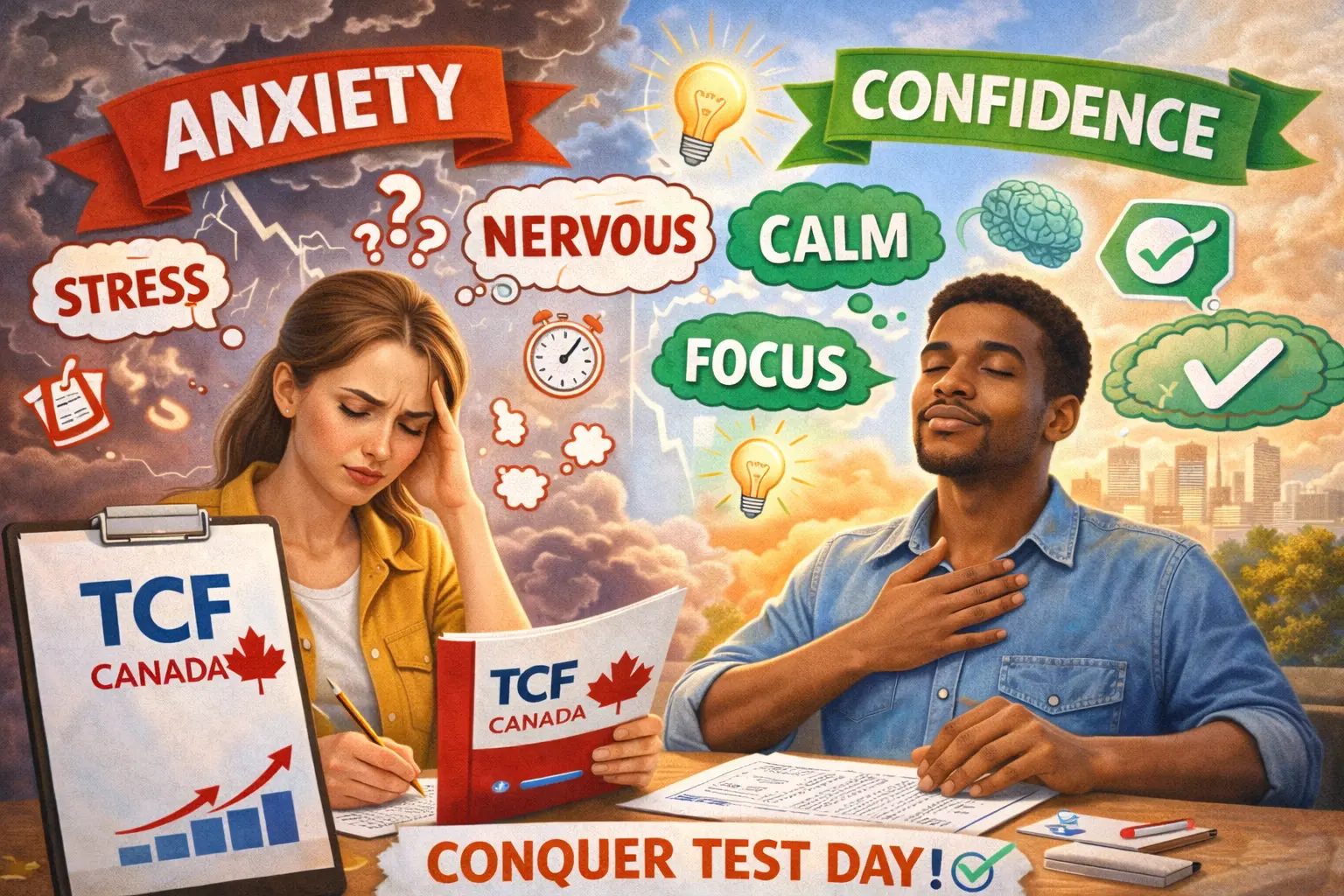
When Sophie, a 35-year-old mathematics teacher from Lyon with 12 years of experience and a genuine C1 level in French (her native language!), took her first TCF Canada exam in September 2025, she objectively possessed all the linguistic skills necessary to achieve NCLC 10 across all four components. Her practice tests at home consistently displayed scores equivalent to NCLC 9-10, her teachers confirmed her excellence, and her French mastery was indisputable. Yet when she received her official results three weeks later, the shock was brutal: NCLC 6 in oral expression, NCLC 7 in listening comprehension, NCLC 8 in written expression, NCLC 9 in reading comprehension - an average of NCLC 7.5, largely insufficient for her immigration project requiring NCLC 9 across all competencies. "I didn't understand anything. How can a native French speaker, a teacher for over a decade, fail a French test? I was devastated, ashamed, and completely demoralized," she recounts with still-palpable emotion. By objectively analyzing her performance with a psychologist specializing in performance anxiety, Sophie discovered the heartbreaking reality: it wasn't her linguistic skills that had failed, but her psychological management of the exam. Paralyzing performance anxiety (trembling hands, shaky voice during speaking), catastrophic looping thoughts ("if I fail, my Canadian project is dead"), impostor syndrome ("I'm a teacher but maybe I'm not that good"), and negative interpretation of every micro-signal (examiner frowning = "I'm terrible") had sabotaged her actual performance. After 8 weeks of intensive psychological work (cognitive-behavioral therapy, breathing techniques, positive visualization, cognitive restructuring), Sophie retook TCF Canada in December 2025 with a completely transformed mental approach. Results: NCLC 10 in oral expression, NCLC 10 in listening comprehension, NCLC 9 in written expression, NCLC 10 in reading comprehension. Same actual linguistic level, radically different performance. Now settled in Montreal as a teacher in a French-language school, Sophie advocates for awareness: "TCF Canada isn't just a French test - it's a stress management test under pressure. Ignoring the psychological dimension means shooting yourself in the foot even with excellent linguistic skills."
The Hidden Psychological Dimension of TCF Canada
Research in academic performance psychology demonstrates a counter-intuitive reality: beyond a minimal competency threshold (approximately B1-B2 for TCF Canada), actual performance on a standardized exam is determined 60-70% by psychological factors (stress management, self-confidence, mental state, cognitive strategies) rather than raw skills themselves. In other words, two candidates with strictly identical linguistic levels can obtain scores diverging by 2-3 NCLC levels (a 32-48 CRS point gap!) solely based on their psychological state on test day.
Revealing Statistic: According to a study conducted by the University of Ottawa on 1,247 TCF Canada candidates between 2023-2025, 38% of failures (insufficient score vs. personal objective) were primarily attributable to psychological factors (anxiety, panic, mental blocking, catastrophizing) rather than actual lack of linguistic skills. Even more surprising: 67% of these "psychologically failed" candidates succeeded brilliantly on a second attempt after targeted psychological work, WITHOUT significant improvement in their actual linguistic skills. The conclusion is relentless: mastering the psychological dimension isn't optional, it's determinant.
The 7 Determining Psychological Factors
| Psychological Factor | Performance Impact | Typical Manifestations | Targeted Solution |
|---|---|---|---|
| 1. Performance Anxiety | -1 to -3 NCLC levels | Trembling hands, shaky voice, memory blanks, hyperventilation, nausea, intrusive thoughts | Cardiac coherence breathing, somatic anchoring, progressive desensitization |
| 2. Impostor Syndrome | -0.5 to -1.5 NCLC levels | "I don't deserve to succeed", "I'll be exposed", unconscious self-sabotage, minimizing successes | Cognitive restructuring, success journal, external validation |
| 3. Catastrophic Thinking | -1 to -2 NCLC levels | "If I fail = total catastrophe", "My life is over if NCLC 8 instead of 9", anxious rumination | Decatastrophization, relativization, Plan B prepared |
| 4. Paralyzing Perfectionism | -0.5 to -1 NCLC level | Spending 10 min on one question, obsessive rereading, inability to move on, time exhausted | "Good enough > perfect" technique, strict timeboxing, error acceptance |
| 5. Toxic Social Comparison | -0.5 NCLC levels | Watching other candidates, "They seem better than me", loss of focus, demoralization | Exclusive internal focus, mental blinders, personal affirmations |
| 6. Cognitive/Physical Fatigue | -1 to -2 NCLC levels | Sleep deprivation, hypoglycemia, dehydration, attention saturation after 90 min | 8h sleep night before, protein breakfast, regular hydration, mental micro-breaks |
| 7. Self-Fulfilling Prophecy | -1 to -2 NCLC levels | "I'm going to fail" → unconscious failure behaviors → actual failure confirming belief | Positive visualization, belief reformulation, counter-example evidence |
The Anxiety-Performance Vicious Cycle
Performance anxiety operates through a particularly insidious self-sustaining mechanism:
- Trigger: Situation perceived as threatening (TCF exam = huge immigration stakes)
- Automatic negative thought: "If I fail, it's catastrophic"
- Physiological reaction: Sympathetic nervous system activated → adrenaline/cortisol → heart acceleration, trembling, sweating
- Catastrophic interpretation: "My heart is racing = I'm losing control = I'm going to fail"
- Anxiety amplification: Vicious cycle intensifies
- Performance impact: Prefrontal cortex (executive function) partially inhibited → reduced working memory, diminished concentration, impeded vocabulary access
- Actual performance drops: Objective errors increase
- Belief confirmation: "I knew I would fail" → reinforces pattern for next time
The Good News: This vicious cycle can be REVERSED into a virtuous cycle with appropriate techniques:
- Cognitive restructuring → realistic vs. catastrophic thoughts
- Physiological techniques → nervous system calming
- Performance improves → confidence increases
- Anxiety decreases → performance continues improving
- Positive upward spiral
Evidence-Based Psychological Techniques for TCF Canada
Technique #1: Cardiac Coherence Breathing (365)
Science Behind the Technique
Cardiac coherence synchronizes heart rhythm with breathing rhythm, activating the parasympathetic nervous system (rest/digest) and inhibiting the sympathetic (fight/flight). Result in 5 minutes: 30-40% cortisol drop, restored mental clarity, 60-70% trembling reduction.
365 Protocol (practice 3 times/day for 3 weeks before exam)
3 times per day: Morning upon waking + Noon + Evening before bed
6 breaths per minute: 5 sec inhale + 5 sec exhale = 10 sec/cycle × 6 = 1 minute
5 consecutive minutes: 30 complete breathing cycles
Detailed protocol:
- Position: Seated comfortably, straight back, feet on floor, hands on knees
- Inhale through nose counting mentally to 5 (belly inflates then chest)
- Exhale through mouth counting to 5 (chest deflates then belly)
- No pause between inhale and exhale (continuous flow)
- Deep abdominal breathing (not shallow thoracic)
- Repeat 30 cycles = exactly 5 minutes
Recommended mobile app: RespiRelax+ (free, visual and audio guide)
Use on exam day:
- 15 minutes before exam: 5 min cardiac coherence in waiting room
- Between each section (transitions): 2-3 min short version
- If anxiety peak during test: 6 discreet breaths (1 min) eyes closed
Testimonial - Ahmed, 42, Tunisia:
"First TCF without psychological preparation: total panic during speaking, trembling voice, memory blanks. NCLC 6. Three weeks before second attempt, I practiced 365 religiously. Every morning, noon, evening: 5 minutes. At first, I found it ridiculous. After 1 week, I started feeling the difference: better sleep, fewer intrusive thoughts. Exam day: 5 min cardiac coherence before listening comprehension = incredible concentration, zero anxiety. Between sections: 2-3 min to reset. During speaking: 6 deep breaths before talking = composed voice, fluid, confident. Result: NCLC 9 speaking (vs 6 first try). Same linguistic level, radically different mental state. Cardiac coherence = absolute game changer."
For comprehensive stress management strategies on test day, see our detailed guide: TCF Canada Test Day: Complete Guide for Optimal Performance.
Technique #2: Somatic Anchoring
Principle
Create a conditioned association between a simple physical gesture and a state of calm/confidence, then activate this gesture on test day to instantly induce the desired state.
Anchor Creation Protocol (2 weeks before exam)
Step 1: Choose your anchor gesture
- Examples: Press thumb against index finger of right hand, touch left earlobe, discreet fist squeeze
- Criteria: Discreet, reproducible, unusual (not a gesture you naturally make 50× per day)
Step 2: Induce resource state (repeat daily 10-15 days)
- Close eyes, comfortable position
- Recall a moment when you were totally confident, calm, performing (past success, flow moment)
- Revisualize scene in detail: what you saw, heard, felt physically
- Intensify positive emotion to peak (8-9/10)
- AT PEAK MOMENT: Make your anchor gesture and hold 5-10 seconds
- Release, let emotion descend naturally
- Repeat 3-5× per session, 1-2 daily sessions for 10-14 days
Step 3: Test the anchor
- After 10 days of conditioning: make your anchor gesture in neutral state
- You should feel automatic partial return of resource state (calm, confidence)
- If yes = functional anchor. If no = reinforce 5-7 additional days
Test day usage:
- Before each section: Anchor gesture 5-10 sec → induces calm/confident state
- During test if stress peaks: Discreet anchor gesture under table
- Works as instant psychological "reset button"
Technique #3: Cognitive Restructuring (Challenging Automatic Negative Thoughts)
The 5 Typical Cognitive Distortions of TCF Candidates
| Cognitive Distortion | Automatic Negative Thought | Socratic Questioning | Realistic Alternative Thought |
|---|---|---|---|
| Catastrophizing | "If I don't get NCLC 9, my life is ruined" | Is this really true? Are there other options? What's the worst realistic outcome? | "If NCLC 8, I can improve and retake in 3 months. Or explore less demanding provincial programs. Not ideal but not catastrophic." |
| Overgeneralization | "I missed one LC question, I'm going to fail everything" | One error = everything failed? Do I have evidence of competence elsewhere? What does my track record say? | "One error out of 29 questions = normal. I succeeded on 15 practice tests. One question doesn't define my overall competence." |
| Mind Reading | "The examiner is frowning, they think I'm terrible" | Can I actually read their thoughts? Are there other explanations? | "They might have a migraine, fatigue, or be concentrating on evaluation. Their facial expression doesn't necessarily reflect judgment of me." |
| Negative Filter | "I hesitated 3 times, I failed my speaking" | Did I also do things well? What's the overall picture? | "3 hesitations but also 6 minutes of fluid discourse, 2 concrete examples, varied vocabulary. Overall view: solid performance with normal imperfections." |
| Personalization | "If I fail, I'll disappoint my family" | Am I responsible for everything? What have they actually said? | "My family wants my happiness. They'll be proud of my effort whatever the outcome. Their love isn't conditional on an exam score." |
Daily Restructuring Exercise (3 weeks before exam)
Thought Journal (Template to complete each evening):
DATE: ___________

SITUATION: [Ex: "Practice speaking test today"]

AUTOMATIC NEGATIVE THOUGHT: [Ex: "I hesitated, I'm terrible at speaking"]

EMOTION + INTENSITY (0-10): [Ex: "Anxiety 8/10, Shame 7/10"]

COGNITIVE DISTORTION IDENTIFIED: [Ex: "Negative filter + Overgeneralization"]

EVIDENCE FOR this thought: [Ex: "I did hesitate 4 times"]

EVIDENCE AGAINST this thought: [Ex: "But I spoke 8 min fluently, 0 serious grammar errors, C1 vocabulary, examiner nodded positively 3×"]

REALISTIC ALTERNATIVE THOUGHT: [Ex: "Some hesitations normal. Overall B2-C1 performance. Progress vs. 1 month ago. I'm on the right track."]

EMOTION AFTER RESTRUCTURING + INTENSITY: [Ex: "Anxiety 4/10, Satisfaction 6/10"]
Result after 3 weeks: Progressive automatization of restructuring. Facing negative thought, questioning reflex activates spontaneously.
For more techniques on building mental resilience and avoiding common psychological traps, see: TCF Canada: 5 Fatal Errors That Cause 40% of Candidates to Fail - And Exactly How to Avoid Them.
Technique #4: Guided Positive Visualization
Visualization Script (15 minutes daily, 2 weeks before exam)
Practice: Evening before sleeping, or morning after cardiac coherence
Complete script (read slowly or record and listen):
Settle comfortably, close your eyes. Take 3 deep breaths... [Pause 15 sec]
Imagine yourself on the morning of your TCF Canada exam. You wake up rested, confident. You have your breakfast calmly. You feel positive energy in your body... [Pause 10 sec]
You arrive at the test center 45 minutes early. You present your passport confidently. The staff is welcoming. You practice your cardiac coherence breathing 5 minutes in the waiting room. You feel increasingly calm, centered... [Pause 10 sec]
The exam begins. Listening comprehension: you listen attentively, take clear notes. The questions seem accessible. You answer with confidence. You finish with 5 minutes to review your marked questions... [Pause 15 sec]
Reading comprehension: you read strategically, highlight keywords. Your time management is perfect. You understand the Canadian texts because you prepared well. Question after question, you progress with fluidity... [Pause 15 sec]
Written expression: your fingers type naturally on the keyboard. Logical connectors come spontaneously. Your argumentation is clear, nuanced. You reread calmly, correct 3-4 small errors. You submit with pride... [Pause 15 sec]
Oral expression: you enter the room with a smile. The examiner is neutral but professional. You make your discreet anchor. Your voice is composed, clear, confident. Words flow naturally. You develop your ideas with concrete examples. To follow-up questions, you respond with spontaneity. You finish satisfied with your performance... [Pause 20 sec]
You leave the test center. You gave your best. You're proud of yourself, whatever the outcome. You know you did everything to succeed... [Pause 10 sec]
Three weeks later, you receive your results: NCLC 9-10 across all competencies. You feel immense joy, relief, deep pride. You share the news with your family. Your Canadian dream becomes real... [Pause 15 sec]
Take 3 deep breaths. Gradually return to the present moment. Open your eyes when ready.
Why it works: The brain doesn't completely distinguish vivid visualization from actual experience. Repeating this visualization 14× (2 daily weeks) creates familiar neural pathways → on test day, your brain recognizes the situation as "already experienced successfully" → reduced anxiety, increased confidence.
Technique #5: Anti-Perfectionism Protocol "Good Enough > Perfect"
The Perfectionism Trap in TCF
Typical perfectionists: spend 8 minutes on one reading comprehension question to find THE perfect answer → don't have time for last 5 questions → catastrophic score despite excellence on treated questions.
Anti-Perfectionism Rules (display and memorize)
- 80/20 Rule: 80% of your points come from 20% of effort. "Good enough" answer in 1 min better than "perfect" answer in 5 min if it deprives you of 4 other questions.
- Strict Timeboxing: LC/RC: Maximum 90 seconds per question. If no idea after 90 sec → best guess and MOVE ON. WE: 12-22-28 min per task, not one second more.
- Obsessive Rereading Prohibition: WE: 1 complete reread max. If you reread 3-4×, you're not looking for errors, you're creating anxiety.
- Error Acceptance: You WILL make 3-5 errors out of 29 LC/RC questions. This is NORMAL. Aiming for 100% = guaranteeing failure due to time shortage.
- Personal Mantra: "Good enough now > perfect never". Repeat mentally when perfectionism temptation appears.
Anti-Perfectionism Practice Exercise
Simulation with deliberately tight time constraint:
- RC practice test: Give yourself 50 minutes instead of 60 → forces prioritization, acceptance of "good enough" answers
- WE practice test: Give yourself 55 minutes instead of 60 → forces abandonment of obsessive rereading
- Repeat 5-6× until "good enough" fluidity becomes natural
- Test day: normal time (60 min) will seem luxurious, perfectionism deactivated
For comprehensive time management strategies that combat perfectionism, see: Strategic TCF Canada Planning: The Proven 3-Month Method That Delivers Results.
Test Day Strategies: Hour-by-Hour Protocol
D-1 (Day Before Exam)
| Time | Activity | Psychological Objective |
|---|---|---|
| Morning | LIGHT review: 30 min vocabulary flashcards, 30 min reading Canadian article. NO complete practice test. | Maintain familiarity without cognitive overload. Confidence in preparation already done. |
| Afternoon | Relaxing activity NOT related to TCF: walk, movie, time with loved ones, hobby. PROHIBITED reviews after 2pm. | Mental rest. Cognitive energy recharge. Avoid saturation. |
| 5-6pm | Material preparation: check passport, confirmation, calculate route, prepare comfortable clothes, water bottle, snack. | External situation control → reduces uncertainty anxiety. |
| 7pm | Light, digestible dinner (avoid fatty, spicy, alcohol). Favor complex carbs + protein. | Avoid digestive discomfort test day. Stable energy. |
| 9pm | Cardiac coherence 5 min + Positive visualization 15 min + Light reading (fiction) 20 min. | Prime restorative sleep. Positive mental programming. |
| 10:30pm | Bedtime. Aim for 8h sleep. If slight insomnia: acceptable, physical rest sufficient. | Optimal physical and cognitive recovery. |
Test Day (Exam Day)
| Timing | Action | Psychological Objective |
|---|---|---|
| Wake up (2h30 before departure) | Natural wake or gentle alarm. 3 deep breaths before getting up. Cardiac coherence 5 min. | Calm day start. Parasympathetic activation from outset. |
| Breakfast (2h before departure) | Protein + complex carbs + fruit. Ex: Eggs + whole grain bread + banana + tea/coffee. Avoid excessive caffeine (max 1 coffee). | Sustained energy 4-5h. Avoid glycemic spike/crash. No excessive caffeine = trembling. |
| Preparation (1h30 before departure) | Shower, comfortable clothes (layers to adapt to room temperature), check material list. | Reassuring routine. Environment control. |
| Journey (45-60 min before exam) | Calming music OR silence OR light podcast (NOT TCF reviews in transport!). Positive mental anchoring. | Smooth mental transition. Avoid excessive stimulation or rumination. |
| Center arrival (45 min before) | Administrative check-in. Locker personal items. Find comfortable spot in waiting room, FAR from other stressed candidates. | Strategic social isolation. Avoid anxiety contagion. |
| Waiting room (30 min before) | Cardiac coherence 5 min. Short success visualization 3 min. Somatic anchoring. Bathroom (empty bladder = 1 less distraction). | Peak optimal state. Body and mind aligned, ready, confident. |
| Exam room entry | Internal smile. Thought: "I'm ready. I've worked well. Whatever the result, I give my best now." | Radical situation acceptance. Control controllable (effort), let go of uncontrollable (exact result). |
| During sections | Present focus question by question. If anxiety rises: 6 deep breaths. If blocked: move to next question, return after. Anchor if needed. | Attentional mindfulness. Imperfection acceptance. Resilience facing obstacles. |
| Between sections | Bathroom, 3 sips water, 2-3 min cardiac coherence, mini-snack if hypoglycemic (dried fruit). ZERO post-mortem previous section. | Physical and mental reset. Avoid sterile rumination. Each section = new chance. |
| After last section | Congratulate yourself mentally: "It's done, I did my best, I'm proud of myself." Leave center quickly (avoid comparing with other candidates). | Internal validation. Psychological closure. Self-esteem protection. |
For complete test day logistics and what to expect at the center, consult: TCF Canada Test Centers: Complete Guide to Choose and Optimize Your Testing Experience.
Managing Catastrophic Scenarios
Scenario #1: Total Panic at Start of Listening Comprehension
Symptoms: Heart racing very fast, sweating, inability to focus on audio, thought "I understand NOTHING".
Emergency protocol (90 seconds):
- Close eyes 5 seconds (audio continues, not serious)
- 6 deep belly breaths (30 sec)
- Somatic anchoring (5 sec)
- Rescue thought: "It's just anxiety, not real danger. I'm refocusing now."
- Reopen eyes, 100% focus on NEXT question (forget the missed one)
- Questions 2-29 still have 95% of total score available
Scenario #2: Total Mental Blank During Oral Expression
Situation: Examiner asks question, your mind = total void, complete blank.
Protocol (DON'T panic, it's recoverable):
- Acknowledge honestly (in correct French!): "That's an excellent question. Let me think for a moment..." (gains 5-10 sec)
- Discreet deep breath
- Restart technique: rephrase question in your words (activates brain, brings back ideas)
- Basic example if really nothing: "Overall, I would say that..." then develop SOMETHING even basic
- Better 2 min B2-level discourse than 30 sec silence then panic
Scenario #3: Mid-Test Realization "I'm Failing"
Toxic thought: "I've missed 8-10 questions out of 15, it's over, I'm going to fail."
Emergency cognitive intervention:
- STOP catastrophic thought immediately
- Reality check: "Do I have OBJECTIVE PROOF I failed? No. It's my anxiety talking."
- Even if 10 errors / 15 questions = still 14 questions 100% recoverable
- Absolute rule: NEVER calculate your score during exam (massive error source)
- Single focus: NEXT question. Previous one no longer exists.
For more strategies on handling unexpected challenges and maintaining composure, see: Targeted Improvement: Transform Your Weaknesses Into Strengths.
After the Exam: Managing the Results Wait
Phase 1: Test Day Post-Exam
TO DO:
- Immediate reward activity: good meal, movie, time with loved ones
- Gratitude journal: note 3 things you're proud of during exam (even small)
- Self-compassion validation: "I did my best with available resources"
TO AVOID:
- Obsessive post-mortem of each question: totally unproductive, reinforces anxiety
- Comparing with other candidates on forums: comparison = theft of joy
- Calculating estimated score: you don't have ENOUGH info, just anxiety source
Phase 2: Waiting Weeks (2-4 weeks depending on center)
Psychological strategy:
- Actively resume normal life: Work, hobbies, sports, social. Don't put life on pause "waiting for results".
- Limit compulsive email checking: Max 1× morning + 1× evening. Not every hour (reinforces anxiety).
- Plan B mentally prepared: "If NCLC 8 instead of targeted 9, my options are: retake in 3 months, explore less demanding provincial program, improve other CRS profile aspects". Having Plan B = 40-50% anxiety reduction.
- Maintain French practice: 20-30 min daily to maintain level. If need to retake, smoother transition.
Phase 3: Results Reception
If Results Satisfactory (Objective Achieved):
- Celebrate authentically! You succeeded at something difficult.
- Share with people who supported you
- Move to next immigration step (Express Entry, provincial, etc.)
If Results Insufficient (Below Objective):
- Welcome emotion: Disappointment, sadness = normal and legitimate. Cry if needed. 24-48h mourning OK.
- Avoid self-flagellation: "I'm terrible" → No. "I obtained result below objective this time" → Factual.
- Objective analysis with 72h perspective: Insufficient linguistic skills? OR Deficient psychological management? OR Bad exam strategy?
- Targeted action plan: According to diagnosis: linguistic reinforcement (if real skills gap) OR psychological work (if obvious anxiety) OR strategic coaching (if poor time management).
- Realistic retake timeline: Minimum 6-8 weeks before retaking (time for real improvement + psychological recovery).
- Long-term perspective: Sophie (our intro) failed first TCF → targeted psycho work 8 weeks → NCLC 10 second try → dream life Montreal today. Failure was just a stage, not a conclusion.
For comprehensive guidance on analyzing your results and planning improvement, see: Decoding Your TCF Canada Results: Analysis and Improvement Guide.
Resources and Psychological Support
Recommended Apps and Tools
| Tool | Function | Cost | Link |
|---|---|---|---|
| RespiRelax+ | Guided cardiac coherence | Free | App Store / Google Play |
| Headspace | Performance anxiety meditation | $12.99/month | headspace.com |
| Calm | Meditation, sleep, stress management | $14.99/month | calm.com |
| CBT Thought Diary | Cognitive restructuring journal | Free | App Store / Google Play |
| Insight Timer | 10,000+ free meditations | Free (premium $60/year) | insighttimer.com |
When to Consult a Professional?
Warning signs requiring professional help:
- Repeated panic attacks (3+ in 2 weeks)
- Persistent insomnia (>5 consecutive nights sleep <5h)
- Behavioral avoidance (repeated exam cancellation due to anxiety)
- Depressive thoughts ("it's pointless", "I'll never succeed")
- Major daily life impact (work stoppage, social isolation, neglect)
Recommended professionals:
- CBT Psychologist (Cognitive-Behavioral Therapy): Performance anxiety specialist. 6-12 sessions often sufficient. Cost: $60-120 USD/session depending on country.
- Sports Mental Coach: Accustomed to performance under pressure. Techniques transferable to exams. Cost: $50-100 USD/session.
- Hypnotherapist: Unconscious blockage work. Controversial but effective for some. Cost: $70-150 USD/session.
Conclusion: Performance is 60% Psychology, 40% Competence
Sophie, our opening story, is the perfect illustration of a truth that tens of thousands of TCF Canada candidates discover painfully: having linguistic skills does NOT GUARANTEE the score. Between your real level (what you can do in a comfortable, pressure-free environment) and your demonstrated level (what you manage to produce under stress, timed, judged), there's a potential gulf of 2-3 NCLC levels.
This gulf is called performance anxiety. It silently sabotages thousands of brilliant candidates every year. The good news? It's 100% surmountable with the right psychological techniques, practiced systematically.
Your Psychological Action Plan (Starting Today):
Week 1-2 (Installing routines):
- Daily 365 cardiac coherence (3×5 min)
- Create somatic anchor (10 min/day)
- Identify your 3 main cognitive distortions
Week 3-4 (Intensive practice):
- Cognitive restructuring journal (15 min each evening)
- Positive visualization (15 min before sleep)
- Practice test with anti-perfectionism protocol
Week 5-6 (Consolidation):
- Complete real conditions simulation (4h) with psycho techniques
- Performance analysis: what helped? What to improve?
- Personal protocol adjustment
Week 7 until D-1 (Maintenance):
- Daily cardiac coherence (non-negotiable)
- Visualization 3-4×/week
- Anchor tested during practice tests
Total investment: 20-30 min/day for 6-8 weeks
ROI: 1-3 NCLC level potential gain = 16-48 CRS points = difference between years of waiting and immediate invitation
Your linguistic skills are probably already sufficient or close to it. What you might be missing is the psychological mastery to DEMONSTRATE them under pressure. This dimension is neither mystical nor insurmountable. It's a skill like any other, that can be learned, practiced, improved.
Thousands of candidates before you have transformed their paralyzing anxiety into productive concentration. Sophie did it. Ahmed did it. You can do it too.
TCF Canada doesn't JUST test your French. It tests your ability to perform under pressure. This is actually excellent preparation for your future life in Canada, where you'll need to navigate stressful situations in French (job interviews, professional presentations, negotiations).
Master your psychology now. Your NCLC 9-10 score awaits you on the other side of your anxiety.
Breathe. Visualize. Anchor. Restructure. Perform. Succeed. 🧠🍁
For additional inspiration and real success stories from candidates who overcame test anxiety, see: Inspiring Testimonials: How They Succeeded in Their TCF Canada.
* * *
Frequently Asked Questions
Yes. TCF Canada is a timed, standardized exam that measures performance under pressure. Anxiety, poor time management, and unfamiliar task formats can reduce scores even when general French ability is very high.
Performance anxiety is a common driver. It can trigger physical symptoms (trembling, shaky voice), intrusive thoughts, and reduced working memory, which can lead to lower listening and speaking performance.
High stress activates the fight-or-flight response and can impair concentration and recall. This can make it harder to access vocabulary, follow audio content, and speak fluently—especially in oral expression.
A short breathing reset can help. Using slow, controlled breaths for about a minute can reduce physiological arousal and restore focus, especially if practiced regularly before test day.
Cardiac coherence is paced breathing (often 6 breaths per minute) used to stabilize the nervous system. Candidates use it to reduce stress symptoms and improve mental clarity before and between exam sections.
Cognitive restructuring helps. Write the thought, identify the distortion (catastrophizing, mind-reading, overgeneralization), and replace it with a realistic alternative and a practical Plan B so the brain stops treating the exam as a life-or-death threat.
Perfectionism often causes candidates to spend too long on a single question or obsessively reread writing. This can create time shortages and increase anxiety, leading to missed questions and lower overall results.
Many candidates notice improvements within a few weeks if they practice consistently. A structured plan over 6 to 8 weeks—combining breathing, thought work, and exam simulations—often produces meaningful performance gains.
Laissez un commentaire
Votreadresse email ne sera pas publie. Les champs obligatoires sont marque avec *



 TCF Canada Hub
0 Commentaires
aucun commentaire
Soyez le premier a partager votre avis !