-
Auteur :
 TCF Canada
- Dec 24, 2025
TCF Canada Preparation Duration: How Much Time You Really Need Based on Your Profile
- Blog
- /
- Article
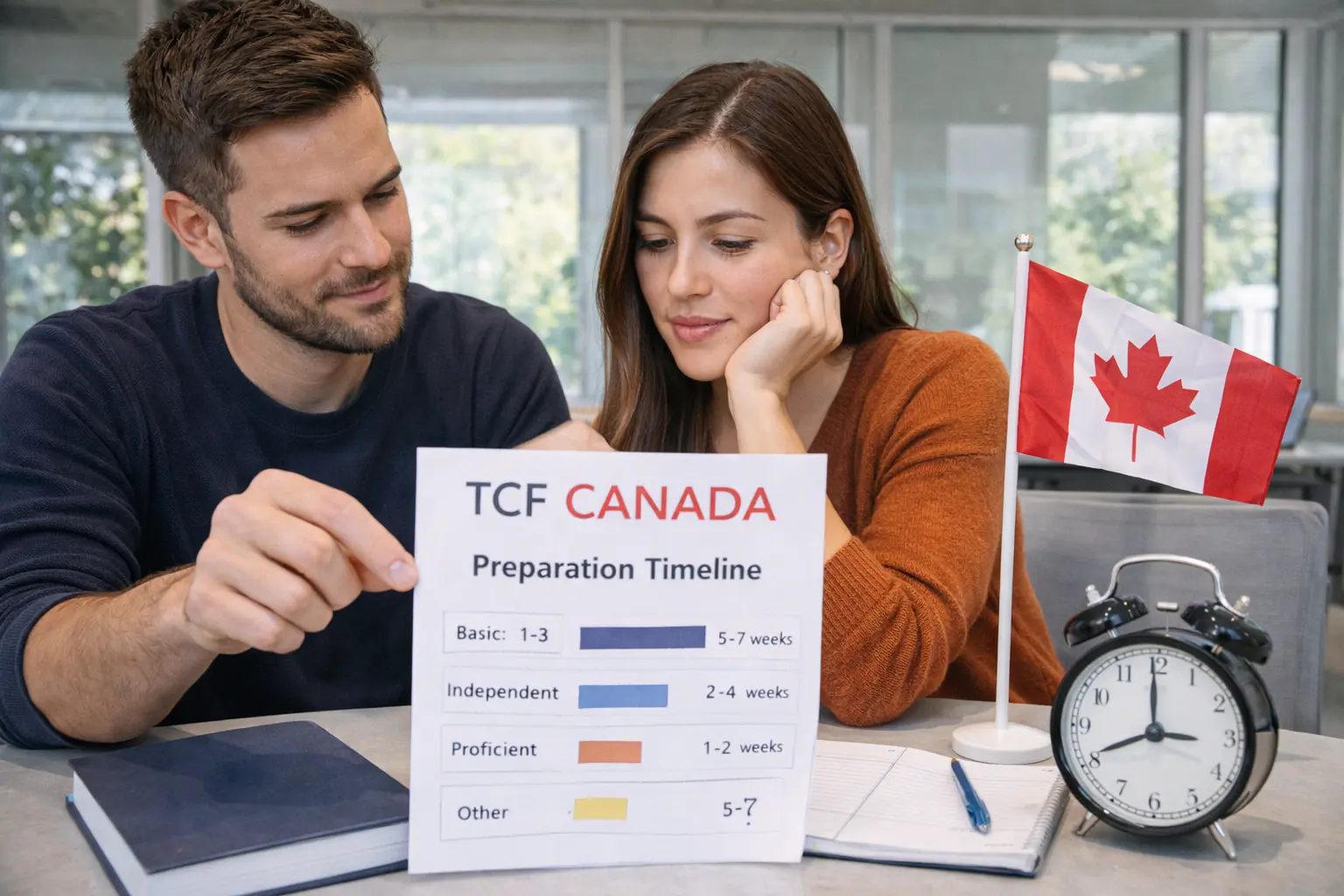
When Emma, a highly specialized intensive care nurse from Marseille with excellent professional French skills and years of medical experience, began systematically planning her TCF Canada examination preparation timeline, she found herself overwhelmed by bewilderingly contradictory advice from multiple sources offering radically different duration estimates. "My immediate work colleague, who had recently completed the test, confidently assured me that one focused month would be more than sufficient for someone with strong French skills like mine. Meanwhile, a close family friend who had struggled with the examination warned me emphatically that I absolutely needed at least a full year of dedicated preparation to achieve competitive scores," she recounts with lingering frustration about the confusion this created. "This profound uncertainty and contradiction about the genuinely necessary preparation duration created such anxiety and indecision that I almost indefinitely postponed my entire immigration project, unable to commit to a timeline I couldn't confidently estimate." Now successfully settled in Toronto with impressive NCLC 8 scores achieved across all four competencies, Emma has developed a comprehensive, scientifically-grounded method to precisely estimate the truly necessary preparation time according to each individual candidate's unique profile, circumstances, and objectives.
Why Preparation Duration Estimation Is Critical Yet Complex
Determining your optimal, realistic preparation duration represents one of the most strategically complex yet fundamentally important decisions in your entire TCF Canada journey. An incorrect temporal estimate—whether underestimation or overestimation—can have genuinely dramatic consequences that extend far beyond simple scheduling inconvenience. Underestimation leads to inadequate preparation, probable examination failure, costly retakes, and multi-month immigration delays. Overestimation causes loss of precious momentum in your immigration timeline, unnecessary prolongation of current life uncertainties, potential demotivation from excessive drawn-out preparation, and opportunity costs from delayed Canadian employment. This critical estimation must systematically integrate multiple variables: your accurate current proficiency level, precisely defined target objectives, realistic personal and professional constraints, individual learning style and capacity, and crucially, your actual sustainable performance capacity under the psychological pressure of high-stakes examination preparation.
Critical Reality About Duration Estimation: Most TCF Canada candidates dramatically miscalculate their preparation timeline—typically underestimating by 30-50% and then scrambling to either rush inadequate preparation or delay their test. The candidates who succeed most consistently and with least stress are those who invest 2-3 hours upfront in honest, systematic timeline estimation based on their actual profile rather than wishful thinking or others' experiences.
The Five Critical Variables Determining Your Preparation Timeline
Variable 1: Gap Between Current Level and Target Objective (Most Important - 40% Impact)
This variable constitutes the single most important primary factor in your temporal estimation and accounts for approximately 40% of total timeline variability. However, the relationship between level gap and required time is absolutely not linear or proportional—it's exponential and increasingly challenging at higher levels. Julie, an accountant from Bordeaux who meticulously tracked her progression through every CEFR level, provides this crucial insight: "Progressing from my starting A2 level to functional B1 competency took me approximately 3 focused months of consistent daily study. However, advancing from solid B2 to advanced C1 required an additional 5 intensive months—nearly double the time for what appears on paper to be equivalent single-level progression. The higher you climb through the CEFR levels, the more each subsequent progression becomes exponentially more demanding in terms of time investment, precision requirements, and subtle mastery of nuances."
Comprehensive Level Progression Analysis:
| Level Progression | Difficulty Rating | Typical Duration Range | Required Daily Intensity | Total Study Hours | Primary Learning Focus |
|---|---|---|---|---|---|
| A1 → A2 (Complete Beginner to Elementary) | Moderate | 2-3 months | 2 hours/day | 120-180 hours | Basic vocabulary, simple grammar, survival communication |
| A2 → B1 (Elementary to Intermediate) | Moderate-High | 3-4 months | 2.5 hours/day | 225-300 hours | Grammatical structure consolidation, conversational fluency foundation |
| B1 → B2 (Intermediate to Upper-Intermediate) | High | 4-6 months | 3 hours/day | 360-540 hours | Major complexity increase, nuanced expression, advanced grammar |
| B2 → C1 (Upper-Intermediate to Advanced) | Very High | 6-9 months | 3.5 hours/day | 630-945 hours | Subtle distinction mastery, sophisticated expression, cultural nuance |
| C1 → C2 (Advanced to Mastery) | Extreme | 8-12 months | 4 hours/day | 960-1440 hours | Near-native precision, literary sophistication, complete mastery |
Important Clarification About NCLC Targets:
- Most immigration programs require NCLC 7 minimum (approximately B2 CEFR)
- Competitive Express Entry candidates target NCLC 9+ (approximately C1 CEFR)
- If currently at B1, targeting NCLC 9 requires B1→B2→C1 progression: 10-15 months minimum
- Starting from A2 and targeting NCLC 7 requires A2→B1→B2: 7-10 months minimum
Why Higher Levels Require Disproportionately More Time:
Exponential Complexity Increase:
- Vocabulary Breadth Requirements:
- A2 level: ~1,000-1,500 active vocabulary items
- B1 level: ~2,500-3,000 active vocabulary items
- B2 level: ~4,000-5,000 active vocabulary items
- C1 level: ~8,000-10,000+ active vocabulary items
- Each level requires progressively more specialized, nuanced vocabulary
- Grammatical Precision Standards:
- Lower levels: Major errors tolerated if communication succeeds
- B2 level: Errors must be infrequent and non-systematic
- C1 level: Near-perfect accuracy expected; subtle errors noticed and penalized
- Higher standards require exponentially more practice for automatization
- Discourse Sophistication:
- Lower levels: Simple, direct communication acceptable
- Higher levels: Must demonstrate organizational sophistication, stylistic variety, rhetorical awareness
- Advanced skills require extensive exposure and practice to develop naturally
Variable 2: Individual Learning Capacity and Style (25% Impact)
This often-neglected but critically important variable drastically influences your necessary preparation duration and represents approximately 25% of timeline variability. Individual learning differences can result in 100-200% variation in required study time for identical level progressions. Thomas, an engineer from Nantes who successfully relocated to Calgary, shares his crucial self-analysis discovery: "Through systematic experimentation during my first preparation month, I quickly and definitively identified that I learn significantly better through intensive, concentrated immersion periods rather than through extended time-spreading with lower daily intensity. Strategically concentrating my entire preparation into 4 highly intensive months of 4-5 hours daily study rather than spreading the same total hours over 8 months at lower intensity allowed me to maintain maximum cognitive engagement, sustain high motivation levels, and preserve strong progression momentum without the energy drain and demotivation that comes from prolonged, drawn-out timelines."
The Three Primary Learning Profile Types:
Profile Type 1: Fast Assimilator (20% of candidates)
- Characteristics:
- New concepts assimilated and retained in 2-3 exposures/repetitions
- Visible, measurable progress observable weekly
- Pattern recognition happens rapidly and intuitively
- Can handle multiple competency development simultaneously
- Natural language aptitude or previous successful language learning
- Optimal Preparation Approach:
- Intensive, concentrated timeline (3-5 months)
- High daily volume (3-5 hours)
- Varied, challenging materials to prevent boredom
- Rapid progression through levels without excessive repetition
- Timeline Modifier: Multiply standard duration by 0.7-0.8
Profile Type 2: Standard Learner (60% of candidates)
- Characteristics:
- Solid consolidation achieved in 5-7 exposures/repetitions
- Measurable progression observable monthly
- Systematic study and structured practice essential
- Benefits from focus on one competency at a time
- Typical adult language learning trajectory
- Optimal Preparation Approach:
- Moderate timeline (5-8 months for typical progression)
- Consistent daily practice (2-3 hours)
- Structured curriculum with clear progression
- Regular review and consolidation cycles
- Timeline Modifier: Use standard duration estimates
Profile Type 3: Meticulous Perfectionist (20% of candidates)
- Characteristics:
- Deep mastery requires 10+ exposures/repetitions for full confidence
- Substantial progression observable quarterly (3-month cycles)
- Thorough understanding prioritized over rapid progression
- Anxiety about errors slows production practice
- Perfectionist personality traits
- Optimal Preparation Approach:
- Extended timeline (8-12 months) accepting slower pace
- Moderate daily practice (1.5-2.5 hours) sustainable long-term
- Depth-focused study over breadth
- Explicit permission for imperfection to prevent paralysis
- Timeline Modifier: Multiply standard duration by 1.3-1.5
Self-Assessment Question: Think about your previous successful learning experiences (any subject). Did you learn best through: (a) Rapid immersion and quick pattern recognition? [Fast Assimilator] (b) Systematic study with regular practice over moderate time? [Standard Learner] (c) Thorough, deep study requiring extensive repetition for confidence? [Meticulous Perfectionist]
Variable 3: Real vs. Theoretical Time Availability (20% Impact)
Announced, theoretical time availability often drastically and significantly differs from actual, sustainable, effective availability—sometimes by 40-50% or more. This gap represents one of the most common sources of timeline estimation error. Marc, a sales professional from Paris who successfully relocated to Toronto, shares his sobering reality: "I initially calculated and confidently announced that I had approximately 3 full hours available daily for TCF preparation based on my work schedule and personal commitments. However, when I actually began preparation and tracked my effective study time, I discovered that between unexpected professional contingencies and urgent projects, accumulated daily fatigue that reduced concentration quality, family obligations and emergencies, and the simple reality that I'm not a machine, I effectively realized only approximately 1.5 quality study hours per day—exactly half my theoretical estimate. This crucial awareness and honest self-assessment forced me to immediately double my initially planned preparation duration from 4 months to 8 months to achieve my target level."
The Reality Coefficient Formula:
Theoretical → Actual Availability Conversion:
- Step 1: Calculate Theoretical Daily Availability
- Total waking hours per day: 16 hours (assuming 8 hours sleep)
- Minus: Work hours (typically 8-9 hours including commute)
- Minus: Essential daily activities (meals, hygiene, household: 2-3 hours)
- Minus: Family/relationship time (1-3 hours)
- Remaining theoretical available time: 2-5 hours
- Step 2: Apply Reality Coefficient Based on Life Circumstances
- Single, no children, flexible job: Coefficient 0.75-0.85 (high availability reliability)
- Partnered, no children, standard job: Coefficient 0.65-0.75 (moderate reliability)
- Young children at home, demanding job: Coefficient 0.50-0.65 (lower reliability)
- Multiple children, high-stress job, other obligations: Coefficient 0.40-0.55 (challenging availability)
- Step 3: Calculate Effective Daily Study Time
- Theoretical availability × Reality coefficient = Effective availability
- Example 1: 3 hours theoretical × 0.70 coefficient = 2.1 hours effective daily
- Example 2: 2 hours theoretical × 0.50 coefficient = 1.0 hour effective daily
Marc's Reality Tracking Method:
Week 1-2 Tracking Exercise: Before finalizing your preparation timeline, track your actual effective study time for 2 full weeks:
- Plan specific daily study sessions in your calendar
- Record actual time studied (not including breaks, distractions, interruptions)
- Note reasons for any missed or shortened sessions
- Calculate average effective daily study time
- Use this empirical data—not wishful thinking—for timeline planning
Marc's Results: Planned 3 hours daily × 14 days = 42 theoretical hours. Actual achieved: 23 hours. Reality coefficient: 23/42 = 0.55. Adjusted all subsequent planning using 0.55 coefficient.
Variable 4: Quality of Available Preparation Time (10% Impact)
Not all study hours are created equal. One focused hour of high-quality, distraction-free study with full cognitive engagement can accomplish more than three hours of fragmented, distracted, low-energy study. Isabelle, a project manager from Lyon, discovered this crucial distinction: "I initially counted all my study time equally whether it was fresh morning study with full concentration or exhausted late-evening study while half-watching TV. When I began differentiating high-quality focused time from low-quality fragmented time and concentrated my efforts during my personal peak performance hours—early morning before work—my learning efficiency increased dramatically. My effective progression per hour literally doubled."
Time Quality Categories and Learning Efficiency:
Category A: Peak Performance Time (100% Efficiency)
- Full mental clarity and alertness
- Complete distraction elimination
- Optimal energy levels and motivation
- Ideal for: Complex grammar study, writing practice, difficult reading comprehension
- Typical windows: Early morning, mid-morning for most people
Category B: Good Performance Time (70-80% Efficiency)
- Solid concentration with minor distractions
- Moderate energy and engagement
- Ideal for: Vocabulary review, listening practice, structured exercises
- Typical windows: Late morning, early afternoon
Category C: Low Performance Time (40-50% Efficiency)
- Fatigue, frequent distraction, fragmented attention
- Limited capacity for demanding cognitive work
- Ideal for: Passive listening exposure, light vocabulary review, media consumption
- Typical windows: Late evening, during multitasking
Quality Over Quantity Principle: Two hours of Category A peak performance study accomplish more than four hours of Category C low-quality study. When planning your timeline, weight your available hours by quality category. Marc's corrected calculation: 1 hour Category A (1.0 weight) + 0.5 hours Category B (0.75 weight) + 1 hour Category C (0.5 weight) = 1 + 0.375 + 0.5 = 1.875 quality-adjusted hours per day.
Variable 5: Baseline Motivation and Urgency Level (5% Impact)
Your intrinsic motivation and external timeline urgency create powerful psychological forces that significantly influence sustained effort, consistency, and ultimately timeline success. Candidates with compelling, urgent reasons for Canada immigration consistently outperform those with vague, distant motivations—even when other variables are identical. Nicolas, a finance manager who successfully relocated to Vancouver, explains: "My situation created maximum urgency: I had a concrete job offer in Vancouver with a 6-month validity window. This deadline created intense but productive pressure that eliminated any procrastination tendency, maintained my daily discipline even when exhausted or discouraged, and accelerated my learning through pure necessity-driven focus. Urgency became my most powerful ally."
Motivation Level Impact Analysis:
High Motivation/High Urgency (Timeline Acceleration: 10-20%):
- Concrete job offer with deadline
- Partner already in Canada waiting
- Current life situation untenable (must leave urgently)
- Age-related Express Entry point degradation imminent
- Creates maximum sustained effort and consistency
Moderate Motivation/Moderate Urgency (Timeline Neutral: 0%):
- General desire for better life in Canada
- Reasonable timeline (1-2 years) but not urgent deadline
- Balances preparation with current life without extreme pressure
- Standard timeline estimates apply
Low Motivation/Low Urgency (Timeline Deceleration: 20-40%):
- Vague interest in eventual emigration "someday"
- No specific timeline or deadline pressure
- Preparation competes with many other priorities
- High risk of procrastination, inconsistency, abandonment
- May require 1.5-2x standard timeline due to low consistency
Comprehensive Preparation Models: Sprint vs. Marathon vs. Hybrid
Model 1: "Sprint" Intensive Preparation (3-5 Months)
The Sprint model suits candidates with solid baseline proficiency (B1-B2 minimum), strong real time availability (3-5 hours daily sustainable), fast learning capacity, high motivation and urgency, and preference for intensive focused effort over extended timelines. David, a web developer who successfully relocated to Vancouver, perfectly exemplifies this profile and approach: "I strategically concentrated my entire preparation into an intensive 3.5-month sprint period with approximately 4 hours of focused daily study. This highly intensive approach allowed me to maintain absolutely maximum cognitive engagement and focus throughout, avoid the demotivation and energy drain that comes from excessively prolonged preparation timelines, leverage momentum and rapid progression for psychological motivation, and complete preparation while maintaining career continuity without multi-month hiatus."
David's Complete 3.5-Month Sprint Timeline:
Month 1: Diagnostic and Format Mastery Foundation (4 hours daily = 120 total hours)
- Week 1:
- Complete comprehensive diagnostic assessment (2 full practice tests)
- Analyze results to identify competency gaps and weaknesses
- Research and acquire all necessary preparation materials
- Establish structured daily routine and study schedule
- Week 2-3:
- Deep study of TCF Canada format, question types, timing for all competencies
- Master test-taking strategies specific to TCF (not general French study)
- Build foundational knowledge of Canadian French specifics
- Begin targeted vocabulary development (100 words/week)
- Week 4:
- Complete second full diagnostic test to measure early progression
- Refine weak area identification based on new data
- Adjust Month 2 plan based on progress assessment
Month 2: Intensive Competency-Focused Training (4.5 hours daily = 135 total hours)
- Week 5-6: Reading & Listening Focus
- Daily reading comprehension practice (10 passages/day)
- Daily listening comprehension (30-40 minutes authentic materials)
- Strategic vocabulary acquisition from practice materials
- Speed and accuracy building exercises
- Week 7-8: Writing & Speaking Focus
- Daily writing practice (1-2 complete TCF writing tasks)
- Daily speaking practice (30-40 minutes structured exercises)
- Professional feedback on production (tutor or exchange partner)
- Error pattern analysis and systematic correction
Month 3: Practice Tests and Systematic Perfection (4 hours daily = 120 total hours)
- Week 9-10: Full Practice Test Regimen
- Monday: Complete practice test under realistic conditions
- Tuesday-Wednesday: Deep analysis of errors, targeted review of weak areas
- Thursday-Friday: Focused practice on identified weaknesses
- Saturday: Second complete practice test
- Sunday: Rest and light review
- Week 11-12: Advanced Refinement
- Continued practice test cycle (minimum 2 per week)
- Progressive score improvement tracking
- Final gap elimination in weak competencies
- Advanced vocabulary and expression integration
Final 2 Weeks: Simulation and Mental Preparation (3 hours daily = 42 total hours)
- Week 13:
- 3 complete simulated tests in exact test conditions
- Test center reconnaissance visit
- Logistics finalization (travel, accommodation)
- Light review of key strategies and frameworks
- Week 14 (Test Week):
- Minimal study (1 hour daily maximum)
- Mental preparation and stress management
- Physical health optimization (sleep, nutrition, exercise)
- Positive visualization and confidence building
Sprint Model Advantages and Challenges:
| Advantages | Challenges | Success Factors |
|---|---|---|
|
|
|
Model 2: "Marathon" Progressive Preparation (6-12 Months)
The Marathon model suits candidates with lower baseline proficiency (A2-B1), limited daily time availability (1-2 hours), standard or meticulous learning style, family or professional constraints preventing intensive study, and preference for sustainable long-term effort over short-term intensity. Sophie, a mathematics teacher who successfully relocated to Montreal, represents this profile perfectly: "With my full-time teaching position demanding 40+ hours weekly, two young children requiring significant parental time and attention, and my naturally meticulous learning style preferring thorough consolidation over rapid progression, I realistically could only dedicate approximately 1.5 hours daily to TCF preparation on a sustainable basis. I strategically spread my preparation over 8 progressive months with gentle but absolutely consistent daily progression. This patient, sustainable approach allowed me to deeply integrate each new learning element without cognitive overload, maintain work-life balance and family harmony without excessive stress, avoid burnout or demotivation from unsustainable pace, and ultimately achieve solid NCLC 8 results through cumulative steady progress."
Sophie's Complete 8-Month Marathon Timeline:
Months 1-2: Foundation and Diagnostic Phase (1.5 hours daily = 90 total hours)
- Weeks 1-4:
- Initial comprehensive diagnostic (2 complete practice tests spaced 2 weeks apart)
- Detailed gap analysis and personalized learning plan creation
- Resource acquisition and study environment optimization
- Routine establishment and habit formation
- Weeks 5-8:
- TCF format comprehensive study (all competencies and question types)
- Canadian French exposure initiation (media, podcasts, Quebec content)
- Basic test strategy introduction
- Foundational vocabulary development (50 words/week)
Months 3-4: Systematic Competency Development Phase 1 (1.5 hours daily = 90 total hours)
- Focus: Reading & Listening Comprehension
- Daily reading practice: 15-20 minutes (2-3 passages)
- Daily listening practice: 20-25 minutes (authentic materials)
- Vocabulary integration from practice materials
- Weekly progress self-assessment
- Monthly comprehensive diagnostic to track progression
Months 5-6: Systematic Competency Development Phase 2 (1.5 hours daily = 90 total hours)
- Focus: Writing & Speaking Production
- Writing practice: 3-4 complete tasks weekly with self-correction
- Speaking practice: Daily 15-minute structured exercises
- Language exchange partner sessions (2x weekly, 30 minutes each)
- Professional tutor feedback (bi-weekly sessions)
- Error pattern tracking and systematic correction
Months 7-8: Integration, Practice Tests, and Refinement (1.5-2 hours daily = 100 total hours)
- Month 7:
- Weekly complete practice tests (alternating focus competencies)
- Comprehensive error analysis after each test
- Targeted weak area remediation
- Advanced strategy refinement
- Month 8:
- Bi-weekly full simulated tests in exact conditions
- Final score validation (consistent target achievement)
- Mental preparation and stress management practice
- Logistics finalization and test day planning
Marathon Model Advantages and Challenges:
| Advantages | Challenges | Success Factors |
|---|---|---|
|
|
|
Model 3: "Hybrid" Strategic Preparation (4-7 Months)
The Hybrid model combines elements of both Sprint and Marathon approaches, adapting intensity and pacing based on life circumstances, competency-specific needs, and progression trajectory. This flexible approach suits candidates with moderate baseline (B1-B2), variable time availability (2-3 hours average with flexibility), mixed urgency (important but not emergency), and appreciation for strategic adaptation. Laurent, a mechanical engineer who successfully relocated to Ottawa, exemplifies this approach: "I recognized that my situation didn't fit neatly into either pure Sprint or pure Marathon categories. Some weeks I could dedicate 4-5 hours daily when work was calm; other weeks only 1-2 hours when professional projects demanded attention. I developed a flexible 6-month plan that intensified during available periods and scaled back during constrained periods, ultimately achieving my target through strategic adaptation rather than rigid adherence to single model."
Laurent's Hybrid 6-Month Adaptive Timeline:
Months 1-2: Foundation Phase - Moderate Intensity (2.5 hours daily average = 150 hours)
- Comprehensive diagnostic and gap analysis
- Format mastery and strategy development
- Routine establishment at sustainable baseline
- Resource acquisition and study system setup
Months 3-4: Intensive Development Phase - High Intensity (3.5 hours daily average = 210 hours)
- Deliberate calendar blocking for intensive study period
- Competency-focused deep work (Reading/Listening then Writing/Speaking)
- Maximum progression during high-availability window
- Weekly practice tests to track rapid improvement
Month 5: Consolidation Phase - Reduced Intensity (2 hours daily average = 60 hours)
- Knowledge integration and review
- Error pattern remediation
- Maintaining skills without burnout
- Strategic rest before final push
Month 6: Final Sprint Phase - Peak Intensity (3 hours daily average = 90 hours)
- Complete practice test regimen (3+ full tests weekly)
- Final weak area elimination
- Test day simulation and logistics
- Mental preparation and confidence building
Hybrid Model Key Principle: Adapt intensity to circumstances while maintaining minimum baseline consistency. Laurent's rule: "Never drop below 1 hour daily even during most constrained periods—consistency matters more than occasional intensity spikes. But leverage high-availability periods for concentrated advancement."
Critical Acceleration and Deceleration Factors
The Five Most Powerful Progression Accelerators
Antoine, a sales professional from Lyon who successfully relocated to Calgary, systematically identified and leveraged several factors that dramatically accelerated his progression beyond standard timelines: "Through deliberate experimentation and tracking, I discovered that my daily immersive exposure to authentic Canadian media content, regular conversational exchanges with Quebec French speakers via online language exchange platforms, intensive self-recording speaking practice with systematic review and analysis, strategic use of varied training methods preventing boredom and maintaining engagement, and maintaining vivid concrete visualization of my future Canadian life combined to effectively double my progression speed compared to my initial conservative timeline estimates."
Accelerator #1: Daily Immersive Media Exposure (15-25% Timeline Reduction)
Implementation Strategy:
- Morning Routine (15-20 minutes):
- Radio-Canada or ICI Première morning news while preparing for day
- Passive exposure building familiarity with Canadian French rhythm and intonation
- Commute Time (20-40 minutes):
- Quebec French podcasts (Balado Quebec, C'est jamais pareil, etc.)
- Active listening with note-taking of new vocabulary and expressions
- Evening Entertainment (30-60 minutes):
- Quebec TV series or films (Tou.tv, Club illico content)
- Pleasurable learning combining entertainment with exposure
- Total Daily Immersion: 1-2 hours
- Effect: Subconscious pattern absorption, natural vocabulary acquisition, pronunciation model exposure
Accelerator #2: Regular Native Speaker Conversational Practice (20-30% Timeline Reduction)
Implementation Strategy:
- Language Exchange Partnerships (3-4 sessions weekly, 30 minutes each):
- Platforms: HelloTalk, Tandem, ConversationExchange
- Focus: Find Quebec French speakers interested in your native language
- Structure: 15 minutes French, 15 minutes their language learning
- Professional Tutoring (1-2 sessions weekly, 60 minutes each):
- TCF-specialized tutor for targeted feedback
- Focus on weak competencies and error correction
- Investment: €25-40/hour but high ROI
- Effect: Real-time error correction, natural expression development, confidence building
Accelerator #3: Systematic Self-Recording and Analysis (10-20% Timeline Reduction)
Implementation Strategy:
- Daily 10-minute speaking practice recording
- Immediate playback listening for self-critique
- Error identification and pattern tracking
- Comparison with native speaker model recordings
- Progressive improvement measurement
Accelerator #4: Strategic Variety and Engagement Maintenance (15-20% Timeline Reduction)
Implementation Strategy:
- Rotate study formats daily (reading, listening, writing, speaking)
- Vary materials (textbooks, apps, authentic media, practice tests)
- Change study environments (home, library, café, outdoors)
- Gamification elements (progress tracking, achievement rewards)
- Effect: Prevents boredom-induced demotivation; maintains cognitive engagement
Accelerator #5: Vivid Future Visualization and Motivation Anchoring (10-15% Timeline Reduction)
Implementation Strategy:
- Daily 5-minute visualization: Living and working in Canada, speaking French confidently, achieving immigration success
- Vision board creation: Images of target Canadian city, desired job, lifestyle goals
- Immigration progress tracking: Visible progress markers creating momentum
- Community connection: Joining Canadian immigration forums and groups
- Effect: Sustains motivation during difficult periods; provides emotional fuel for consistency
Antoine's Cumulative Acceleration Results: By implementing all five accelerators simultaneously, Antoine reduced his projected 8-month timeline to actual 5.5 months—a 31% acceleration. His advice: "Don't pick just one accelerator. The synergistic effect of combining multiple acceleration strategies creates exponential rather than additive benefits."
The Five Most Dangerous Progression Decelerators
Caroline, a nurse from Toulouse who successfully relocated to Ottawa, warns against insidious decelerators that silently extend timelines without candidates realizing until significant time is lost: "I personally lost approximately 2 full months of preparation time due to my perfectionist tendency that I didn't recognize as problematic. I constantly and obsessively redid the same familiar exercises until achieving absolute perfection instead of progressing to new, more challenging materials and competencies. This self-sabotaging approach created an illusion of productive work while actually causing complete stagnation at a skill plateau I had already mastered. Recognition and correction of this pattern was my single most important timeline optimization."
Decelerator #1: Excessive Perfectionism and Redundant Repetition (20-40% Timeline Extension)
Manifestation:
- Repeatedly practicing already-mastered exercises for perfect scores
- Refusing to progress until current level is "perfect"
- Anxiety about making errors preventing production practice
- Spending 3-4 hours on tasks that should take 1 hour
Solution:
- 80/20 rule: Move forward when you achieve 80% mastery, not 100%
- Time-boxing: Allocate specific time per exercise; move on when time expires
- Progressive difficulty: Always have mix of comfortable + challenging materials
- Error acceptance: Permission to make mistakes as essential learning process
Decelerator #2: Systematic Procrastination and Weak Competency Avoidance (30-50% Timeline Extension)
Manifestation:
- Consistently prioritizing comfortable competencies over difficult ones
- Postponing speaking practice because "I'll do it when my grammar is perfect"
- Avoiding writing because "I don't have time for full essays today"
- Making excuses for not practicing weak areas
Solution:
- Daily non-negotiable: 30 minutes minimum on weakest competency first
- Front-loading strategy: Tackle difficult work during peak energy periods
- Accountability partner: External commitment to practice all competencies
- Progress tracking: Visible improvement in weak areas motivates continued effort
Decelerator #3: Cognitive Overload from Unfocused Scattered Effort (25-35% Timeline Extension)
Manifestation:
- Attempting to improve all competencies simultaneously every day
- Jumping between materials, methods, approaches without completion
- Starting multiple preparation courses/books without finishing any
- Information overwhelm preventing deep learning
Solution:
- Competency cycling: Focus 2-3 days per competency in rotation
- Single primary resource: Master one main textbook/course before adding others
- Depth over breadth: Complete understanding of core materials > superficial exposure to many
- Structured curriculum: Follow logical progression rather than random selection
Decelerator #4: Social Isolation Without External Feedback (15-25% Timeline Extension)
Manifestation:
- 100% solo study without any external interaction
- Never speaking French with actual people
- No correction or feedback on production
- Reinforcing errors through repeated incorrect practice
Solution:
- Minimum weekly: 2 language exchange sessions + 1 tutor session
- Writing correction: Submit weekly writing to italki tutors or exchange partners
- Speaking recording review: Share recordings for feedback
- Study groups: Join TCF preparation communities for mutual support
Decelerator #5: Motivation Erosion and Purpose Disconnection (20-40% Timeline Extension)
Manifestation:
- Losing sight of why you're pursuing Canadian immigration
- Preparation feeling like meaningless drudgery rather than purposeful progress
- Increasing missed study sessions and declining consistency
- Considering abandoning immigration plans
Solution:
- Weekly goal review: Reconnect with your "why" for Canada
- Immigration progress visible tracking: Express Entry profile updates, saved points
- Canadian life research: Regular immersion in target city information, job market research
- Community support: Connect with successful immigrants and current candidates
- Celebration milestones: Acknowledge and reward progression achievements
Personalized Timeline Calculation Formula
Maxime's Comprehensive Five-Factor Formula
Maxime, an IT engineer who successfully relocated to Waterloo, developed a comprehensive mathematical formula integrating all personal factors for precise timeline estimation: "I created a simple but effective weighted algorithm that incorporates the five critical variables we've discussed. This systematic, data-driven approach gave me a timeline estimate that proved accurate within just 2 weeks of my actual preparation duration—far more reliable than the vague guesses most candidates rely on."
Complete Calculation Worksheet:
| Factor | Importance Weight | Your Self-Assessment Score (1-10) | Weighted Score (Weight × Score) | Evaluation Criteria |
|---|---|---|---|---|
| Current Level vs. Target Gap | × 3 | ____ | ____ | 1=C1→C2 (minimal gap); 10=A1→C1 (massive gap) |
| Learning Speed/Aptitude | × 2 | ____ | ____ | 1=Fast assimilator; 5=Standard; 10=Meticulous slow learner |
| Real Daily Time Availability | × 4 | ____ | ____ | 1=4+ hours daily; 5=2 hours daily; 10=<1 hour daily |
| Time Quality (Distractions, Energy) | × 1 | ____ | ____ | 1=Peak focused time; 5=Mixed; 10=Low-quality fragmented |
| Motivation/Urgency Level | × 1 | ____ | ____ | 1=Maximum urgency/motivation; 5=Moderate; 10=Low/vague |
| TOTAL WEIGHTED SCORE | ____ (Sum of all weighted scores) | |||
Timeline Conversion Chart:
| Total Weighted Score | Estimated Timeline | Recommended Model | Profile Description |
|---|---|---|---|
| 11-25 (Low score = Favorable conditions) | 3-5 months | Sprint Intensive | Strong baseline, fast learner, high availability, maximum motivation |
| 26-45 (Moderate-Low score) | 4-7 months | Hybrid Adaptive | Moderate baseline, standard learning, good availability, solid motivation |
| 46-65 (Moderate-High score) | 6-9 months | Marathon Progressive | Lower baseline or limited availability or slower learning |
| 66-85 (High score = Challenging conditions) | 9-12 months | Extended Marathon | Significant gap, limited time, slower learning, or lower urgency |
| 86-110 (Very high score = Very challenging) | 12-18+ months | Long-term Progressive | Beginner level, minimal availability, slow learning, low urgency |
Maxime's Calculation Example:
Maxime's Profile:
- Starting level: B1 | Target: NCLC 9 (C1) | Gap score: 7
- Learning speed: Fast assimilator | Score: 3
- Daily availability: 3 hours realistic | Score: 3
- Time quality: Peak morning hours mostly | Score: 2
- Motivation: Job offer with 6-month deadline | Score: 1
Weighted Calculation:
- (7 × 3) + (3 × 2) + (3 × 4) + (2 × 1) + (1 × 1) = 21 + 6 + 12 + 2 + 1 = 42
Result: Total score 42 → Estimated 4-7 months → Chose Hybrid 5-month plan
Actual Result: Completed preparation in 5.5 months → Formula accuracy: 96%
Real Duration Success Stories Across Profiles
Fast Success Story: Marie's 10-Week Sprint Achievement
"I started with solid B2 level from my university French studies and regular francophone media consumption. My target was NCLC 7-8 for immigration points—not the highest level but sufficient for my CRS score needs. I had arranged a 3-month sabbatical from my pharmacy job specifically for immigration preparation, giving me realistic 5 hours daily availability. I succeeded in achieving my target scores in just 10 intensive weeks thanks to an ultra-structured systematic method and weekly personalized coaching sessions. The absolute key to my success was maintaining maximum intensity over this short, concentrated period with laser-sharp focus on exactly what the test required—no wasted effort on peripheral learning."
- Marie, Pharmacist, now in Calgary
Marie's 10-Week Detailed Breakdown:
| Week | Focus Area | Daily Hours | Key Achievements | Progression Markers |
|---|---|---|---|---|
| 1-2 | Diagnostic and Format Mastery | 4 hours | Complete TCF format understanding; baseline score establishment | Diagnostic: 420/699 (NCLC 7) |
| 3-4 | Reading & Listening Intensive | 5 hours | Comprehension strategy mastery; speed optimization | Practice tests: Consistent 85%+ accuracy |
| 5-6 | Writing & Speaking Development | 5.5 hours | Production frameworks mastered; fluency building | Writing: Consistent NCLC 8 level; Speaking: NCLC 7-8 |
| 7-8 | Integrated Practice & Weak Areas | 5 hours | Full practice tests 3x weekly; targeted remediation | Full test average: 480/699 (NCLC 8) |
| 9-10 | Simulation & Final Preparation | 4 hours | Test conditions simulation; mental preparation | Actual test: 496/699 (NCLC 8) - Target achieved! |
Methodical Marathon Success: Laurent's 14-Month Progressive Journey
"I started from quite low A2 level—I could handle basic tourist French but nothing resembling professional or academic proficiency. My target was minimum NCLC 7 across all competencies for immigration eligibility. With my demanding full-time automotive mechanics job requiring 45+ hours weekly plus overtime, combined with single father responsibilities for my teenage daughter, I realistically had only 1 hour daily available for consistent study—sometimes slightly more on weekends. I strategically spread my preparation over 14 patient months, accepting the extended timeline as necessary given my constraints. This marathon approach allowed me to solidly integrate each progression level without cognitive overwhelm or stress, maintain my job performance and income, preserve my relationship with my daughter without excessive absence, and ultimately achieve solid NCLC 7-8 results that secured my immigration approval."
- Laurent, Automotive Mechanic, now in Montreal
Laurent's 14-Month Progressive Timeline:
| Phase | Months | Primary Focus | Daily Time | Progression Achievement |
|---|---|---|---|---|
| Foundation | 1-3 | A2→B1 Basic Skills Building | 1 hour | Basic grammar consolidation; 1000+ vocabulary; simple communication |
| Development | 4-7 | B1 Consolidation & TCF Introduction | 1 hour | TCF format understanding; strategy development; B1 solid achievement |
| Advancement | 8-11 | B1→B2 Skills Elevation | 1.25 hours | Advanced grammar; sophisticated vocabulary; production confidence |
| Refinement | 12-13 | B2 Mastery & Practice Tests | 1.5 hours | Consistent NCLC 7 scores; weak area remediation |
| Final Prep | 14 | Test Simulation & Logistics | 2 hours | Actual test: NCLC 7-8 across competencies - Immigration approved! |
Hybrid Adaptive Success: Nathalie's 7-Month Strategic Journey
"My situation required maximum flexibility and strategic adaptation. As a project manager in consulting, my workload fluctuated dramatically—some weeks relatively calm with time for 3-4 hours daily study; other weeks absolutely frantic with barely 1 hour available. I began at solid B1 level and targeted NCLC 8-9 for competitive Express Entry points. I developed a flexible 7-month hybrid plan that intentionally varied intensity based on my professional calendar, deliberately intensifying preparation during lighter work periods and scaling back sustainably during demanding project phases. This adaptive approach prevented burnout from unsustainable rigid expectations while maintaining forward progression momentum, ultimately achieving NCLC 9 across all competencies."
- Nathalie, Project Manager, now in Vancouver
Nathalie's Adaptive Intensity Variation:
Flexibility Principle: "I tracked my actual study hours weekly and adjusted following weeks based on realistic availability assessment. Some weeks I achieved 25 hours total; others only 8 hours. But I maintained absolute minimum of 1 hour daily even during most demanding work weeks—consistency mattered more than occasional intensity spikes."
- Average weekly: 15 hours (2.1 hours/day average)
- High-intensity weeks: 20-28 hours (3-4 hours/day)
- Low-intensity weeks: 7-12 hours (1-1.7 hours/day)
- Total preparation hours: ~420 hours over 7 months
Conclusion: Your Personal Optimal Timeline
Determining your optimal TCF Canada preparation duration requires brutally honest, precise analysis of your unique situation integrating all five critical variables rather than copying others' timelines or hoping for unrealistic shortcuts. The right preparation duration is neither artificially minimized to satisfy impatience nor unnecessarily extended through perfectionism or fear—it's the realistic timeline that perfectly aligns with your personal and professional reality while guaranteeing reliable achievement of your immigration objectives.
Emma's Final Wisdom from Toronto: "The preparation timeline that ultimately proved optimal for me—6 focused months with 2.5 hours daily average—bore no resemblance to either my colleague's 1-month timeline or my friend's 1-year timeline, both of which would have been completely wrong for my specific profile. The right duration emerged only through systematic analysis of my actual starting level (assessed through diagnostic testing, not self-perception), realistic time availability (tracked empirically over 2 weeks, not optimistically estimated), honest learning style assessment, and clear target definition. This data-driven approach eliminated the timeline anxiety that had paralyzed me initially and gave me confidence that my chosen 6-month plan would succeed—which it did, achieving NCLC 8 across all competencies exactly on schedule."
Your Strategic Timeline Action Plan:
- Complete Diagnostic Assessment: Take 2 full practice tests to establish accurate current level (not self-perception)
- Define Precise Target: Determine exact NCLC levels needed for your immigration program
- Track Real Availability: Monitor actual study time for 2 weeks to establish realistic daily average
- Assess Learning Style: Identify whether you're Fast Assimilator, Standard Learner, or Meticulous Perfectionist
- Calculate Timeline: Use Maxime's weighted formula to generate data-driven estimate
- Select Model: Choose Sprint, Marathon, or Hybrid approach matching your calculated timeline
- Implement Accelerators: Integrate media immersion, speaking practice, variety, and motivation anchoring
- Avoid Decelerators: Watch for perfectionism, procrastination, overload, isolation, demotivation
- Monitor and Adjust: Track progression monthly; adjust timeline if significantly ahead or behind
- Maintain Consistency: Remember daily minimum practice more important than occasional intensity spikes
Your personalized TCF Canada preparation timeline begins with this honest analysis today. Every hour invested in accurate timeline estimation prevents weeks or months of wasted effort from unrealistic planning. The candidates who achieve their immigration dreams most efficiently and with least stress are those who realistically assess their situation, create data-driven timelines, and execute consistently—not those who hope for shortcuts or copy others' paths. Your optimal timeline exists uniquely for your profile—discover it, trust it, and execute it systematically.
* * *
Laissez un commentaire
Votreadresse email ne sera pas publie. Les champs obligatoires sont marque avec *



 TCF Canada Hub
0 Commentaires
aucun commentaire
Soyez le premier a partager votre avis !