-
Auteur :
 TCF Canada
- Dec 22, 2025
TCF Canada vs TEF Canada: The Definitive Comparison Guide 2026
- Blog
- /
- Article
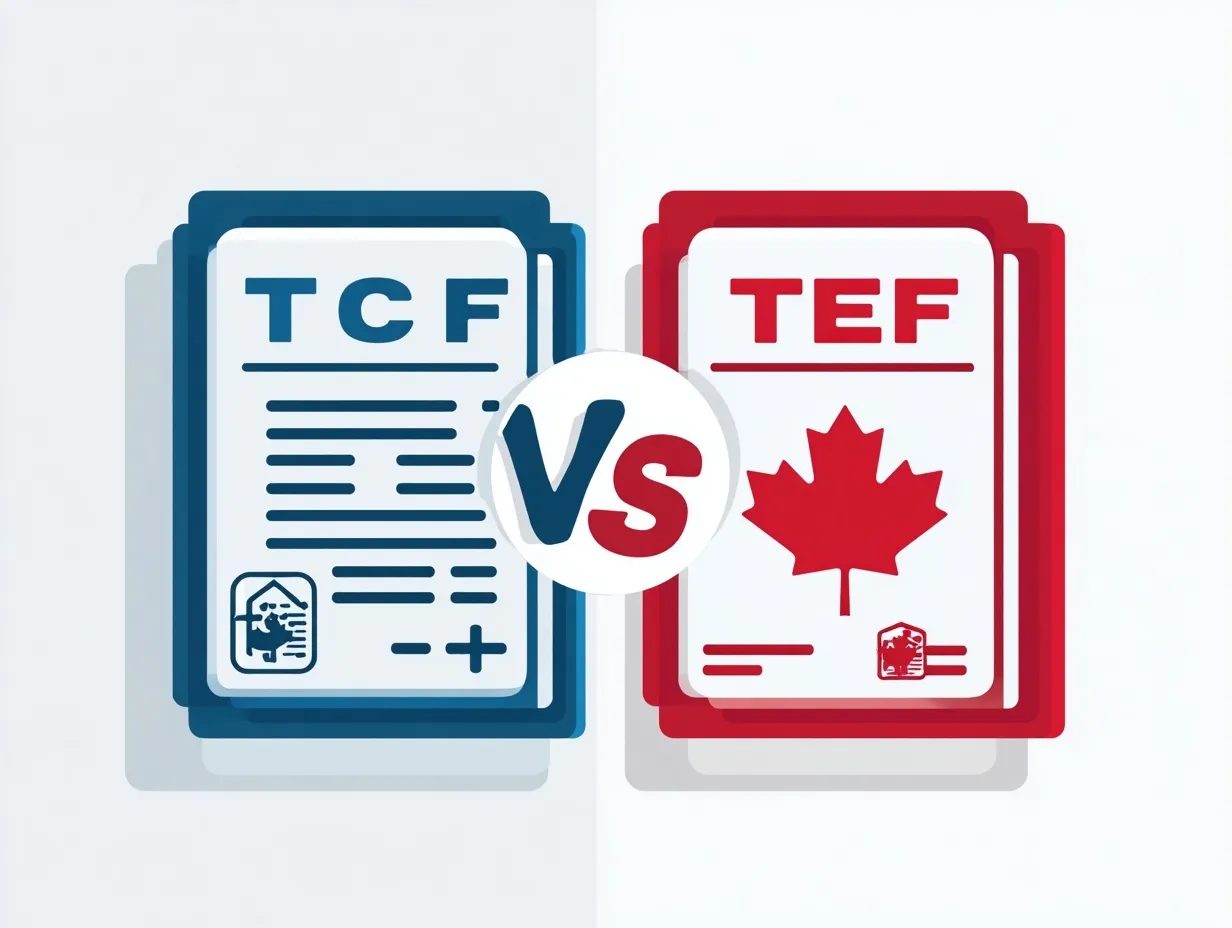
If you are planning to immigrate to Canada and want to boost your Express Entry Comprehensive Ranking System (CRS) score, achieving French language proficiency can add a crucial 50 bonus points. However, the first major decision you face is choosing between TCF Canada and TEF Canada. Both tests are officially recognized by Immigration, Refugees and Citizenship Canada (IRCC), but they have significant differences that could impact your success.
This comprehensive guide provides an in-depth comparison based on real test-taker experiences, official test structures, and strategic insights to help you make the informed choice for your immigration journey.
Understanding the Two Tests
What is TCF Canada?
The Test de Connaissance du Français (TCF Canada) is a French language proficiency test administered by France Éducation international. This organization also creates the DELF and DALF examinations and operates under the supervision of the French Ministry of National Education and Youth.
Key Features: TCF Canada is methodology-focused and emphasizes systematic language competency assessment aligned with European Framework standards. The test is recognized by IRCC for Express Entry and by Quebec's Ministère de l'Immigration, de la Francisation et de l'Intégration (MIFI) since January 2022.
What is TEF Canada?
The Test d'Évaluation de Français (TEF Canada) is organized by the Chambre de Commerce et d'Industrie de Paris (CCI Paris Île-de-France). The test was designed to evaluate French language proficiency with a business and practical communication focus.
Key Features: TEF Canada is practical and communication-oriented, with emphasis on real-world language use in professional and everyday contexts. It is fully accepted by IRCC for all Canadian immigration programs, including Express Entry, Provincial Nominee Programs, and citizenship applications.
The Critical Scoring Difference
This is the Most Important Difference: TEF Canada has two B2 levels: B2 Inferior (which gives 0 bonus points for Express Entry) and B2 Superior (which gives 50 bonus points). TCF Canada does NOT have B2 Inferior. Any B2 score on TCF Canada qualifies you for the full 50 bonus CRS points.
What This Means: If you score exactly at the minimum B2 threshold (10/20) on TCF Canada, you receive your 50 bonus points. The same score on TEF Canada might fall into "B2 inferior" and give you zero bonus points despite achieving B2 level.
Section by Section Comparison
1. Listening Comprehension (Compréhension orale)
| Feature | TCF Canada | TEF Canada |
|---|---|---|
| Number of Questions | 39 multiple-choice questions | 60 multiple-choice questions |
| Duration | 35 minutes | 40 minutes |
| Question Preview | No preview time (questions appear after audio) | Time to preview questions before audio |
| Audio Playback | Played once only | Played once only |
| Difficulty Pattern | Progressive difficulty increase | Progressive difficulty increase |
Real Test-Taker Experience: "There is not much difference in the two exams. In this one, I would say TEF is slightly easier because they allow you to read the questions for a bit before the recordings start. In TCF, they just line up one after another with almost no time to read the multiple-choice answers." (ashu2111, forum contributor who took both tests)
Strategic Insight: If you process information quickly and do not need pre-reading time, TCF's format works well. If you benefit from question preview to anticipate what to listen for, TEF has a slight advantage in this section.
2. Reading Comprehension (Compréhension écrite)
| Feature | TCF Canada | TEF Canada |
|---|---|---|
| Number of Questions | 39 multiple-choice questions | 50 multiple-choice questions |
| Duration | 60 minutes | 60 minutes |
| Time per Question | 92 seconds per question | 72 seconds per question |
| Difficulty Pattern | Progressive from easy to hard | Easy, then very hard, then easy again |
| Text Complexity | Standard documents and articles | Includes complex French literature passages |
Major Difference Alert: Reading comprehension is where TCF Canada is considered significantly easier than TEF Canada. This difference has affected many candidates' overall scores.
Real Test-Taker Experience: "This is where TCF Canada is clearly and undeniably easier than TEF Canada. First of all, you have 39 questions in 60 minutes. In TEF you have 50 questions in 60 minutes. One of the main reasons I personally performed so poorly in this section when I did TEF was the time limit.
In TEF, the first 10 to 15 questions are relatively easy and then the difficulty immediately increases where you have extremely long and very complicated articles from French literature. Once you get through those, then it becomes easy again. So basically, the first 10 to 20 questions are easy, the next 20 to 35 questions are extremely hard and long and then the last 15 questions become easy again.
I was scratching my head thinking who was the person responsible for creating this part of the TEF Canada. Overall, it is a massive time game and to finish all questions on time, you will have to rush through the easy questions like crazy.
In TCF, the questions get progressively difficult and yet I found that although they did become quite hard towards the end, they were not quite as challenging as the questions in TEF. Not to mention that I still had 15 minutes left after I completed all the questions and I was able to revise some other difficult questions in my spare time." (ashu2111)
In TEF, the first 10 to 15 questions are relatively easy and then the difficulty immediately increases where you have extremely long and very complicated articles from French literature. Once you get through those, then it becomes easy again. So basically, the first 10 to 20 questions are easy, the next 20 to 35 questions are extremely hard and long and then the last 15 questions become easy again.
I was scratching my head thinking who was the person responsible for creating this part of the TEF Canada. Overall, it is a massive time game and to finish all questions on time, you will have to rush through the easy questions like crazy.
In TCF, the questions get progressively difficult and yet I found that although they did become quite hard towards the end, they were not quite as challenging as the questions in TEF. Not to mention that I still had 15 minutes left after I completed all the questions and I was able to revise some other difficult questions in my spare time." (ashu2111)
TCF Canada Reading Advantages:
- Fewer questions (39 vs 50)
- More time available per question
- Predictable progressive difficulty
- Typically 10 to 15 minutes remaining for review
- No extreme difficulty spikes
TEF Canada Reading Challenges:
- More questions in the same timeframe
- Severe time pressure throughout
- Unpredictable difficulty pattern
- Complex French literature passages in the middle
- Must rush through easier questions to finish on time
3. Written Expression (Expression écrite)
| Feature | TCF Canada | TEF Canada |
|---|---|---|
| Number of Tasks | 3 tasks | 2 tasks |
| Duration | 60 minutes | 60 minutes |
| Task 1 | Short message (60 to 120 words) | Controversial newspaper story or "fait divers" (200 to 250 words) |
| Task 2 | Article, letter, or report (120 to 150 words) | Formal letter to magazine editor (200 to 250 words) |
| Task 3 | Compare viewpoints and express opinion (120 to 180 words) | Not applicable |
| Creativity Required | Moderate (structured tasks) | High (especially for "fait divers") |
Real Test-Taker Experience: "I find that the writing part for TEF was particularly hard. In the first task, you're supposed to write a 'fait divers', and for those of you who do not know, a fait divers is a type of story that often appears in the newspapers in France. They're supposed to be a bit controversial and at times provocative. This task requires a certain level of creativity and a good level of vocabulary at the same time. I found it particularly hard because I was not able to properly translate my ideas into French.
In TCF, you have three different tasks. One short letter, one blog post or a slightly longer letter and then for the third task, you have to make a resume of two documents and express your point of view on it. Even though it might sound a bit complicated, I personally believe that it is a bit easier because they're not asking you to do something very different or out of your comfort range." (ashu2111)
In TCF, you have three different tasks. One short letter, one blog post or a slightly longer letter and then for the third task, you have to make a resume of two documents and express your point of view on it. Even though it might sound a bit complicated, I personally believe that it is a bit easier because they're not asking you to do something very different or out of your comfort range." (ashu2111)
TCF Canada Writing Advantages:
- Structured and predictable tasks
- Shorter word counts per task
- Clear methodology that can be learned
- Less creative writing required
- Document synthesis follows standard format
TEF Canada Writing Challenges:
- "Fait divers" requires creativity and cultural knowledge
- Higher word counts (200 to 250 per task)
- More difficult to prepare templates
- Controversial or provocative style needed
- Understanding of French journalism style helpful
4. Oral Expression (Expression orale)
| Feature | TCF Canada | TEF Canada |
|---|---|---|
| Number of Tasks | 3 tasks | 2 tasks |
| Total Duration | 12 minutes (including 2 minutes preparation) | 15 minutes |
| Task 1 | Structured interview and self-introduction (2 minutes, no preparation) | Roleplay scenario |
| Task 2 | Interactive roleplay (5.5 minutes total, 2 minutes preparation) | Roleplay scenario |
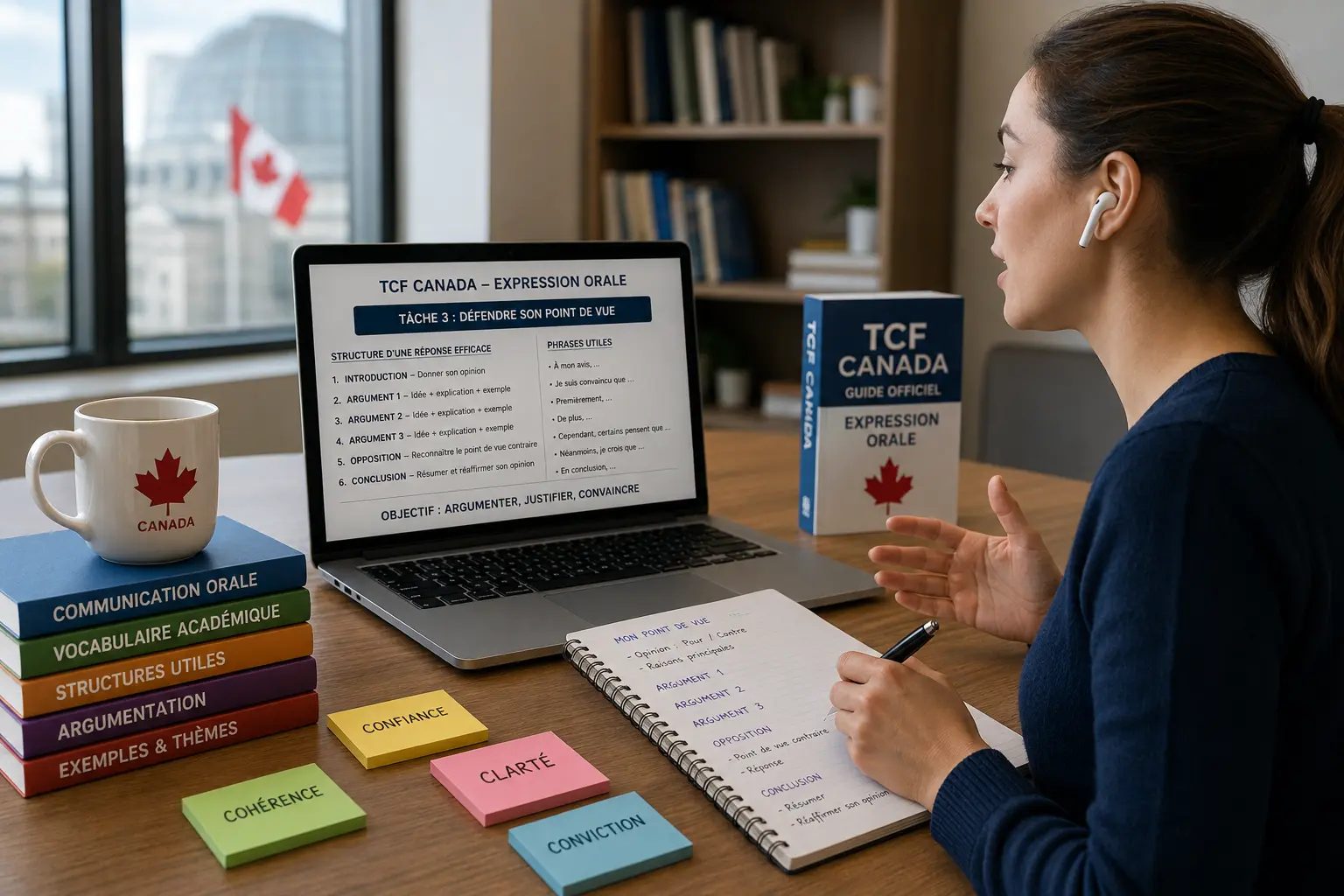
| Task 3 | Express viewpoint (4.5 minutes, no preparation) | Not applicable |
| Preparation Time | 2 minutes for Task 2 only | Preparation time for both tasks |
Real Test-Taker Experience: "In TEF, the speaking part is slightly easy. You only have two tasks. You have to do a roleplay in both of the tasks and if you can have a conversation in French, then you can easily get a B2.
In TCF, you have three tasks and the first task is ALWAYS the same. It's basically presenting yourself. So, if you can prepare yourself in advance for that task, you can start off really well. The second task is a roleplay and unlike TEF, you get 2 minutes to prepare for the roleplay so you can quickly jot down all the questions that you may ask. The third task is a bit complicated because you have to speak on a subject or a statement for more than 4 minutes WITHOUT any preparations. However, if you do well in your first two tasks and mess up a bit in the third one, you'd still get your B2." (ashu2111)
In TCF, you have three tasks and the first task is ALWAYS the same. It's basically presenting yourself. So, if you can prepare yourself in advance for that task, you can start off really well. The second task is a roleplay and unlike TEF, you get 2 minutes to prepare for the roleplay so you can quickly jot down all the questions that you may ask. The third task is a bit complicated because you have to speak on a subject or a statement for more than 4 minutes WITHOUT any preparations. However, if you do well in your first two tasks and mess up a bit in the third one, you'd still get your B2." (ashu2111)
TCF Canada Speaking Advantages:
- Task 1 is always the same (self-introduction)
- Can prepare self-introduction in advance
- Two minutes preparation time for Task 2
- Strong performance on first two tasks compensates for weaker Task 3
TCF Canada Speaking Challenges:
- Task 3 requires over 4 minutes of spontaneous speech
- No preparation time for final argumentative task
- Must think quickly and organize thoughts on the spot
TEF Canada Speaking Advantages:
- Only 2 tasks (simpler structure)
- Both tasks are roleplays (familiar format)
- No spontaneous argumentative speech required
TEF Canada Speaking Challenges:
- No consistent Task 1 to prepare for
- Must perform well on both tasks
- Longer overall duration
Overall Difficulty Comparison Summary
| Section | TCF Canada | TEF Canada | Easier Test |
|---|---|---|---|
| Listening | Moderate | Moderate to Easy | TEF (slight advantage) |
| Reading | Moderate | Hard | TCF (clear advantage) |
| Writing | Moderate | Hard | TCF (clear advantage) |
| Speaking | Moderate | Moderate to Easy | TEF (slight advantage) |
| Scoring System | Favorable | Restrictive | TCF (critical advantage) |
Who Should Choose TCF Canada?
TCF Canada is ideal if you:
- Are at B1 to B2 level (the absence of "B2 inferior" means borderline B2 scores still count)
- Struggle with time pressure in reading sections
- Prefer structured writing tasks over creative composition
- Studied with DELF methodology (TCF is from the same organization)
- Want progressive difficulty rather than irregular patterns
- Can prepare a strong self-introduction in advance
- Need a safety margin for qualifying for bonus points
Who Should Choose TEF Canada?
TEF Canada is ideal if you:
- Are solidly at B2 or higher level
- Excel at speaking and listening
- Prefer preview time for listening questions
- Enjoy creative writing and understand French journalism style
- Handle time pressure exceptionally well
- Have more test centers available in your location
Decision Framework
Ask Yourself These Key Questions:
1. What is your current French level?
- A2 to B1 level: Choose TCF Canada (more forgiving scoring)
- Solid B2 or higher level: Either test works
- B2 to C1 level: Choose based on stronger skills (reading and writing favor TCF; speaking and listening favor TEF)
2. What are your strongest skills?
- Strong in reading and writing: TCF Canada
- Strong in listening and speaking: TEF Canada
3. How do you handle time pressure?
- Struggle with tight deadlines: TCF Canada (especially for reading)
- Excel under time pressure: TEF Canada will not be an issue
4. What is your preparation background?
- Studied with DELF or DALF: TCF Canada (same organization and methodology)
- Self-study or business French background: TEF Canada might suit you
5. How critical are those 50 CRS points?
- Must have 50 points: TCF Canada (no B2 inferior means lower risk)
- Confident in achieving B2 superior: Either test works
Real Success Story: From TEF Failure to TCF Success
Complete Experience from Test-Taker (3 years French learning):
TEF Canada Results:
Writing: B1
Reading: B2 inferior (zero points)
Listening: C1
Speaking: C1
Outcome: Did not qualify for 50 bonus points due to B1 writing and B2 inferior reading
TCF Canada Results (after switching):
Writing: B2
Reading: C1
Listening: C1
Speaking: B2
Outcome: Qualified for full 50 bonus CRS points
Key Insight: "After I finished TEF and got an unsatisfactory score, I was quite worried that I will potentially need to spend many more months to get a decent score to get over the reading and the writing hurdle. However, when I got to know more about TCF Canada, I felt that it was something doable with my current level and although I did practice to hone up my skills, I did not feel like it was a massive challenge." (ashu2111)
TEF Canada Results:
Writing: B1
Reading: B2 inferior (zero points)
Listening: C1
Speaking: C1
Outcome: Did not qualify for 50 bonus points due to B1 writing and B2 inferior reading
TCF Canada Results (after switching):
Writing: B2
Reading: C1
Listening: C1
Speaking: B2
Outcome: Qualified for full 50 bonus CRS points
Key Insight: "After I finished TEF and got an unsatisfactory score, I was quite worried that I will potentially need to spend many more months to get a decent score to get over the reading and the writing hurdle. However, when I got to know more about TCF Canada, I felt that it was something doable with my current level and although I did practice to hone up my skills, I did not feel like it was a massive challenge." (ashu2111)
Preparation Resources Comparison
TCF Canada Resources:
- France Éducation international website with official materials
- PrepMyFuture platform (official practice platform)
- TV5Monde TCF section
- RFI Savoirs listening exercises
- Books: ABC TCF, Réussir le TCF, CLE publications
TEF Canada Resources:
- CCI Paris official website
- Official TEF preparation guides
- More YouTube channels and blogs
- Books: ABC TEF, Réussir le TEF (more variety available)
- More active online communities and forums
Resource Reality: TEF Canada has more preparation resources and active test-taker communities due to longer market presence. However, TCF Canada's connection to DELF means that DELF preparation materials can be helpful for TCF preparation.
Cost and Availability
Examination Fees:
Both tests typically cost between $340 and $400 CAD, depending on the test center location. Prices are generally comparable, so cost should not be a deciding factor.
Test Center Availability:
TCF Canada Centers: Primarily offered at Alliance Française branches across Canada and internationally. Fewer testing locations overall compared to TEF.
TEF Canada Centers: More widespread availability through both Alliance Française and other authorized testing centers.
Booking Timeline: Both tests typically require booking 1 to 2 months in advance during peak immigration seasons.
Preparation Strategies
If You Choose TCF Canada:
- Focus on methodology and systematic preparation
- Practice document synthesis for writing Task 3
- Prepare and memorize your self-introduction for speaking Task 1
- Use DELF preparation materials as supplementary resources
- Master reading strategies to take advantage of extra time
- Practice spontaneous speaking for over 4 minutes without preparation
If You Choose TEF Canada:
- Study the "fait divers" journalistic format thoroughly
- Build reading speed to complete 50 questions in 60 minutes
- Practice identifying and triaging easy versus hard reading questions
- Master roleplay format for both speaking tasks
- Use preview time wisely to scan listening questions effectively
- Aim for B2 superior scores, not borderline B2
Common Mistakes to Avoid
Do Not Make These Errors:
- Choosing based on popularity alone rather than your skill profile
- Ignoring the B2 inferior versus B2 superior issue
- Not considering your time management abilities
- Underestimating TCF Task 3 speaking requirements
- Assuming both tests are identical in structure and difficulty
- Not trying practice tests for both before committing
- Forgetting about retake waiting periods (30 to 60 days)
Final Verdict
For Most Candidates: TCF Canada is the safer strategic choice due to:
- No "B2 inferior" scoring trap
- Easier and more manageable reading section
- More structured and predictable writing tasks
- Progressive difficulty patterns that are easier to navigate
Final Recommendation:
Choose TCF Canada if you are at B1 to B2 level, prefer structured tasks, need extra time in the reading section, or want to minimize the risk of falling into "B2 inferior."
Choose TEF Canada if you are solidly B2 or higher level, excel at speaking and listening, handle extreme time pressure well, and can master the creative writing requirements.
Conclusion
The choice between TCF Canada and TEF Canada is not simply about which test is easier overall. It is about which test aligns better with your current skills, learning style, and immigration timeline. While TEF Canada has more resources and active test-taker communities, TCF Canada's scoring system and section structures offer significant advantages for many candidates, particularly those at B1 to B2 levels.
The absence of "B2 inferior" in TCF Canada is a critical difference that can mean the difference between receiving 0 or 50 bonus CRS points. Combined with the more manageable reading section and structured writing tasks, TCF Canada emerges as the strategic choice for most immigration applicants.
However, if you are solidly at B2 or higher level and excel at speaking and listening, TEF Canada's simpler oral format and preview time for listening might serve you better. The key is honest self-assessment and strategic planning based on your individual strengths and weaknesses.
Regardless of which test you choose, remember that achieving NCLC 7 (CLB 7) in French opens doors to French-language Express Entry draws with CRS cutoffs 100 to 150 points lower than general draws. The investment in French language proficiency is one of the most impactful steps you can take in your Canadian immigration journey.
* * *
Frequently Asked Questions
Yes, you can take both tests and submit whichever score is higher to IRCC. However, you must wait 30 to 60 days between attempts for the same test. Since they are different tests, you could theoretically take TCF Canada and TEF Canada in the same month. Keep in mind that each test costs $340 to $400, so taking both represents a significant financial investment.
TCF Canada: Results are typically available within 15 working days from when France Éducation international receives your test papers from the examination center.
TEF Canada: Results are usually available within 2 to 4 weeks after the test date, depending on the examination center.
Both certificates are valid for 2 years from the date of issue. You must collect your certificate from the test center where you took the exam.
TEF Canada: Results are usually available within 2 to 4 weeks after the test date, depending on the examination center.
Both certificates are valid for 2 years from the date of issue. You must collect your certificate from the test center where you took the exam.
Yes, both TCF Canada and TEF Canada require you to retake all four sections (listening, reading, writing, and speaking) if you do not achieve your target score. You cannot retake individual sections. For Canadian immigration purposes, you need to achieve at least NCLC 7 (CLB 7) in all four skills to receive the 50 bonus CRS points. If even one section is below this threshold, you must retake the complete examination.
TEF Canada generally has more frequent test sessions and wider availability across Canada and internationally. TEF is offered at more examination centers beyond Alliance Française locations. TCF Canada is primarily available at Alliance Française branches, which means fewer testing locations overall. However, availability varies by region, so check with your local Alliance Française or authorized test center for specific dates. During peak immigration seasons, both tests typically require booking 1 to 2 months in advance.
Yes, unfortunately you still need to take either TCF Canada or TEF Canada. DELF and DALF certificates are NOT accepted by Immigration, Refugees and Citizenship Canada (IRCC) for Express Entry or immigration purposes. Only TCF Canada and TEF Canada are officially recognized for Canadian immigration applications. However, if you have DELF B2, you already have a strong foundation in French, and TCF Canada may be easier for you since both tests are created by France Éducation international and follow similar methodologies.
Laissez un commentaire
Votreadresse email ne sera pas publie. Les champs obligatoires sont marque avec *

 TCF Canada Hub
0 Commentaires
aucun commentaire
Soyez le premier a partager votre avis !