
-
Auteur :
 Antoine C.
- Oct 30, 2026
The Shadowing Method for TCF Canada Speaking
Many TCF Canada candidates understand French far better than they speak it. They follow podcasts, read articles without difficulty, and still freeze during the 12-minute Speaking section: sentences come out slowly, the rhythm is choppy, and the examiner hears hesitation rather than fluency. The problem is not knowledge. It is the gap between the language stored in your head and the muscles that produce it. Shadowing is one of the most efficient techniques to close that gap.
Shadowing means listening to a native speaker and repeating what they say almost simultaneously, a fraction of a second behind, like a shadow. Used by interpreters for decades, it trains pronunciation, intonation, rhythm and automatic sentence patterns at the same time. This guide explains how to adapt it specifically to the TCF Canada Speaking section and gives you a six-week programme.
Why Shadowing Works for the Speaking Section
The Speaking section is scored out of 20 by examiners who assess, among other things, fluency, pronunciation, lexical range and grammatical control. Fluency is where most intermediate candidates lose points: long pauses, restarts, and word-by-word construction. Shadowing attacks exactly these weaknesses.
| Speaking weakness | What shadowing trains | Expected effect after 6 weeks |
|---|---|---|
| Slow, hesitant delivery | Speaking at native speed without translating | Fewer and shorter pauses |
| Flat or foreign intonation | French melody and stress on the final syllable of word groups | More natural, easier to understand |
| Missing liaisons and elisions | Connected speech (les‿amis, c'est‿important) | Smoother, more authentic sound |
| Limited ready-made expressions | Absorbing full sentence frames | Automatic transitions and openings |
| Fear of speaking | Daily low-stakes speaking practice | More confidence in front of the examiner |
Shadowing complements, but does not replace, practice with real Speaking tasks. Think of it as the gym session that makes your performance on the field easier. For task methodology, see our guides to Speaking Tasks 1 and 2 and Speaking Task 3.
Choosing the Right Audio
The audio you shadow determines what you absorb. Choose material that matches the TCF Canada context: everyday conversations, interviews and opinion segments, ideally with a transcript.
Criteria for good shadowing material:
- Length: 1 to 3 minutes per clip; long enough for context, short enough to repeat
- Speed: Natural but clear; avoid heated debates at first
- Content: Opinions, explanations, descriptions, the functions tested in Speaking
- Transcript: Essential in the first weeks
- Accent: Mostly standard or Canadian French; you want to imitate an accent that is widely understood
Good sources:
- Radio-Canada OHdio: interviews and opinion segments from Canadian public radio
- TV5Monde Apprendre: videos with transcripts and graded exercises
- RFI's "Journal en français facile": slow, clear news with transcripts, ideal for beginners in shadowing
- Your own recordings of model TCF answers written with a tutor
The Five-Step Shadowing Session (20 Minutes)
A complete daily session:
- Step 1 – Listen (3 min): Play the clip once without speaking; understand the gist
- Step 2 – Read along (3 min): Play again while reading the transcript silently; mark liaisons and stressed syllables
- Step 3 – Mumble shadowing (4 min): Repeat quietly just behind the speaker, focusing on rhythm, not on perfect words
- Step 4 – Full shadowing (6 min): Repeat aloud at normal volume, three times, trying to match intonation and speed
- Step 5 – Record and compare (4 min): Record your final attempt and compare with the original; note two things to fix tomorrow
Do not aim for perfection on the first day. Many learners can only follow 50% of the words at first. That is normal: the brain is building a new automatic pathway. After two to three weeks, most candidates notice they can shadow a clip at full speed after only two listens.
From Shadowing to TCF-Style Speech
Shadowing becomes truly powerful when you connect it to the three TCF Speaking tasks. After shadowing a clip, reuse its structures immediately in your own words.
Transfer exercise after each session:
- For Task 1 (guided interview): Shadow a clip where someone describes their work or daily life, then describe your own in 1 minute using the same structures
- For Task 2 (interaction): Shadow a clip with questions (an interview, a phone call), then formulate 8 questions on a new situation
- For Task 3 (opinion): Shadow an editorial or debate segment, then give your own opinion on the same topic for 3 minutes, reusing at least three expressions you shadowed
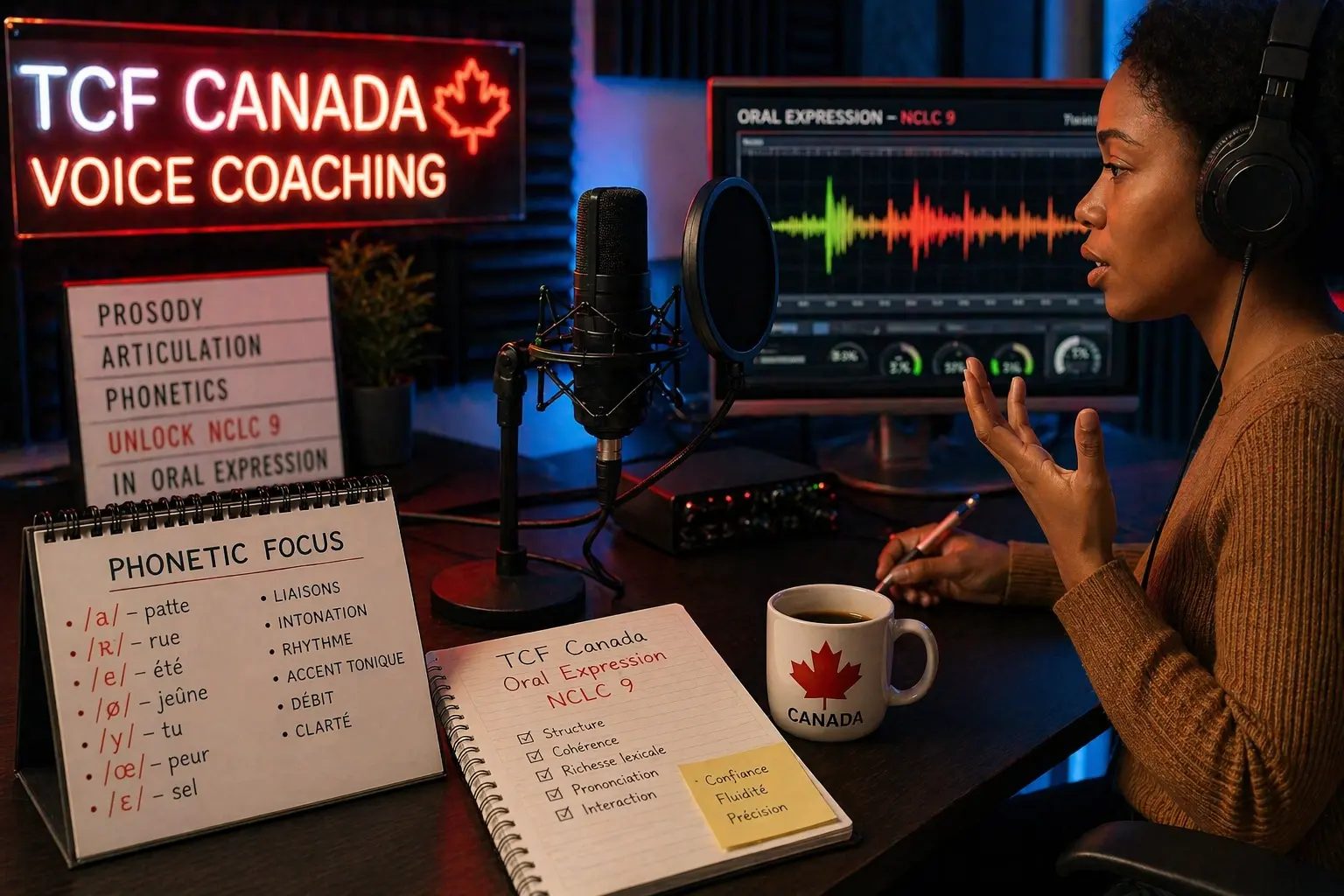
To expand the stock of expressions you reuse, combine shadowing with our phrase bank of 54 ready-to-deploy formulas. And for pronunciation details (nasal vowels, the French "r", the "u" vs "ou" contrast), see our guide to voice coaching for TCF Canada.
A Six-Week Shadowing Programme
| Week | Material | Focus | Daily time |
|---|---|---|---|
| 1 | Slow news with transcripts | Rhythm and liaisons | 15 min |
| 2 | Slow news + short interviews | Intonation of questions and statements | 15-20 min |
| 3 | Radio interviews | Natural speed, connectors | 20 min |
| 4 | Opinion segments | Argumentation structures for Task 3 | 20 min |
| 5 | Mixed, Canadian speakers | Speed and accent flexibility | 20 min + transfer exercise |
| 6 | Model TCF answers | Task-specific fluency, full simulations | 25 min + 1 simulation |
Illustrative case: Olivia, a Colombian nurse preparing for the French-language category, had Speaking mock scores of 9 and 10 out of 20. Her comprehension was already at NCLC 8. She added 20 minutes of shadowing every morning before work for six weeks, recording herself each day. Her examiner-style evaluations moved to a stable 12/20, with feedback noting clearer pronunciation and far fewer pauses. The content of her answers had barely changed; the delivery had.
Common Shadowing Mistakes
Avoid these errors:
- Choosing clips that are too fast or too long in the first weeks
- Reading the transcript aloud instead of following the audio
- Never recording yourself, so you cannot hear your progress
- Shadowing passively while doing something else
- Stopping at imitation without transferring structures into your own answers
- Imitating a very strong regional accent that makes you harder to understand
Fitting Shadowing Into a Busy Day
Shadowing is ideal for candidates with jobs and families because it needs no partner and no desk. You can do the mumble phase on public transport, the full phase in the car or during a walk, and the recording step at home. What matters is consistency: 15 to 20 minutes every day beats two hours once a week. If you use a study log, record your shadowing sessions alongside other activities, as described in our 5-block study log system.
Your Shadowing Checklist
Start tomorrow with:
- Five clips selected: 1-3 minutes each, with transcripts
- A recording app: On your phone, with a folder per week
- A fixed time slot: 20 minutes, same time every day
- A transfer exercise: One TCF-style answer after each session
- A weekly comparison: Listen to your day-1 and day-7 recordings side by side
Shadowing is simple, free and slightly uncomfortable at first. That discomfort is the sign that your mouth is learning what your brain already knows. After six weeks, the examiner will not hear someone translating in their head: they will hear someone speaking French.



0 Commentaires
aucun commentaire
Soyez le premier a partager votre avis !