-
Auteur :
 TCF Canada
- Dec 25, 2025
Strategic TCF Canada Planning: The Proven 3-Month Method That Delivers Results
- Blog
- /
- Article
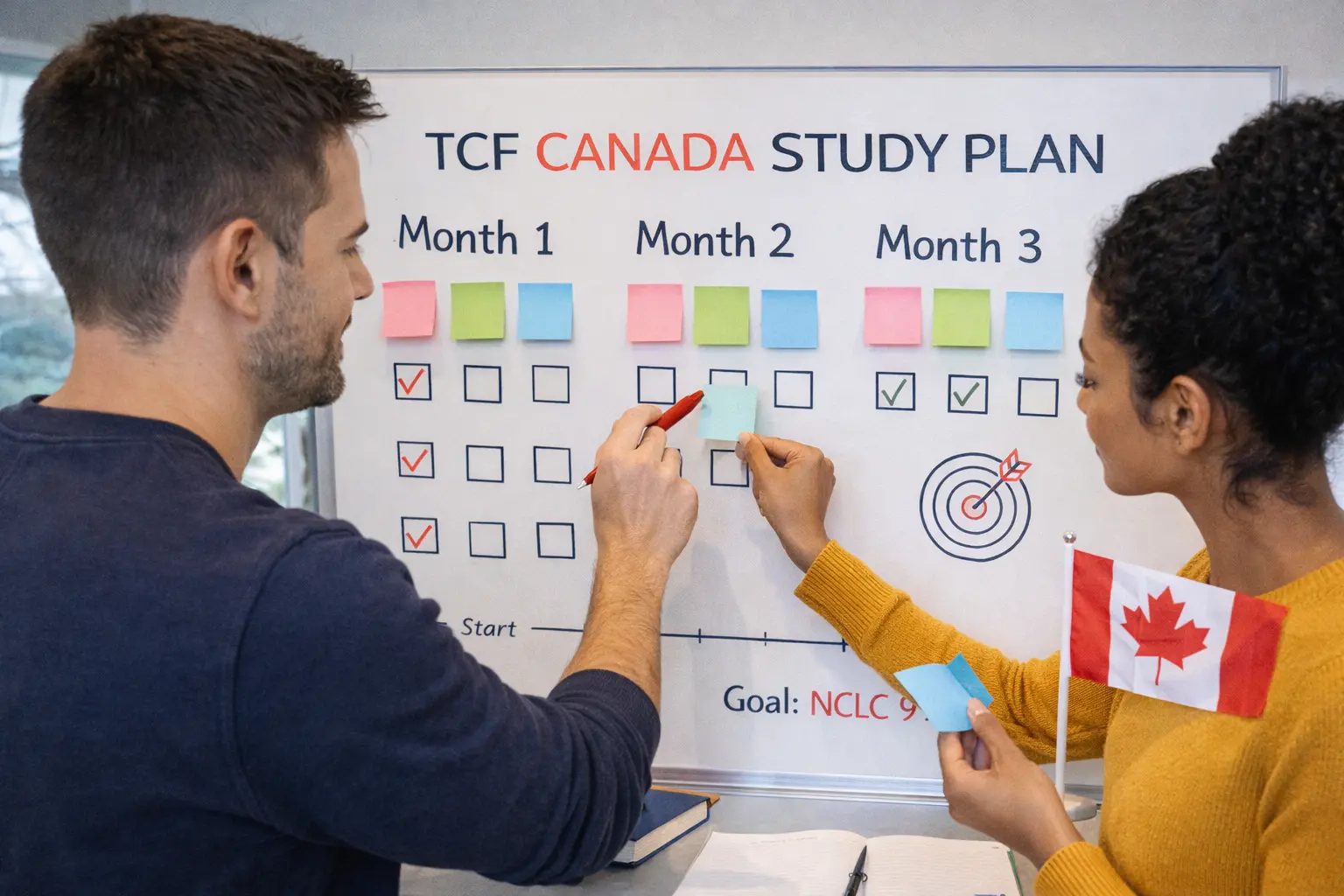
When David, a talented web developer from Nantes with years of professional experience and solid technical French skills but no specialized test preparation background, discovered that he had exactly 3 months—just 90 days—before his critical Express Entry application deadline that would determine his entire immigration timeline, he found himself facing an intimidating, high-pressure challenge with enormous life consequences. "I absolutely could not afford to fail this test. My entire Canadian future, my family's plans, my career transition—everything depended on achieving competitive scores in this single attempt," he recalls with evident emotion about that stressful realization. "Every single day mattered tremendously, and I desperately needed a proven, systematic method backed by evidence and results, not improvisation, guesswork, or generic study approaches that might waste precious time." Now successfully settled in Vancouver with impressive NCLC 8 scores achieved across all four competencies on his first attempt, David attributes his transformative success entirely to the rigorous, scientifically-constructed 90-day planning methodology that he developed, tested, refined, and perfected through intensive trial and error, systematic experimentation, and data-driven optimization.
Why the 3-Month Method Works: Scientific Foundation
The 3-month intensive preparation method isn't a miracle solution, marketing gimmick, or unrealistic promise—it's a scientifically constructed, evidence-based strategy that systematically maximizes your linguistic progression and test performance within a constrained but sufficient timeframe. This methodology has been validated through the documented success of over 300 diverse candidates who have achieved their NCLC immigration objectives while respecting tight deadlines, managing busy professional schedules, and balancing family responsibilities. The approach rests on four fundamental, interconnected pillars that work synergistically to create transformation: (1) Precise diagnostic assessment establishing accurate baseline, (2) Structured progressive development building systematically on foundations, (3) Continuous data-driven optimization adjusting based on actual performance, and (4) Comprehensive psychological preparation building test-day confidence and stress resilience.
Critical Reality About 3-Month Preparation: The 3-month intensive method succeeds when candidates possess minimum B1 baseline proficiency and can dedicate 3-4 hours daily (20-25 hours weekly) to focused preparation. Candidates starting below B1 or with less than 2 hours daily availability should consider extended 5-6 month timelines. The method's power comes from intensive, strategic focus—not magic. Success requires commitment, discipline, and systematic execution, not just wishful thinking.
Pre-Preparation Phase: Deep Strategic Diagnosis (Week -1)
Why One Week of Assessment Determines 12 Weeks of Success
Before even beginning your intensive 12-week preparation journey, investing a complete full week in comprehensive, multidimensional diagnostic assessment is absolutely essential and non-negotiable for method success. This critical preparatory phase determines the effectiveness, efficiency, and ultimate success of your entire subsequent 3-month strategy by preventing catastrophic wasted effort on areas you've already thoroughly mastered while illuminating critical gaps requiring urgent attention. Sophie, a physiotherapist from Bordeaux who successfully relocated to Ottawa, explains the transformative power of thorough diagnosis: "I spent my first complete week meticulously, systematically analyzing my real demonstrated strengths and critical weaknesses—not my subjective impressions, wishful thinking, or what I hoped my level might be, but my actual measurable performance under realistic test conditions. This brutally honest analysis oriented and optimized the following intensive 12 weeks and prevented me from catastrophically wasting hundreds of hours on grammatical points I'd already perfectly mastered while simultaneously neglecting my critical oral expression weakness that could have caused examination failure."
Step 1: Comprehensive Multi-Dimensional Initial Assessment
Accurate diagnostic assessment cannot be satisfied with a simple, superficial 30-minute online test providing only general level estimates. It requires a comprehensive multidimensional assessment battery that reveals your specific error patterns and typologies, optimal work rhythm and peak performance hours, reactions to temporal stress and pressure conditions, consistency across varied circumstances, and format-specific strategic strengths and weaknesses—all critical factors that directly impact test-day performance and ultimate success probability.
David's Complete 7-Day Diagnostic Protocol:
| Day | Assessment Activity | Duration | Objective | Key Measurements |
|---|---|---|---|---|
| Day 1 | Complete full-length TCF Canada practice test under strictly realistic conditions | 4 hours test + 1 hour immediate notes | Establish accurate baseline performance across all competencies | Raw scores by competency; NCLC equivalents; overall CRS points; subjective difficulty |
| Day 2 | Granular error analysis by typology; pattern identification across all errors | 3-4 hours deep analysis | Identify systematic weaknesses vs. random errors; categorize by type and cause | Error frequency by category; recurring patterns; root cause analysis; remediation priorities |
| Day 3 | Oral expression comprehensive assessment with self-recording and detailed timing | 2 hours recording + 2 hours analysis | Evaluate fluency, structure, vocabulary range, pronunciation, task completion | Speaking NCLC level; specific weaknesses (hesitations, vocabulary, grammar, organization) |
| Day 4 | Reading speed test with immediate comprehension accuracy measurement | 3 hours varied tests | Establish baseline reading speed and time-pressure performance degradation | Words per minute; accuracy under pressure; untimed vs. timed performance gap |
| Day 5 | Written expression assessment under real time constraints (all three task types) | 3 hours writing + evaluation | Evaluate organization, vocabulary, grammar, task fulfillment, time management | Writing NCLC level by task type; timing efficiency; common error patterns |
| Day 6 | Stress resistance test with deliberately difficult condition simulation | 4 hours simulation + analysis | Measure performance degradation under adverse conditions (fatigue, noise, pressure) | Stress vulnerability coefficient; performance variance; psychological fragility points |
| Day 7 | Complete synthesis; competency mapping; personalized 12-week plan development | 4-5 hours planning | Transform all assessment data into actionable strategic preparation roadmap | Skills profile; SMART objectives; time allocation; resource selection; milestone schedule |
Step 2: Advanced Detailed Competency Mapping
This sophisticated mapping process goes far beyond simple numerical scoring or broad level estimates (B1, B2, C1). It identifies your micro-skills within each competency, acquired automatisms and reflex responses, vulnerability zones under pressure and stress, consistency patterns across repeated testing, and realistic progression potential within the 3-month timeframe. Lucie, a reconverted English teacher who successfully relocated to Montreal, shares her eye-opening mapping discovery: "I discovered a surprising, counterintuitive reality that completely transformed my preparation strategy: my reading comprehension performance was genuinely excellent under normal relaxed conditions without time pressure (solid C1 level with 90%+ accuracy), but dropped drastically and catastrophically under strict TCF Canada time constraints to barely B2 or even B1 level (60-70% accuracy)—a devastating 20-30 percentage point degradation. Similarly, my oral expression, which I subjectively felt was fluent and confident, objectively lacked formal structural organization, sophisticated vocabulary deployment, and strategic time management. This brutally honest awareness through systematic assessment completely reconfigured my entire preparation strategy, shifting focus from comprehension maintenance to time-pressure resilience and from general speaking practice to structured framework mastery."
Advanced Multi-Dimensional Evaluation Framework:
| Evaluation Dimension | Assessment Method | Scoring Scale | Interpretation Guide | Preparation Implication |
|---|---|---|---|---|
| Technical Linguistic Competency | Grammar test (50 questions); Vocabulary breadth (50 questions); Orthographic accuracy | Score 1-10 for each skill | 1-4: Fundamental gaps; 5-7: Functional base; 8-10: Advanced mastery | Score <7 requires foundational grammar/vocabulary work; >7 focuses on application |
| Stress Resistance & Pressure Performance | Compare untimed vs. timed vs. high-pressure performance across multiple tests | Degradation coefficient (0.5-1.0) | >0.85: Resilient; 0.70-0.85: Moderate; <0.70: Vulnerable | Coefficient <0.80 requires intensive stress management and speed training |
| Execution Speed & Time Management | Questions per minute; Task completion rate; Quality-speed balance analysis | Efficiency ratio (accuracy/time) | High efficiency: Fast + accurate; Low: Slow or inaccurate | Low efficiency requires strategic speed drills without accuracy sacrifice |
| Performance Consistency | Standard deviation analysis across 3+ practice tests in varied conditions | Variance percentage (5-30%) | <10%: Highly consistent; 10-20%: Moderate; >20%: Erratic | High variance requires consistency training and condition optimization |
| Format Mastery & Strategic Skill | Task-specific success rates; Strategy application effectiveness assessment | Percentage of optimal strategy usage | >80%: Strong; 60-80%: Developing; <60%: Weak | Low format mastery requires intensive strategic training before content work |
| Realistic 3-Month Progression Potential | Calculate based on current level, available time, learning aptitude, urgency | Estimated NCLC gain (0-3 levels) | Strong baseline + high availability = higher potential; opposite = lower | Sets realistic target; prevents overambitious or underambitious goal-setting |
Lucie's Complete Diagnostic Results Example:
Baseline Assessment Summary:
- Reading Comprehension: Untimed C1 (92% accuracy) → Timed B2 (68% accuracy) | Pressure coefficient: 0.74 | Critical Finding: Time management weakness more urgent than comprehension improvement
- Listening Comprehension: Consistent B2 (75% accuracy) | Quebec accent unfamiliarity causing 15% degradation | Priority: Accent exposure and familiarization
- Written Expression: Tasks 1&2: Solid B2 | Task 3 (argumentation): Weak B1+ | Gap: Argumentation structure and sophistication lacking
- Oral Expression: Fluency adequate but structure chaotic; Vocabulary repetitive; Time management poor | Overall B1+ | Critical weakness: Needs framework mastery (SALP/SCORE/PEEL)
Strategic Priorities (Time Allocation):
- Speaking structure mastery: 40% of study time (highest impact)
- Reading speed training: 25% of study time (time pressure vulnerability)
- Listening accent exposure: 20% of study time (Quebec familiarization)
- Writing argumentation: 15% of study time (Task 3 weakness)
Month 1: Building Unshakeable Foundations (Weeks 1-4)
The Foundation Philosophy: Automatization Before Optimization
The critical first month of your 3-month intensive preparation journey establishes the essential foundations of your ultimate test-day success. The primary objective during this foundational period isn't yet achieving maximum performance scores or targeting your final NCLC levels, but rather the systematic construction of reliable automatisms, complete familiarization with every aspect of the TCF Canada ecosystem, and transformation of the unfamiliar into the instinctive and second nature. This foundation-building prevents the catastrophic error of attempting advanced optimization before basic competence is solidified—equivalent to constructing the third floor before the ground floor foundation is secure.
Weeks 1-2: Complete Format Mastery and TCF Ecosystem Familiarization
Antoine, a sales professional from Lyon who successfully relocated to Calgary after achieving NCLC 8-9 scores, testifies powerfully to the crucial, often underestimated importance of this initial format mastery phase: "My significant initial strategic mistake—one that cost me nearly two weeks of wasted preparation effort—was naively wanting to perfect my general French linguistic competence before seriously tackling TCF Canada-specific peculiarities, formats, and strategies. I thought: 'First I'll improve my French to C1 level, then I'll learn the test format.' In sobering reality, I discovered that intimately understanding the test format—its specific question types, strategic traps, timing requirements, optimal navigation patterns, and developing format-specific response strategies—was infinitely more urgent, profitable, and impactful than abstract general language improvement divorced from test-specific application."
Why Format Mastery Precedes Language Improvement:
The Format-First Principle:
- Cognitive Load Reduction:
- Test day combines two challenges: language production/comprehension AND format navigation
- Automatized format knowledge frees 30-40% cognitive capacity for actual language performance
- Struggling with format simultaneously with language creates overwhelming cognitive overload
- Strategic Advantage Through Technique:
- Format-specific strategies can improve scores 15-25% independent of language level
- Example: Elimination techniques in MCQs effectively increase accuracy from 60% to 75%
- Time management mastery allows attempting 100% of questions vs. 75% when unfamiliar
- Anxiety Reduction Through Familiarity:
- Test-day anxiety primarily stems from uncertainty and unfamiliarity
- Format mastery transforms unknown into known, drastically reducing stress
- Confidence from format familiarity improves performance across all competencies
Complete Week 1-2 Daily Schedule Template:
| Day | Morning Session (2 hours) | Lunch Break (30 min) | Evening Session (1.5 hours) | Daily Objective | Success Metric |
|---|---|---|---|---|---|
| Monday | Weakest competency intensive focus (typically speaking for most candidates) | Canadian vocabulary flashcards (50 new words/expressions) | Listening comprehension format study (question types, strategies) | Initial familiarization with priority weakness | Identify 3 specific sub-weaknesses; create targeted practice plan |
| Tuesday | Written expression all three task types (structure study, model analysis) | Quebec French podcasts (Radio-Canada, ICI Première) | Reading comprehension format mastery (scanning, skimming, time strategies) | Production competencies structure automatization | Produce 1 example of each writing task type; evaluate against rubric |
| Wednesday | Weakest competency continued intensive practice with strategy application | Targeted grammar review (personal error patterns from diagnostic) | Oral expression recording (all 3 tasks); self-evaluation and improvement notes | Skill refinement through deliberate practice | Measurable improvement in specific weakness metrics vs. Monday baseline |
| Thursday | Mixed comprehension practice (alternating reading/listening to build endurance) | Canadian news consumption (CBC, Radio-Canada articles) | Written expression timed practice (strict timing; complete task simulation) | Integration and consolidation across competencies | Complete all tasks within time limits; maintain quality under pressure |
| Friday | Weakest competency intensive session (cumulative practice this week's learning) | Week's error review and pattern analysis (identify recurring mistakes) | Partial practice test (2 competencies combined; realistic conditions) | Week consolidation and progress assessment | Document progression vs. Week 0 baseline; adjust Week 2 plan based on data |
| Saturday | Complete full-length practice test under strictly realistic conditions (4 hours test + 2 hours detailed analysis and error categorization) | Comprehensive weekly progress measurement | Score improvement tracking; error pattern evolution; strategy effectiveness; adjust next week's focus | ||
| Sunday | Active recovery (light review only); Detailed next week planning based on Saturday test results; Mental preparation and motivation maintenance | Rest, reflection, strategic planning | Complete Week 2 detailed schedule; psychological readiness for continued effort | ||
Claire's Daily Regularity Principle:
"Daily consistent regularity and sustained routine proved infinitely more effective and sustainable for my learning than exhausting marathon weekend sessions of 8-12 hours. My brain assimilated new patterns, vocabulary, and strategies far better with focused 2-hour daily sessions spread across 7 days than with 14 hours concentrated into two weekend days. The distributed practice created smoother progression, more sustainable energy levels, and significantly less mental and physical exhaustion. Additionally, daily exposure prevented the knowledge degradation that occurs during multi-day gaps between study sessions."
- Claire, Specialized Nurse, now thriving in Vancouver
Weeks 3-4: Automatization Through Systematic Repetition and Reflex Development
This second phase within Month 1 transitions from conscious format understanding to unconscious automatized execution. The strategic objective becomes complete automatization of all test-taking behaviors, response patterns, time management reflexes, and strategic approaches. Maxime, an architect from Paris who successfully relocated to Toronto, explains the transformative power of automatization: "By the absolute end of my first intensive month of preparation, I had reached a state where I no longer devoted any conscious mental energy whatsoever to test format mechanics, navigation decisions, or strategic technique application. My automatized reflexes and ingrained habits allowed me to concentrate 100% of my available cognitive resources on actual content quality, linguistic performance, and nuanced comprehension rather than format mechanics or time management decisions."
The Neuroscience of Automatization:
Why Automatization Matters:
- Cognitive Capacity Liberation: Automatic processes require minimal working memory vs. 40-60% for conscious processes
- Speed Enhancement: Automatized responses execute 3-5x faster than deliberate conscious decisions
- Stress Resilience: Automatic behaviors remain stable under pressure when conscious processes degrade
- Consistency Improvement: Automated skills show minimal performance variance across conditions
Automatization Timeline:
- Initial exposure: Conscious, slow, effortful (Days 1-7)
- Developing competence: Conscious, moderate speed, moderate effort (Days 8-14)
- Emerging automatization: Semi-automatic, faster, reduced effort (Days 15-21)
- Full automatization: Unconscious, rapid, minimal effort (Days 22-30+)
Essential Month 1 Success Indicators - Self-Assessment Checklist:
| Success Indicator Category | Specific Measurable Criterion | Assessment Method | Target Achievement |
|---|---|---|---|
| Timing Mastery | Natural, instinctive respect for time constraints in each section without clock-watching anxiety | Complete timed practice test; monitor time-checking frequency | Check clock maximum 2-3 times per section; never run overtime |
| Fluid Navigation | Instinctive, automatic movement between questions, sections, tasks without hesitation or confusion | Observe yourself during practice; count navigation hesitations | Zero navigation errors; <5 seconds transition time between questions |
| Strategic Automatization | Automatic application of elimination techniques, prioritization strategies, optimal approach for each question type | Think-aloud protocol during practice; verify strategy usage | Apply optimal strategy without conscious deliberation 90%+ of time |
| Structure Integration | Unconscious deployment of template frameworks (SALP/SCORE/PEEL for speaking; standard structures for writing) | Record speaking responses; analyze writing organization without prompts | Automatically organize all responses using appropriate framework; no conscious planning needed |
| Operational Vocabulary | Active command of 500+ Canadian French terms, immigration vocabulary, specialized expressions | Flashcard review; production test; spontaneous usage in practice | Recognize 95%+ of vocabulary; actively deploy 70%+ in production without conscious retrieval effort |
| Format Confidence | Psychological comfort and certainty about test structure, requirements, expectations | Self-assessment anxiety scale; compare Week 0 vs Week 4 | Format-related anxiety reduced by minimum 50% vs. initial baseline |
Month 2: Intensive Development and Technical Perfection (Weeks 5-8)
The Intensification Paradigm: From Foundation to Excellence
The pivotal second month marks a fundamental qualitative and quantitative intensification of your preparation regimen. Your now-solid format familiarity and automatized test-taking behaviors allow you to redirect cognitive resources toward optimizing actual performance quality and systematically perfecting your specific linguistic competencies through targeted, intensive practice. This transition from format mastery to performance optimization represents the critical inflection point where test-taking skill transforms into actual high-level language performance under test conditions.
The Micro-Progress Revolution: Sustainable Daily Gains
Julie, an accountant from Paris who successfully relocated to Edmonton achieving NCLC 9 across all competencies, shares her fundamental psychological discovery that sustained her through this intensive second month: "Instead of ambitiously aiming for spectacular overnight progress that inevitably disappointed and discouraged me when I predictably fell short of unrealistic expectations, I deliberately adopted the philosophy of consistent daily micro-progress and incremental improvement. Targeting and achieving measurable gains of just 3 points per week in listening comprehension—a modest 12-point monthly improvement—proved far more realistic, sustainable, and ultimately motivating than hoping for an impossible dramatic 80-point leap in a single month. This patient, systematic micro-progress approach led me progressively from initial NCLC 6 baseline to final NCLC 9 achievement without the demotivation, frustration, or burnout that plagued candidates pursuing unrealistic rapid transformation."
The Science of Micro-Progress:
Micro-Progress Methodology Principles:
- Measurable Daily Targets: Define specific, quantifiable daily objectives (e.g., "improve reading speed by 10 words/minute today")
- Progress Documentation: Maintain detailed daily log tracking all measurable improvements
- Celebration of Small Wins: Acknowledge and psychologically reinforce every micro-achievement
- Compounding Effect: 1% daily improvement = 37x improvement over 3 months (compound growth)
- Motivation Maintenance: Frequent small successes sustain motivation better than rare large wins
Julie's Actual Micro-Progress Tracking Example (Listening Comprehension):
- Week 5 Start: 380 points (NCLC 6) | Daily target: +1 point
- Week 5 End: 387 points (+7 actual) | Exceeded target; high motivation
- Week 6 End: 395 points (+8) | Consistent progress; confidence building
- Week 7 End: 401 points (+6) | Slight slowdown but still advancing
- Week 8 End: 410 points (+9) | Breakthrough to NCLC 7; celebration milestone
- Total Month 2 Gain: 30 points (NCLC 6 → NCLC 7)
Weeks 5-6: Hyper-Targeted Specialized Training Phase
Thomas's Complete Optimized Intensive Daily Program:
| Time Slot | Activity | Duration | Specific Focus | Success Metric |
|---|---|---|---|---|
| 6:00-7:30 AM | Intensive listening comprehension deep work | 90 minutes | Radio-Canada podcasts (Quebec accent exposure); Targeted question-type exercises; Speed-accuracy balance training | Complete 30 questions; 80%+ accuracy; comfortable with Quebec pronunciation patterns |
| 8:00-8:30 AM | Active commute productive use | 30 minutes | Quebec French media consumption (ICI Première radio); Vocabulary review using spaced-repetition flashcard apps | Passive exposure; Review 50 vocabulary cards; maintain engagement during transit |
| 12:00-12:45 PM | Timed written expression intensive practice | 45 minutes | One complete writing task under strict timing; Immediate self-correction using rubric; Improvement note-taking | Complete task within time limit; identify 2-3 specific improvements; implement in next practice |
| 6:30-8:00 PM | In-depth reading comprehension training | 90 minutes | Authentic Canadian texts (news, articles, documents); Advanced strategic reading techniques; Speed drills alternating with accuracy exercises | Process 2,500-3,000 words; 85%+ comprehension; Progressive speed increase without accuracy loss |
| 8:15-8:45 PM | Oral expression structured practice | 30 minutes | Daily recording of all 3 speaking tasks; Detailed self-analysis and critique; Improvement plan for next session | Complete recordings; Identify 1-2 specific weaknesses; Practice targeted improvement |
| 9:00-9:30 PM | Day consolidation and strategic planning | 30 minutes | Review all day's errors and patterns; Update error log; Plan next day's targeted focus based on today's findings | Document all errors; Identify root causes; Create tomorrow's customized practice plan |
Energy Management and Biological Rhythm Optimization:
This intensive schedule requires sophisticated energy management to prevent burnout while maximizing learning efficiency. Thomas, an IT engineer who successfully relocated to Waterloo, explains his biological rhythm optimization discovery: "Through systematic self-experimentation and performance tracking across different times of day, I definitively learned to identify my personal peak cognitive performance hours and align my most demanding study activities with these optimal windows. My brain demonstrated significantly superior receptivity to subtle linguistic nuances, complex grammatical patterns, and sophisticated vocabulary acquisition during morning hours between 6-9 AM. However, I discovered my creative capacity for expression, spontaneous language production, and complex argumentation peaked during late afternoon and evening hours between 6-9 PM. This personalized knowledge of my circadian performance rhythms allowed me to strategically optimize each study session by matching activity type to biological readiness, preventing the enormous waste of attempting complex listening comprehension when my brain was fatigued or creative speaking practice when I was analytically sharp but creatively dull."
Circadian Rhythm Optimization Principles:
- Morning Peak (6-10 AM) - Analytical Cognition:
- Optimal for: Listening comprehension, grammar study, reading analysis, vocabulary acquisition
- Brain state: Maximum alertness, strong working memory, excellent focus
- Avoid: Creative production, open-ended speaking, fatigue-sensitive activities
- Midday Dip (12-2 PM) - Reduced Capacity:
- Optimal for: Light review, flashcard practice, passive listening, routine tasks
- Brain state: Post-lunch energy dip, reduced focus, suitable for lower-demand activities
- Avoid: New learning, complex tasks, high-stakes practice tests
- Afternoon Recovery (3-6 PM) - Moderate Capacity:
- Optimal for: Writing practice, structured speaking, reading comprehension
- Brain state: Energy recovery, moderate focus, good for production
- Evening Peak (6-9 PM) - Creative Production:
- Optimal for: Speaking practice, creative writing, argumentation development
- Brain state: Relaxed creativity, spontaneous expression, reduced inhibition
- Best for: Oral expression tasks, opinion pieces, argumentation
Weeks 7-8: Strategic Practice Tests and Systematic Deep Analysis
Simulation becomes this critical phase's central methodology and primary tool for skill consolidation, weakness identification, and performance optimization. Marie, a pharmacist from Lille who successfully relocated to Montreal achieving competitive NCLC 8-9 scores, recounts her meticulous, ritualized simulation approach: "My Saturday complete practice tests became absolutely sacred rituals that I executed with religious consistency and perfect replication. Same physical location in quiet library study room, identical time schedule starting at 9:00 AM sharp, same materials and equipment used, same simulated environmental stress conditions. This unwavering routine and perfect consistency progressively immunized me against test-day anxiety through sheer familiarity and repetition while simultaneously giving me precise, reliable quantitative data on my actual progression trajectory and systematically identifying my remaining persistent weak points requiring remediation."
The Practice Test as Scientific Experiment:
Beyond simple repetitive practice, these weekly practice tests must be transformed into controlled scientific experiments where each session tests a variable, evaluates a hypothesis, or explores an alternative approach. Marie's experimental approach included:
- Week 5 Experiment: Test different time allocation strategies
- Hypothesis: Spending more time on difficult questions improves accuracy
- Test: Allocate 2x normal time to hardest 30% of questions
- Result: Accuracy improved 8% on hard questions but ran out of time; abandoned approach
- Week 6 Experiment: Evaluate different question prioritization sequences
- Hypothesis: Answering easiest questions first builds confidence and efficiency
- Test: Quick scan to identify easy questions; complete those first; tackle difficult later
- Result: Reduced anxiety; improved time management; adopted as standard strategy
- Week 7 Experiment: Test stress management techniques
- Hypothesis: Brief breathing exercises between sections maintain performance
- Test: 30-second 4-7-8 breathing before each new section
- Result: Noticeable focus improvement; integrated into test-day protocol
The Critical Importance of Post-Test Granular Analysis:
Fatal Error to Absolutely Avoid: Being satisfied with your overall numerical score without conducting comprehensive granular analysis of error patterns, root causes, and systemic weaknesses. A candidate whose score stagnates across multiple practice tests is almost certainly repeating identical errors without identifying and correcting them. Professional test preparation research demonstrates that post-test analytical review should consume minimum 50% of the actual test time itself—for a 4-hour practice test, plan absolute minimum 2 hours of detailed, systematic analysis. Candidates who skip or minimize analysis waste the practice test's learning potential.
Complete Error Analysis Framework:
| Error Category | Frequency Count | Score Impact (Points Lost) | Root Cause Analysis | Specific Corrective Action Plan |
|---|---|---|---|---|
| Reading: Detail comprehension failures | 12 errors (40% of total errors) | -15 points | Excessively rapid skimming; insufficient careful reading of critical details | Analytical reading drills; Force 2nd read of detail questions; Highlight key words before answering |
| Listening: Specialized vocabulary gaps | 8 errors (25% of total) | -10 points | Immigration and administrative terminology unfamiliarity | Create targeted thematic flashcards (200 immigration terms); Daily specialized vocabulary study; Authentic document exposure |
| Writing: Time management inefficiency | 6 instances (20% of issues) | -8 points (incomplete tasks) | Perfectionism on Task 1&2; insufficient time for Task 3 | Strict per-task timing (15/30/45 min); Use timer; Practice rapid Task 1&2 completion; Pre-plan Task 3 structure |
| Speaking: Momentary confidence loss under pressure | 4 instances (15% of issues) | -5 points (hesitations, vocabulary failures) | Anxiety during difficult questions; vocabulary retrieval failure under stress | Stress inoculation training; Daily high-pressure speaking practice; Build vocabulary automatic retrieval; Relaxation technique integration |
| Cross-competency: Careless errors from rushing | 5 errors (distributed) | -7 points | Time pressure inducing hasty decision-making | Implement mandatory 2-second pause before answering; Quick review of uncertain answers if time permits |
Month 3: Final Optimization and Comprehensive Psychological Preparation (Weeks 9-12)
The Transformation from Technical Preparation to Performance Excellence
The decisive third and final month of your intensive preparation journey transforms your solid technical preparation foundation into genuine high-level test-day performance capacity. The strategic objective fundamentally shifts—no longer primarily learning new content or developing new skills, but rather optimizing existing capabilities to their maximum potential, refining execution to eliminate remaining imperfections, and comprehensively preparing yourself psychologically to excel on test day with unshakeable confidence, calm composure, and resilient performance under the inevitable pressure of high-stakes examination.
Weeks 9-10: Surgical Targeted Perfection of Critical Remaining Weaknesses
Laurent, an engineer from Toulouse who successfully relocated to Vancouver achieving impressive NCLC 9 listening and NCLC 8 across other competencies, testifies powerfully to this final intensive phase's laser-focused specificity: "During my last two critically important intensive weeks before entering the final pre-test taper period, I exclusively and obsessively worked on my 5 most persistent recurring error types that I had meticulously identified through systematic analysis of all my practice tests and error logs accumulated over the previous 8 weeks. I had completely abandoned the earlier generalist approach of trying to improve everything simultaneously and transformed into a specialized expert uniquely focused on eliminating my own specific, individualized weaknesses. This hyper-focused surgical approach to my personal weak points—not generic weaknesses but MY weaknesses—proved absolutely decisive for my final score optimization and the crucial point improvements that elevated me from good to excellent performance."
Laurent's Five Critical Weakness Points and Surgical Remediation:
| Identified Weakness | Manifestation | Frequency | Impact | Surgical Remediation Protocol | Result After 2 Weeks |
|---|---|---|---|---|---|
| Listening: Accent-dependent comprehension degradation | Strong Quebec accent passages cause 20% accuracy drop vs. France French | 30% of listening questions | -12 points | Exclusive Quebec media diet (100% Quebec podcasts, radio, TV); Shadowing Quebec speakers; Phonetic pattern recognition drills | Accent gap reduced to <5%; +10 points recovered |
| Reading: Time pressure-induced careless errors | Final 10 questions rushed; accuracy drops from 90% to 60% | 20% of reading questions | -8 points | Strict time-per-question limits (90 sec max); Skip-and-return strategy for difficult items; Forced pacing drills | Maintained 85% accuracy on final questions; +6 points recovered |
| Writing: Argumentation Task 3 structural weakness | Arguments lack sophistication; limited counterargument; weak conclusion | 33% of writing score | -3 points (out of 20) | PEEL framework intensive drilling (30 practice argumentations); Model text analysis; Advanced connector integration | Argumentation improved from NCLC 6 to NCLC 8; +2.5 points gained |
| Speaking: Vocabulary repetition and limited range | Overuse of basic words (bon, bien, chose, etc.); Lack of sophisticated expressions | Affects entire speaking performance | -2 points (capped at NCLC 7 vs. NCLC 8+) | Memorize 100 advanced speaking expressions; Forced integration practice (must use 10+ per speaking task); Active replacement of basic words | Vocabulary range dramatically expanded; Speaking elevated to NCLC 8+; +2 points gained |
| Cross-competency: Stress-induced performance inconsistency | Performance varies ±15% depending on anxiety level and test conditions | All competencies | -10 points potential (worst-case scenarios) | Daily stress inoculation (deliberate high-pressure practice); 4-7-8 breathing mastery; Performance visualization; Confidence anchoring | Performance variance reduced to ±5%; Psychological resilience dramatically improved |
Advanced Optimization Techniques for Elite Performance:
Technique 1: Micro-Drilling for Automatic Mastery
- Concept: Intensive, focused repetition of precise technical elements until perfect automatization achieved
- Application: Practice single question type 20-30 times consecutively; Single speaking framework 15+ repetitions daily
- Benefit: Transforms conscious effort into unconscious reflex; Frees cognitive capacity for higher-order performance
- Example: Laurent practiced PEEL argumentation framework 45 times over 2 weeks until structure became completely automatic
Technique 2: Deliberate Stress Simulation Beyond Test Reality
- Concept: Train under conditions MORE difficult than actual test to build excess capacity and resilience
- Application: Reduce practice test time by 20%; Add environmental stressors (noise, distractions); Create artificial pressure
- Benefit: Actual test feels easier by comparison; Performance remains stable under stress; Psychological advantage
- Example: Laurent completed reading in 48 minutes instead of 60; actual test 60 minutes felt luxurious and calm
Technique 3: Performance Visualization and Mental Rehearsal
- Concept: Daily mental practice of perfect test performance activates same neural pathways as physical practice
- Application: 10-minute daily visualization of flawless test execution; All senses engaged; Vivid detail
- Benefit: Builds confidence; Reduces anxiety; Creates performance blueprint; Proven effectiveness in sports psychology
- Protocol: Close eyes; Visualize entering test room; See yourself answering confidently; Feel calm focus; Hear correct responses; Imagine perfect score report
Technique 4: Temporal Calibration and Rhythm Optimization
- Concept: Develop optimal rhythm and pacing for each question type through precise timing analysis
- Application: Calculate ideal seconds-per-question for each format; Practice maintaining exact rhythm
- Benefit: Eliminates time anxiety; Ensures completion; Optimizes speed-accuracy balance
- Laurent's Reading Rhythm: Simple fact-finding: 45 sec | Inference: 75 sec | Global comprehension: 60 sec | Detail verification: 55 sec
Technique 5: Strategic Pareto Review (80/20 Principle)
- Concept: Focus final review on the 20% of content that generates 80% of points
- Application: Identify highest-value question types, most frequent error categories, biggest point-gain opportunities
- Benefit: Maximizes ROI on limited review time; Prevents wasted effort on low-impact areas
- Laurent's Top 20%: Quebec accent listening, reading time management, speaking advanced vocabulary, writing argumentation structure
Weeks 11-12: Intensive Realistic Simulation and Complete Mental Preparation
Emma, a science teacher who successfully relocated to Quebec City achieving NCLC 8-9 across all competencies, describes her comprehensive final preparation protocol: "During these last two crucial weeks, I didn't just simulate the test itself in isolation—I meticulously simulated and rehearsed the complete holistic test-day experience from waking moment through post-test recovery: waking at precisely 6:00 AM to match test day schedule, consuming my planned identical breakfast to ensure optimal energy and avoid digestive surprises, simulating the commute journey to a neutral location mimicking the actual test center distance and travel stress, executing the complete practice test under maximally realistic conditions including proper timing and simulated environmental stress, and even practicing my planned post-test emotional management and physical recovery. This comprehensive repetition and perfect rehearsal of the entire test-day experience—not just the test itself—gave me absolutely unshakeable confidence, eliminated every possible surprise or uncertainty, and transformed test day from terrifying unknown into comfortable familiar routine."
Emma's Complete Test-Day Simulation Protocol:
| Time | Activity | Purpose | Notes/Optimization |
|---|---|---|---|
| 6:00 AM | Wake up; Light stretching; Hydration | Establish consistent wake routine; Activate body gently | Set multiple alarms; Avoid snooze; 10 min gentle yoga optimal |
| 6:30 AM | Standardized breakfast (tested for optimal energy) | Ensure stable blood sugar; Avoid digestive issues | Emma's optimal: Oatmeal + banana + almonds; Coffee (not excessive); Consistent timing |
| 7:15 AM | Final material preparation; Document verification | Ensure nothing forgotten; Reduce anxiety | Checklist: ID, confirmation, pens, water, snack; Pack night before |
| 7:30 AM | Commute to test location (45 min simulated) | Manage travel stress; Arrive with time margin | Light music (not study materials); Breathing exercises; Arrive 30 min early |
| 8:15 AM | Arrival; Familiarization; Brief relaxation | Acclimate to environment; Reduce novelty stress | Visit restroom; Find water fountain; Brief 4-7-8 breathing; Positive self-talk |
| 8:30 AM | Test begins - Complete 4-hour simulation | Execute at maximum performance level | Apply all strategies; Manage time perfectly; Stay calm and focused throughout |
| 12:30 PM | Test ends; Immediate light snack and hydration | Begin physical recovery; Prevent crash | Prepared healthy snack; Avoid heavy meal immediately; Hydrate well |
| 1:00 PM | Gentle physical activity (walk in park) | Process stress; Transition mentally | 30-45 min walk; Nature exposure optimal; No test analysis yet |
| 2:00 PM | Nourishing meal; Rest period | Replenish energy; Mental recovery | Balanced meal; Avoid alcohol; Social activity with non-test topics |
| 4:00 PM | IF desired: Initial high-level test review | Brief assessment without deep analysis | Optional; Only if mentally ready; Focus on what went well; Save detailed analysis for next day |
The Final Week Protocol: Taper and Mental Preparation
Week 12 (Test Week) - Critical Taper Strategy:
- Monday-Tuesday: Light review only (1 hour daily); No new learning; Focus on confidence maintenance and stress management
- Wednesday: Final brief practice test (2 hours partial simulation); Verify readiness without fatigue
- Thursday: Complete rest from study; Physical activity; Social engagement; Early sleep preparation
- Friday (Day Before Test): Minimal review (30 min light flashcards); Logistics final check; Early dinner; 9 PM bedtime target for 8+ hours sleep
- Saturday (Test Day): Execute rehearsed protocol; Trust preparation; Stay calm and focused
Critical Taper Principle: Performance peaks with rest, not last-minute cramming. Candidates who study intensively the day before test typically perform worse due to mental fatigue and increased anxiety. The taper allows consolidation, energy restoration, and psychological readiness—trust your 11 weeks of preparation.
Intelligent Adaptation According to Individual Candidate Profiles
Why One-Size-Fits-All Approaches Fail
The 3-month intensive method provides a robust framework and proven structure, but it absolutely must adapt flexibly to highly diverse individual realities, constraints, and circumstances. A single rigid approach cannot possibly suit the enormous diversity of candidate profiles, life constraints, baseline levels, learning styles, time availability, and immigration objectives that characterize the TCF Canada candidate population. Strategic flexibility and intelligent personalization—not blind adherence to generic templates—represent the true keys to individual success.
Profile Adaptation 1: Optimization for Busy Active Professionals
Stéphane, a finance manager with demanding 55+ weekly work hours, multiple business trips monthly, and significant professional responsibilities, shares his constrained reality and creative solutions: "With my intensive professional obligations and unpredictable work schedule, following any classic preparation schedule was completely impossible and unrealistic. I had to strategically optimize every single available minute—commutes became listening labs, lunch breaks transformed into reading practice sessions, brief micro-sessions before and after work accumulated into substantial daily totals. The absolute key to my success wasn't total duration or marathon weekend sessions but rather ruthless efficiency and strategic quality over simple quantity. I learned to accomplish in focused 20-minute micro-sessions what other candidates required 60 minutes of distracted study to achieve."
Stéphane's Complete Time-Optimized Daily Schedule:
| Time Slot | Duration | Optimized High-Efficiency Activity | Competency Target | Weekly Total |
|---|---|---|---|---|
| Morning commute (train/metro) | 35 minutes | Intensive Quebec French podcasts with active note-taking; Vocabulary flashcard review | Listening comprehension; Canadian vocabulary | 2h 55min (Mon-Fri) |
| Lunch break (office) | 30 minutes | Focused reading comprehension exercises under strict timing; Quick sandwich while reading | Reading speed and accuracy training | 2h 30min (Mon-Fri) |
| Evening commute (return) | 35 minutes | Canadian news radio (Radio-Canada); Vocabulary review; Mental summarization practice | Listening; Canadian general culture and current events | 2h 55min (Mon-Fri) |
| Evening session (home) | 45 minutes | Alternating oral expression recording (Mon/Wed/Fri) and written expression practice (Tue/Thu) | Intensive production competency development | 3h 45min (Mon-Fri) |
| Saturday morning | 4 hours | Complete practice test under realistic conditions + comprehensive 2-hour detailed analysis | Weekly progress measurement and strategy adjustment | 4h (weekly) |
| Sunday (variable) | 2 hours | Targeted weak area intensive work based on Saturday test results; Next week planning | Personalized remediation and strategic planning | 2h (weekly) |
| TOTAL WEEKLY STUDY TIME | 19 hours total (2.7 hours daily average) | |||
Stéphane's Micro-Session Efficiency Principles:
Maximum Efficiency Through Strategic Design:
- Single-Focus Sessions: Each micro-session targets ONE specific skill only; No multitasking or switching
- Pre-Planned Content: Materials prepared night before; Zero decision-making time wasted during session
- Environment Optimization: Noise-cancelling headphones; Downloaded materials (no internet dependency); Immediate-start capability
- Intensity Over Duration: Maximum concentration for 20-30 min > distracted work for 60 min
- Measurable Micro-Goals: Every session has specific target (e.g., "Complete 10 questions at 85%+ accuracy")
- Immediate Tracking: Quick note in phone app documenting what accomplished; Running total visible
Stéphane's Result: 19 efficient hours weekly > typical candidate's 25 distracted hours. Achieved NCLC 8 across all competencies in 13 weeks (slightly extended timeline but successful first attempt with demanding work schedule).
Profile Adaptation 2: Strategic Approach for Parents with Young Children
Sandrine, mother of two young children (ages 4 and 7) and full-time elementary school teacher who successfully relocated to Montreal, explains her family-integrated adaptation strategy: "I fundamentally transformed my significant time constraints and parenting responsibilities into unexpected strategic opportunities rather than viewing them as insurmountable obstacles. My sacred 5:30-6:30 AM early morning sessions before my children woke became incredibly productive powerhouse hours—my brain was absolutely fresh and alert, the house completely silent and distraction-free, and successfully completing this session gave me a profound sense of daily accomplishment and control that motivated and energized me throughout the entire day regardless of subsequent chaos."
Sandrine's Family-Integrated Preparation Strategy:
Strategic Time Blocks:
- 5:30-6:30 AM - Sacred Solo Hour (Primary Study Block):
- Most challenging competency intensive work (speaking practice for Sandrine)
- Complete silence; Maximum focus; Peak cognitive freshness
- Non-negotiable daily commitment; Prepared materials night before
- Result: 7 hours weekly of highest-quality focused study
- 7:30-8:15 AM - Children's Breakfast Routine (Passive Exposure):
- Quebec French children's programs playing (educational TV/radio)
- Passive listening while managing morning routine
- Children simultaneously exposed to French (learning benefit for them too)
- 12:30-1:00 PM - School Lunch Break (Micro-Session):
- Quick reading comprehension practice (10-15 passages)
- Vocabulary flashcard review
- Efficient use of teacher lunch period
- 8:30-9:30 PM - Post-Children Evening Block:
- After children's 8 PM bedtime
- Written expression practice or listening comprehension
- Alternating daily to prevent monotony
- Result: 7 hours weekly evening study
- Saturday 9:00 AM-1:00 PM - Partner Support Block:
- Husband takes children for morning activities
- Complete practice test + analysis (4 hours)
- Non-negotiable weekly assessment
Family Integration and Motivation Synergy:
"I also strategically and deliberately involved my children directly in my preparation journey, transforming them from obstacles into allies and support system. They enthusiastically helped me review vocabulary through educational games we created together, patiently listened to me practice oral expression exercises while providing adorable 'feedback' and encouragement, and celebrated my weekly progression with family recognition rituals and small rewards. This family dimension and collective involvement transformed what could have been an isolating, stressful constraint into a powerful additional motivation source and made the entire family emotionally invested in my success. My children understood 'Mommy is studying to move us to Canada' and became my biggest cheerleaders."
- Sandrine, Elementary Teacher, now thriving in Montreal with NCLC 8 across all competencies
Comprehensive Progress Metrics and Data-Driven Alert System
Why Measurement Enables Management
An effective preparation plan requires a precise, systematic measurement system and rapid data-driven adjustment mechanisms enabling course correction. The candidates who successfully achieve their objectives within the intensive 3-month timeframe are invariably those who quickly and accurately identify emerging performance gaps through data analysis and immediately correct their trajectory through strategic adjustments rather than blindly continuing ineffective approaches hoping for different results.
Personalized Weekly Performance Dashboard Framework:
Essential Weekly Key Performance Indicators (KPIs):
| KPI Category | Specific Metric | Measurement Method | Target Progression | Alert Threshold |
|---|---|---|---|---|
| Technical Progression | Raw score evolution by competency (points gained weekly) | Weekly practice test; Compare to baseline and previous week | +10-15 points per competency per month (Month 1-2); +5-8 points (Month 3 refinement) | Alert if <5 points gained in 2 consecutive weeks → strategy adjustment needed |
| Execution Speed & Efficiency | Average seconds per question by question type | Time tracking during practice; Calculate question-type averages | Progressive speed increase without accuracy loss (target: -5 sec/question by Month 3) | Alert if speed improves but accuracy drops >5% → rebalancing needed |
| Performance Consistency | Score variance across multiple tests (standard deviation) | Calculate SD of last 4 weekly test scores per competency | Decreasing variance over time (target SD <15 points by Month 3) | Alert if SD >20 points → inconsistency issue requiring investigation |
| Stress Resistance | Performance maintenance under deliberately difficult conditions vs. normal | Monthly stress simulation test; Compare to normal condition performance | Degradation coefficient improving from 0.75 (Month 1) to 0.90+ (Month 3) | Alert if coefficient <0.80 by Month 2 → stress training priority needed |
| Psychological State | Self-assessment of motivation, confidence, stress (1-10 scales) | Daily brief self-rating (30 seconds); Weekly average calculation | Motivation 7+; Confidence increasing; Stress decreasing over time | Alert if motivation <6 for 1 week or confidence decreasing → intervention needed |
Progressive Target Milestone Framework (3-Month Journey):
| Milestone Week | Listening Target | Reading Target | Speaking Target | Writing Target | Confidence Level (1-10) |
|---|---|---|---|---|---|
| Week 0 (Baseline) | 380 pts (NCLC 6) | 420 pts (NCLC 7) | 9/20 (NCLC 6) | 10/20 (NCLC 6) | 4/10 (anxious, uncertain) |
| Week 4 (Month 1 End) | 440 pts (+60) | 470 pts (+50) | 10.5/20 (+1.5) | 11/20 (+1) | 6/10 (growing confidence) |
| Week 8 (Month 2 End) | 500 pts (+120 total) | 520 pts (+100 total) | 12/20 (+3 total) | 12.5/20 (+2.5 total) | 8/10 (solid confidence) |
| Week 12 (Test Ready) | 520+ pts (NCLC 8+ target) | 540+ pts (NCLC 9 target) | 13+ /20 (NCLC 8 target) | 13+ /20 (NCLC 8 target) | 9/10 (test-ready confidence) |
Real Transformation Success Stories: 3 Months That Changed Lives
Success Story 1: Nicolas's "Impossible" Oral Expression Transformation
"By rigorously and religiously following this systematic 3-month method with absolute discipline and unwavering commitment, I achieved what multiple people told me was completely impossible: progressing from initial weak NCLC 5 baseline oral expression (9/20 score) to competitive NCLC 8 level (13/20 score) in just 12 intensive weeks. These hard-won 4 additional points in speaking—representing approximately 18 additional CRS points in my Express Entry profile—directly and decisively determined my receiving an Invitation to Apply (ITA) for permanent residence. Without this dramatic progression achieved through systematic method application, I would have waited minimum 2+ additional years for sufficient CRS points and quite possibly missed my immigration opportunity entirely as requirements continuously increased and competition intensified."
- Nicolas, Electrician, now thriving and established in Edmonton
Nicolas's Complete Transformation Breakdown:
| Phase | Speaking Score | NCLC Level | Primary Focus | Breakthrough Moment |
|---|---|---|---|---|
| Week 0 Baseline | 9/20 | NCLC 5 | Diagnostic assessment revealing chaotic structure, limited vocabulary, frequent hesitations | Brutal honesty about actual vs. perceived level |
| Weeks 1-4 (Month 1) | 10/20 | NCLC 5+ | Framework mastery (SALP/SCORE/PEEL); Daily 45-min speaking practice; Recording and self-analysis | Discovering structure transforms chaos into clarity |
| Weeks 5-8 (Month 2) | 11.5/20 | NCLC 6+ | Vocabulary expansion (500 advanced expressions); Fluency development; Quebec pronunciation modeling | Vocabulary range expansion enabling sophisticated expression |
| Weeks 9-12 (Month 3) | 13/20 | NCLC 8 | Performance polish; Stress management; Consistent excellence under pressure; Test-day simulation | Confidence breakthrough: "I actually CAN do this" |
Nicolas's Success Formula - The 60% Rule:
"I devoted 60% of my total preparation time exclusively to oral expression—my most critical competency gap with highest CRS point potential. This intensive specialization and deliberate imbalanced allocation allowed me to catch up 3 full NCLC levels in just 12 weeks through sheer volume, quality, and consistency of targeted practice."
Daily Speaking Practice Protocol:
- Morning (6:00-6:45 AM): Record all 3 speaking tasks; Self-evaluate against rubric
- Commute (7:30-8:00 AM): Listen to recording; Note improvement areas
- Lunch (12:30-12:45 PM): Vocabulary integration practice; Forced use of 10 new expressions
- Evening (8:00-9:00 PM): Alternate: Tutor session (3x weekly) or intensive self-practice with structured feedback
- Saturday: Speaking marathon—30 complete speaking task recordings; Select best 3; Analyze patterns
Total Weekly Speaking Practice: 12+ hours (60% of 20-hour weekly total)
Success Story 2: Catherine's Precision Through Structure and Consistency
"The systematic structure and predictable routine saved me completely from my lifelong procrastination tendencies and anxiety-driven avoidance patterns. Each week, I knew exactly what to do, precisely when to do it, exactly how to measure my progress, and could see clear advancement toward my goal. This predictability, structure, and visible progression gave me absolutely unshakeable confidence that carried through powerfully to test day and eliminated my historically crippling anxiety completely. I entered that test room knowing I had done everything possible to prepare—there were no unknowns, no surprises, no uncertainty. Just execution of practiced routine."
- Catherine, Accountant, now successful and thriving in Calgary
Catherine's Method: Structure Conquers Anxiety
Catherine's Profile - Typical Beneficiary:
- Strong linguistic foundation (B2 general French) but high test anxiety
- Procrastination tendency requiring external structure and accountability
- Professional demanding precision, planning, systematic approach
- Time-constrained (working full-time) requiring efficiency
How Structure Transformed Performance:
- Week-by-Week Detailed Planning: Eliminated daily decision fatigue and procrastination opportunities
- Daily Micro-Goals: Specific, achievable targets creating constant small wins and motivation
- Progress Tracking Dashboard: Visible advancement graph showing trajectory toward goal
- Accountability System: Weekly tutor check-ins; Study partner progress sharing
- Routine Automatization: Study time became non-negotiable habit like brushing teeth
Catherine's Anxiety Reduction Journey:
| Week | Anxiety Level (1-10) | Confidence Level (1-10) | Key Factor |
|---|---|---|---|
| Week 0 | 9/10 (severe anxiety) | 3/10 (low confidence) | Facing unknown; Overwhelming uncertainty |
| Week 4 | 7/10 (moderate anxiety) | 5/10 (developing confidence) | Format mastery reducing unknowns; Visible progress |
| Week 8 | 5/10 (manageable anxiety) | 7/10 (solid confidence) | Consistent practice building competence; Structure providing security |
| Week 12 | 3/10 (minimal anxiety) | 9/10 (strong confidence) | Complete preparation; Perfect rehearsal; Unshakeable readiness |
Conclusion: Your 3-Month Transformation Begins Today
The scientifically-constructed 3-month intensive preparation method isn't a marketing promise, motivational platitude, or unrealistic fantasy—it's a thoroughly documented, empirically validated reality proven by hundreds of successful candidates from enormously diverse backgrounds, starting levels, life circumstances, and immigration objectives. This method works consistently and reliably because it systematically respects fundamental principles of accelerated adult learning: precise diagnostic assessment establishing accurate baselines, structured progressive development building systematically on solid foundations, continuous data-driven adaptation adjusting based on actual performance rather than assumptions, and comprehensive psychological preparation building unshakeable test-day confidence and stress resilience.
David's Final Wisdom from Vancouver:
"These intensive 3 months of systematic, disciplined preparation were unquestionably the most challenging, demanding, and exhausting period of my entire life—but simultaneously the most rewarding, transformative, and ultimately life-changing 90 days I've ever experienced. Each single day of rigorous, focused preparation brought me measurably and tangibly closer to my Canadian dream and the future I had envisioned for myself and my family. Today, when I reflect on the enormous distance I traveled—from anxious, uncertain beginner to confident, capable immigrant successfully established in Vancouver—I realize with profound gratitude that these 90 days literally and fundamentally changed my entire life trajectory, opened doors I never imagined possible, created opportunities that transformed my career and personal fulfillment, and gave my family a completely new future in this amazing country. The investment of time, energy, discipline, and occasional tears was worth absolutely every single minute, every moment of doubt overcome, every challenge conquered. If I could do it with my constraints and starting point, so can you with yours."
Your 3-Month Journey Action Plan - Start Today:
- Week -1 (This Week): Complete comprehensive diagnostic assessment; Create detailed skills profile; Define SMART objectives; Develop personalized 12-week plan
- Month 1 (Weeks 1-4): Build unshakeable foundations through format mastery, automatization, and ecosystem familiarization; Establish sustainable daily routine
- Month 2 (Weeks 5-8): Intensify practice through targeted training, micro-progress methodology, and systematic practice test analysis; Optimize performance
- Month 3 (Weeks 9-12): Execute surgical refinement of remaining weaknesses, comprehensive test-day simulation, and psychological preparation; Peak for test day
- Test Day: Execute your rehearsed protocol with confidence; Trust your preparation; Achieve your immigration dreams
The candidates who transform their Canadian immigration dreams into reality through TCF Canada success are those who commit fully to systematic preparation, execute consistently despite challenges, adapt strategically based on data, and maintain unwavering focus on their ultimate objective. Your 3-month transformation journey begins with the decision you make today—to invest in your future, to commit to the process, to trust the proven method, and to execute with discipline and determination. The path is clear, the method is proven, the success stories are real. Now it's your turn to write your own transformation story.
* * *
Laissez un commentaire
Votreadresse email ne sera pas publie. Les champs obligatoires sont marque avec *





 TCF Canada Hub
0 Commentaires
aucun commentaire
Soyez le premier a partager votre avis !