-
Auteur :
 TCF Canada
- Jan 09, 2026
How to Prepare for TCF Canada in 2026 : Complete Methodology
- Blog
- /
- Article

Preparing for TCF Canada represents a crucial investment for your immigration project. In 2026, requirements remain strict and competition intensifies in the Express Entry system. A structured methodology adapted to your profile constitutes the key to success. This exhaustive guide will accompany you from initial assessment to exam day.
2026 Critical Update: With Canada's enhanced focus on Francophone immigration and new AI-assisted scoring systems implemented in late 2025, TCF Canada preparation requires more sophisticated strategies than ever before. Recent IRCC data shows that candidates achieving CLB 9+ across all four competencies receive Invitations to Apply (ITAs) an average of 42 days faster than those at CLB 7-8, while securing 50-60 additional CRS points—often the difference between receiving an ITA or remaining in the pool indefinitely.
Understanding TCF Canada: 2026 Fundamentals and Stakes
The Test de Connaissance du Français for Canada (TCF Canada) evaluates four distinct language skills: listening comprehension (compréhension orale), reading comprehension (compréhension écrite), oral expression (expression orale), and written expression (expression écrite). Unlike general French proficiency tests (DELF/DALF), TCF Canada specifically fits into a Canadian immigration context, with themes, vocabulary, and scenarios related to professional, social, and administrative life in Canada.
2026 Enhanced Test Characteristics
- Canadian Context Mandatory: All test content now explicitly references Canadian society, geography, policies, and cultural norms. European French examples have been largely replaced with Canadian-specific scenarios.
- Digital Scoring Enhancement: AI-assisted preliminary scoring (implemented October 2025) ensures greater consistency but also stricter evaluation of grammatical accuracy, vocabulary sophistication, and structural organization.
- Quebec Accent Integration: Listening comprehension now includes 35-40% Quebec French accent content (up from 25-30% in 2024), requiring specific accent familiarization training.
- Time Pressure Increased: While official timing remains unchanged, question difficulty has increased in 2025-2026, making effective time management even more critical.
Structure and Scoring (2026 Format)
Each skill is evaluated independently according to the Canadian Language Benchmarks (CLB/NCLC) scale. To maximize your points in Express Entry, the optimal objective is to reach NCLC 9 or 10 in each skill, corresponding to European CEFR C1-C2 levels.
NCLC Equivalences for Express Entry (2026):
- NCLC 10+: 34 points per skill (maximum) | CEFR C2 | TCF 549-699
- NCLC 9: 32 points per skill | CEFR C1 | TCF 524-548
- NCLC 8: 23 points per skill | CEFR B2 | TCF 499-523
- NCLC 7: 17-22 points per skill | CEFR B2 | TCF 453-498
- NCLC 4-6: 6 points per skill | CEFR B1-A2 | TCF below 453
The difference between NCLC 7 and NCLC 9 potentially represents 60 additional CRS points in your Express Entry profile (15 points per skill × 4 skills), equivalent to 3-4 years of Canadian professional experience or a Canadian master's degree. In 2026's competitive Express Entry environment, candidates with CLB 9+ French proficiency often receive ITAs even without Canadian experience, while those at CLB 7 may wait months despite strong credentials. This reality underscores the importance of meticulous preparation.
For comprehensive understanding of how TCF Canada scores convert to CLB levels and Express Entry points, see our detailed CLB Conversion Guide: Maximizing Your Express Entry Points.
Phase 1: Initial Diagnosis and Objective Setting (Weeks 1-2)
Realistic Assessment of Your Current Level
Before any preparation investment, an honest evaluation of your current level is essential. Many candidates overestimate their skills, particularly in oral and written expression, which leads to unsuitable preparation plans and disappointing results. The 2026 AI scoring systems detect weaknesses that traditional evaluation might miss.
Initial Assessment Methods (2026):
- Take official diagnostic test from France Éducation international ($20-30 USD)
- Record yourself speaking 3 minutes on current topic, objectively reassess fluency, vocabulary, pronunciation
- Write formal 250-word letter, have it corrected by native speaker or qualified teacher
- Test comprehension with Radio-Canada podcast without subtitles
- NEW 2026: Test Quebec accent comprehension and Canadian vocabulary knowledge (50 common terms)
Set SMART Objectives
Your objectives must be Specific, Measurable, Achievable, Realistic, and Time-defined. If you're currently at NCLC 5, aiming for NCLC 9 in 2 months is unrealistic. However, reaching NCLC 7 in 4 months, then NCLC 8-9 in 8-12 months constitutes a realistic objective with regular work.
Example Progressive Objectives (2026 Realistic Timelines):
- Initial level A2-B1 (NCLC 4-5): NCLC 7 in 8-12 months, NCLC 8-9 in 12-18 months (15-20 hours weekly)
- Initial level B2 (NCLC 6-7): NCLC 8 in 3-6 months, NCLC 9 in 6-10 months (12-15 hours weekly)
- Initial level C1 (NCLC 8): NCLC 9-10 in 3-5 months with TCF specialization (8-12 hours weekly)
Phase 2: Building Comprehensive Preparation Plan (Weeks 3-4)
Temporal Structuring
An effective preparation plan respects four fundamental principles: regularity, balance, progression, and Canadian integration. Regularity takes priority over intensity: 90 daily minutes produces better results than 10 weekend hours. Balance between the four skills avoids penalizing imbalances in your final score.
Typical Weekly Schedule (12-15 hours/week - 2026 Optimized):
- Listening Comprehension: 3.5 hours (daily 30-min podcasts + targeted exercises + Quebec accent exposure)
- Reading Comprehension: 2.5 hours (Canadian articles, official texts, TCF exercises)
- Written Expression: 3 hours (daily writing practice + corrections + template mastery + Canadian context integration)
- Oral Expression: 3 hours (daily recordings + weekly tutoring sessions + conversation practice)
- Canadian Context Building: 1 hour (research, database creation, vocabulary memorization)
- Practice Tests: 2 hours (one complete test every 10-14 days)
Total: ~15 hours weekly distributed as 2 hours daily + weekly 3-hour practice test session
Selecting Adapted Resources (2026 Comprehensive Guide)
In 2026, the TCF Canada resource offering has considerably enriched. However, quality varies enormously. Prioritize official resources and recognized platforms over unverified free content.
Recommended 2026 Resources:
Official Manuals (Essential Purchases)
- "Réussir le TCF Canada" (Hachette, 2025): Most comprehensive book. 6 complete tests, strategies, audio. ~$40-50 USD
- "TCF Canada: 250 activités" (CLE International): Exercise bank by skill level. ~$35-45 USD
- "ABC TCF Canada" (CLE International): Skill-by-skill systematic approach. ~$30-40 USD
Online Platforms
- France Éducation international: Official administrator. Free samples, official practice tests ($30-50)
- Préparer TCF Canada: Specialized platform. Subscription ~$35-50/month. Simulation tests, exercises, feedback
- TV5Monde: Free comprehensive resources for all levels
- RFI Savoirs: Free graded listening exercises, simplified news
Canadian Content Sources (Critical for 2026)
- Radio-Canada: Essential daily resource. News, podcasts, documentaries
- Radio-Canada Ohdio: Podcasts: "Médium large," "Les années lumière," "Moteur de recherche"
- La Presse: Quebec daily newspaper for reading practice
- Le Devoir: Sophisticated Quebec intellectual newspaper
Applications
- Anki: Spaced repetition flashcards for vocabulary. Free (iOS $25)
- Forvo: Pronunciation dictionary with native recordings. Free
- BonPatron: French grammar checker. Free (premium $10/month)
- Tandem/HelloTalk: Language exchange apps for Canadian conversation partners. Free
Professional Tutoring
For detailed resource reviews and recommendations by proficiency level, see our TCF Canada Resources Guide 2026: Complete Review.
Phase 3: Foundation Skill Development (Months 1-3)
Listening Comprehension: Active Immersion Strategies
Listening comprehension often represents the most accessible skill for rapid progress. Daily exposure to varied audio content forms the foundation, but active listening differentiates average candidates from excellent performers.
Progressive Listening Program (12 Weeks - 2026):
Weeks 1-3: Foundation - Adapted Content
- Content: RFI "Journal en français facile," TV5Monde graded exercises (B1-B2)
- Method: Listen with French subtitles, pause and replay difficult sections
- Duration: 20-25 minutes daily
- Objective: Build confidence, establish daily habit, vocabulary foundation
Weeks 4-6: Intermediate - Normal Speed
- Content: Radio-Canada news, short podcasts, French interviews
- Method: First listen without subtitles, take notes, verify with subtitles
- Duration: 30-35 minutes daily
- NEW 2026: Introduce 40% Canadian French content (Quebec accent familiarization)
Weeks 7-9: Advanced - Accent Variety
- Content: Radio-Canada debates, Quebec podcasts, multi-speaker discussions
- Method: No subtitles, comprehensive note-taking, summarize in French
- Duration: 40-45 minutes daily
- Canadian Content: Minimum 50% Quebec French sources
Weeks 10-12: TCF Specialization
- Content: TCF practice tests, live Radio-Canada broadcasts
- Method: Timed practice, identify difficult question types, develop elimination strategies
- Duration: 45-60 minutes daily
- Objective: Perfect test strategies, consistent NCLC 8-9 performance
For comprehensive listening strategies, Quebec accent mastery, and note-taking systems, see our TCF Canada Listening Comprehension Excellence Guide 2026.
Reading Comprehension: Develop Analytical Reading
TCF Canada evaluates your ability to quickly understand varied texts: articles, administrative documents, professional correspondence, informative texts. Reading speed and global comprehension matter as much as detail understanding—60 minutes for 39 questions across 5-6 texts.
Two-Phase Reading Technique (Essential for Time Management):
- Phase 1 - Quick Scan (30-45 seconds): Identify text type, locate title/author/source, skim first and last paragraphs for main idea, note structure
- Phase 2 - Targeted Reading (2-3 minutes): Read questions FIRST, locate relevant sections, read carefully for specific answers, eliminate wrong options
Reading Development Program (12 Weeks):
- Weeks 1-4: Daily 2-3 articles (400-600 words) from La Presse, Le Devoir. Increase speed from 150 to 200+ words/min while maintaining 80%+ comprehension
- Weeks 5-8: Diversify text types (articles, administrative texts, correspondence, advertisements). 60% Canadian sources. Practice analytical reading
- Weeks 9-12: Complete 10-15 full TCF reading sections (timed). Target: 85%+ accuracy (33-35/39) = NCLC 9
Written Expression: Master Formats and Structures
Written expression requires mastery of structure, vocabulary, and grammatical correctness. The 2026 AI scoring emphasizes structural organization and Canadian context integration.
2026 Critical Written Expression Requirements:
- Mandatory Canadian Context: Tasks 2-3 MUST include explicit Canadian references. Absence = 3-4 point deduction
- Structural Templates Essential: SAFE (Task 1), STEEL (Task 2), Dialectical (Task 3) provide reliable scoring framework
- Advanced Connectors Required: NCLC 9 requires 15+ different sophisticated connectors (not repetitive "mais," "donc," "et")
- Zero Tolerance for Incomplete Tasks: All 3 tasks completed within 60 minutes. Incomplete Task 3 = automatic failure
Standard Structures to Master (2026):
Task 1: Personal Message (60-120 words, 15 minutes)
SAFE Structure: Salutation → Amorce (context) → Fond (core message) → Expression finale (closing)
Register: Informal but respectful, Canadian expressions welcome
Task 2: Informative Article (120-150 words, 23 minutes)
STEEL Structure: Strong opening (Canadian hook) → Topic context → Essential information (2-3 points with Canadian examples) → Examples → Link/conclusion (Canadian perspective)
Register: Journalistic, semi-formal, objective yet engaging
Task 3: Argumentative Text (120-180 words, 22 minutes)
Dialectical Structure: Introduction (topic + Canadian relevance) → Thesis (arguments supporting with Canadian examples) → Antithesis (counterarguments) → Synthesis (nuanced conclusion with Canadian perspective)
Register: Formal analytical, sophisticated vocabulary, advanced connectors
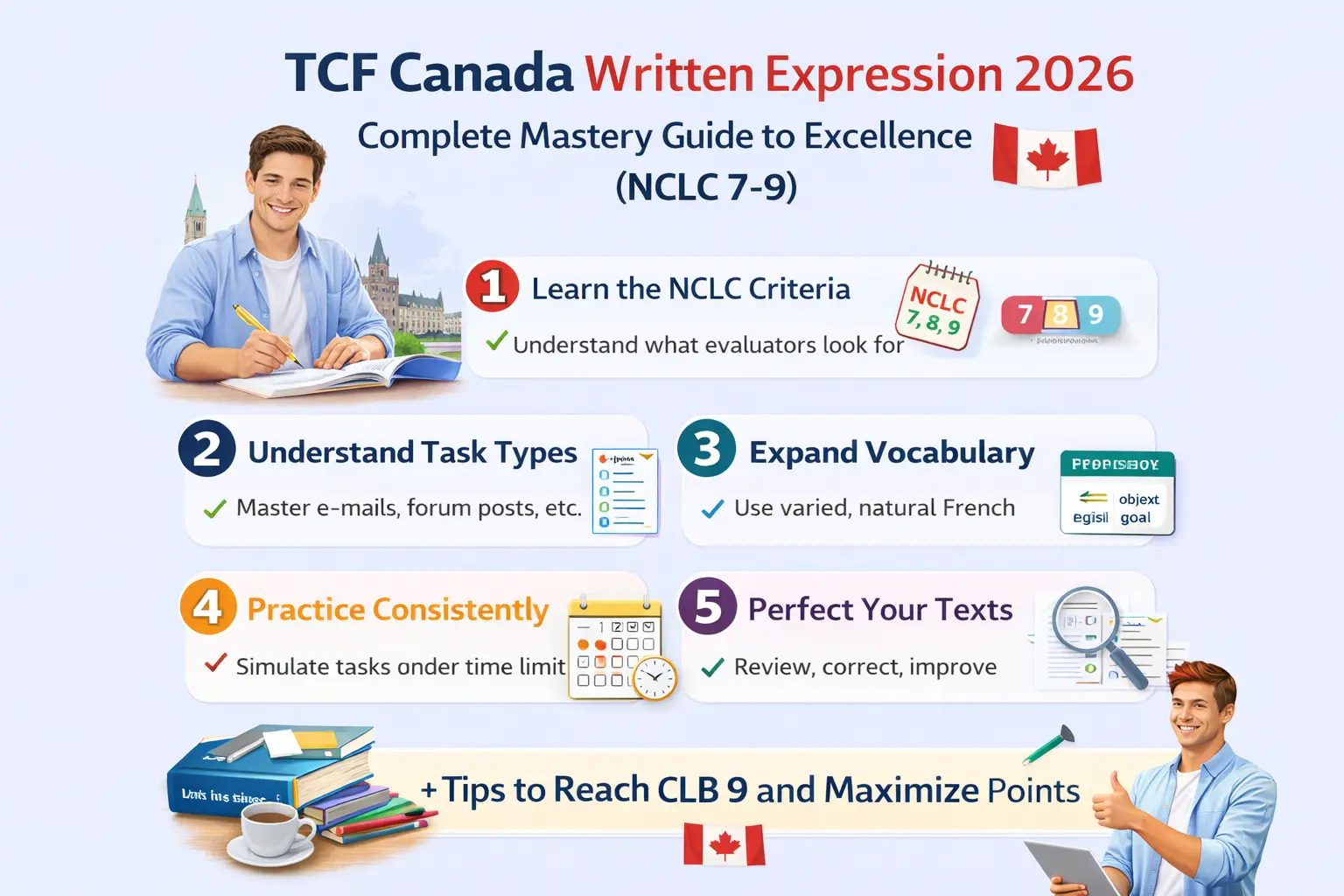
For complete written expression mastery including all 7 argumentation structures, advanced connector lists, and 50+ practice prompts, see our TCF Canada Written Expression 2026: Complete Mastery Guide.
Oral Expression: Overcome Performance Anxiety
Oral expression terrifies many candidates. TCF Canada evaluates spontaneous expression, coherent argumentation, and natural interaction—all under time pressure (12 minutes total for 3 tasks).
TCF Canada 2026 Oral Format:
- Task 1 - Interview: Personal questions (2 minutes, no preparation)
- Task 2 - Information Exchange: Role-play problem-solving (4 minutes: 1 min prep + 3 min response)
- Task 3 - Argumentation: Defend position on societal topic (5.5 minutes: 1.5 min prep + 4 min response)
Progressive Desensitization Program (12 Weeks):
- Weeks 1-3: Private daily recordings (10-15 min), personal topics, build confidence
- Weeks 4-6: Structured task practice with timing, internalize frameworks
- Weeks 7-9: Native speaker interaction 2-3x weekly (tutors or exchange partners)
- Weeks 10-12: Full test simulations under exact conditions, target consistent NCLC 8-9
For comprehensive oral strategies including pronunciation guides, fluency techniques, and 100+ practice prompts, see our TCF Canada Oral Expression Mastery Guide 2026.
Phase 4: TCF Canada Specialization (Months 4-6)
Familiarization with Exact Exam Format
Knowing the precise TCF Canada format provides considerable advantage. Familiarity reduces stress and optimizes time management—often worth 1-2 CLB levels in performance.
TCF Canada 2026 Complete Format:
Listening Comprehension
- Duration: 35 minutes (audio controlled)
- Questions: 39 multiple-choice (4 options each)
- Accents: 35-40% Quebec French, remainder varied
- Repetition: Audio plays ONCE only
Reading Comprehension
- Duration: 60 minutes (self-paced)
- Questions: 39 multiple-choice (4 options each)
- Texts: 5-6 different texts (100-450 words)
- Time Management: Average 1.5 minutes per question
Written Expression
- Duration: 60 minutes (strictly enforced)
- Tasks: Task 1 (60-120 words, 15 min) → Task 2 (120-150 words, 23 min) → Task 3 (120-180 words, 22 min)
- Critical: All 3 tasks must be completed
Oral Expression
- Duration: 12 minutes total (individually recorded)
- Tasks: Interview (2 min) → Information exchange (4 min: 1 prep + 3 response) → Argumentation (5.5 min: 1.5 prep + 4 response)
Specific Strategies by Section
Section-Specific Approaches:
Listening Strategies
- Read questions + answers BEFORE audio (anticipate what to listen for)
- Active note-taking: keywords, numbers, names
- Eliminate distractor answers containing keywords but incorrect meaning
- Always answer every question (no penalty for wrong answers)
Reading Strategies
- Read questions before detailed text reading
- Don't spend more than 2 minutes on single question
- Use context clues for unknown vocabulary
- Base inference answers on text evidence, not opinion
Writing Strategies
- Strict checkpoints: 15 min (Task 1 done) → 38 min (Task 2 done) → 55 min (Task 3 done) → 60 min (review complete)
- Outline before writing (1-2 min prevents disorganization)
- Verify Canadian context in Tasks 2-3 before moving forward
- Use diverse advanced connectors consciously
Speaking Strategies
- Use EVERY second of preparation time
- Speak continuously—fluency weighted heavily
- Use structural signposting: "Premièrement," "En conclusion"
- Speak slightly slower than natural pace for clarity
Phase 5: Optimization and Practice Tests (Months 7-8)
Crucial Importance of Practice Tests
Practice tests serve four essential objectives: evaluate progress, identify weaknesses, accustom to exam conditions, refine strategies. Complete minimum 10-15 full tests in the two months preceding your exam.
Practice Test Methodology:
Before Test: Simulation Preparation
- Schedule 3-hour uninterrupted block
- Eliminate distractions (phone off, quiet environment)
- Use authentic test materials
During Test: Exact Simulation
- Strict timing with visible countdown timer
- No pauses, no resources (dictionary, grammar references)
- Record oral responses for later review
After Test: Comprehensive Analysis
- Immediate scoring of listening/reading sections
- Categorize each error by type (vocabulary gap, comprehension failure, time pressure, strategic error)
- Track scores in spreadsheet to visualize progress
- Create remediation plan for next 4-5 days
Correcting Last Weaknesses
The final two months serve to polish skills and eliminate persistent weaknesses through targeted remediation.
Common Weakness Remediation:
- Number Comprehension in Listening: Daily 15-min practice with French news statistics, phone numbers, dates, financial amounts
- Administrative Vocabulary Gap: Memorize 150-200 administrative terms using Anki (immigration, healthcare, housing, employment)
- Argumentation Coherence: Master 2-3 frameworks, practice outlining before writing/speaking, memorize 30 advanced connectors
- Time Management Failure: Daily timed micro-exercises focusing on weakest section until automatic pacing develops
Mental and Logistical Preparation (Final 2-3 Weeks)
Pre-Exam Stress Management
Stress constitutes the primary enemy of optimal performance. Complete preparation must integrate stress management techniques practiced regularly.
Proven Stress Management Techniques:
- Cardiac Coherence Breathing: 5 minutes rhythmic breathing (4 sec inhale → 4 sec hold → 6 sec exhale). Practice daily 2 weeks before exam
- Positive Visualization: 10-15 min daily visualizing successful performance. Brain rehearses success, creating neural pathways
- Confidence Routine: Create pre-exam ritual (music, motivational phrase, lucky item) used before every practice test
- Sleep Optimization: 8 hours night before exam. No screens 1 hour before bed, no late cramming
- Physical Exercise: 30-45 min daily moderate exercise in final week (walking, jogging, yoga)
Logistical Preparation
Essential Logistical Checklist (Complete 1 Week Before):
- ✓ Verify exact test center address, visit location in advance if unfamiliar
- ✓ Plan transportation with 30-minute safety margin
- ✓ Valid passport/ID (exact document used for registration)
- ✓ Test confirmation email (printed + digital backup)
- ✓ Permitted materials: pencils, erasers, water (clear bottle), reliable watch
- ✓ Understand recording equipment (oral expression)
D-Day: Exam Execution Strategies
Optimal Time Management
Optimal Written Expression Timing (60 minutes total):
- Task 1 (60-120 words): 12-15 minutes (2 min planning + 8-10 min writing + 2-3 min review)
- Task 2 (120-150 words): 23-25 minutes (3-4 min planning + 15-17 min writing + 4-5 min review)
- Task 3 (120-180 words): 20-22 minutes (3 min planning + 13-15 min writing + 4 min review)
- Final Review: 3-5 minutes (systematic grammar check, verify all tasks completed, Canadian context present)
Success Mentality
Psychological Strategies for Peak Performance:
- Section Independence: Each skill evaluated independently. Poor performance in one section doesn't affect others—reset mentally between sections
- Perfectionism Trap: Target strong B2/C1 (NCLC 8-9), not absolute perfection. Minor errors acceptable
- Difficult Question Protocol: Acknowledge "this is hard," make best guess, move on immediately
- Focus on Controllables: Control preparation, effort, strategy, attitude. Don't worry about specific questions or test difficulty
- Break Utilization: Use 5-10 min breaks for bathroom, water, stretching, breathing, mental reset
After Exam: Results Analysis and Next Steps
TCF Canada results arrive within 2-3 weeks in 2026 (improved from 3-4 weeks due to digital scoring). Results include numerical scores, NCLC levels, official attestation.
Results Action Plans:
Scenario 1: All Scores Meet Target
- Immediately update Express Entry profile with new scores
- Upload official attestation within 48 hours
- CRS recalculated within 24-48 hours
- Continue French exposure while awaiting ITA
Scenario 2: Scores Close to Target (1-2 points below)
- Analyze specific weaknesses causing point loss
- Decide if retake worthwhile based on immigration timeline
- Focus 4-6 weeks intensive work ONLY on weak skills
- Book retest 6-8 weeks out
Scenario 3: Significant Gaps Remain (3+ levels below)
- Honest assessment: preparation inadequate or timeline too compressed
- Extend preparation 3-6 months, consider professional tutoring
- If one skill dramatically weaker, dedicate 60-70% time to that skill
- Consider structured program (Alliance Française, online course)
Conclusion: Keys to TCF Canada Success in 2026
Essential Success Principles (Evidence-Based 2026):
- Method Over Magic: Systematic methodology produces results far more reliably than sporadic efforts or "secret tricks"
- Regularity Over Intensity: Daily 90-minute focused practice dramatically outperforms weekend 10-hour marathons
- Balance Across Skills: Equal attention to all four competencies prevents devastating score imbalances
- Canadian Integration Mandatory: 2026 requires explicit Canadian context, Quebec accent comprehension, Canadian vocabulary mastery
- Practice Tests Essential: Minimum 10-15 full simulations build test-taking stamina and refine strategies
- Professional Feedback Critical: Oral and written production require expert correction—self-study insufficient for NCLC 9
- Realistic Timelines: 6-12 months preparation standard depending on starting level. Rushing leads to disappointment
- Stress Management Non-Optional: Mental preparation and stress techniques as important as language skills
To remember: Preparing for TCF Canada in 2026 requires method, regularity, and personal adaptation. An investment of 6-12 months depending on your initial level constitutes the norm for reaching competitive scores (NCLC 8-9). The key lies in balance between general linguistic development and specific familiarization with TCF Canada format and Canadian context requirements.
Your success depends less on your initial level than on your capacity to follow rigorous methodology and persevere despite difficulties. Each hour invested in intelligent preparation brings you closer to your Canadian immigration objective. With commitment, proper methodology adapted to 2026 requirements, and consistent effort, reaching B2 or C1 levels (CLB 8-10) is absolutely attainable for motivated candidates from any background.
Your Next Steps (Start Today):
- This Week: Take diagnostic test to establish baseline, set SMART objectives, book test date 8-12 weeks out
- Week 1: Purchase essential resources, create detailed study schedule, begin daily immersion routine
- Week 2: Launch systematic skill development, consider enrolling in course or scheduling tutoring
- Month 2: Complete first practice test, analyze weaknesses, adjust strategy accordingly
- Ongoing: Maintain daily discipline, track progress weekly, stay motivated through community support
* * *
Laissez un commentaire
Votreadresse email ne sera pas publie. Les champs obligatoires sont marque avec *
 TCF Canada Hub
0 Commentaires
aucun commentaire
Soyez le premier a partager votre avis !