-
Auteur :
 TCF Canada
- Aug 31, 2026
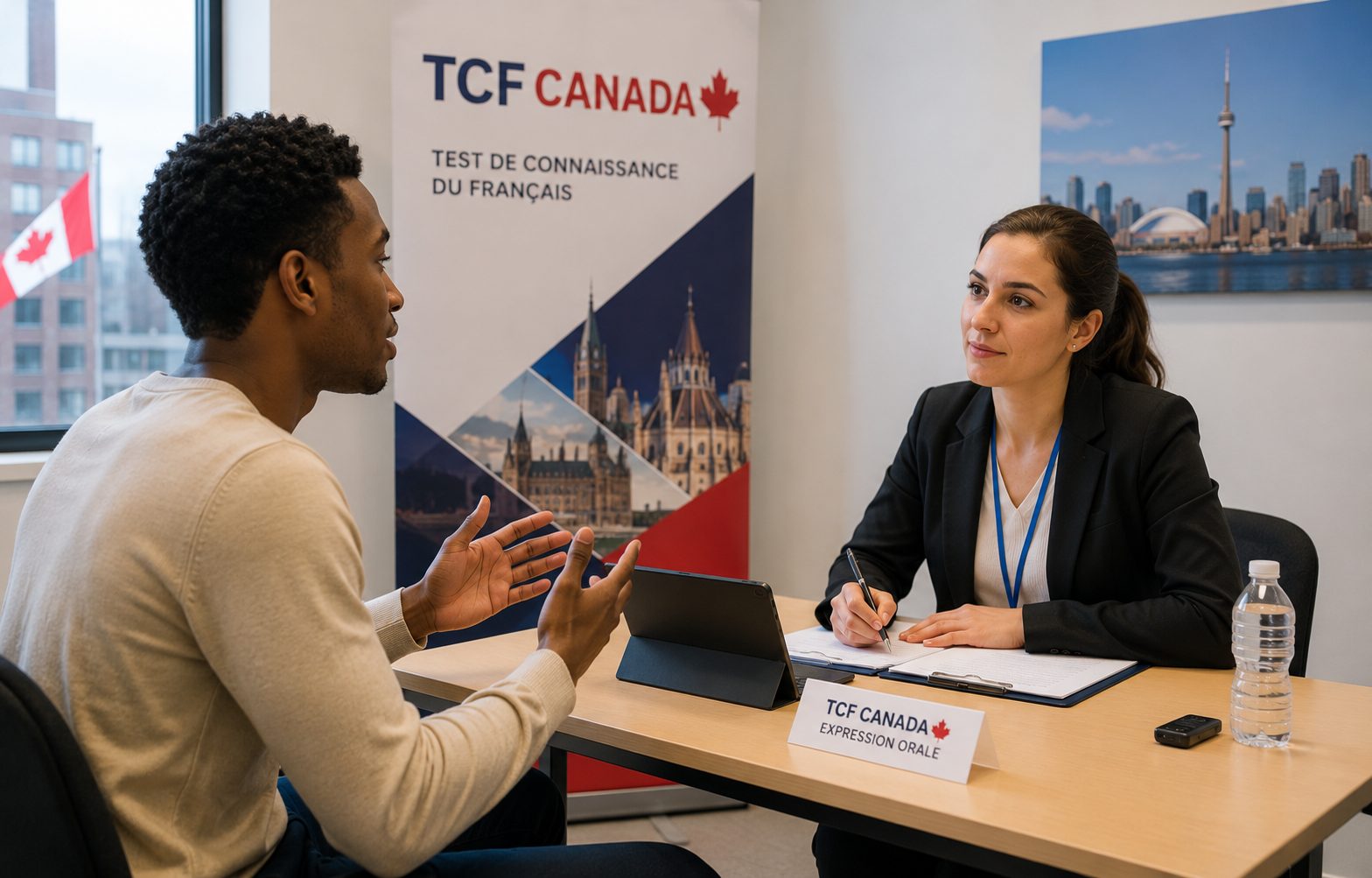
While Task 3 of the TCF Canada speaking component receives most preparation attention, Tasks 1 and 2 represent 40% of your oral expression score — and many candidates underperform them not for lack of language ability, but for lack of task-specific understanding. Task 1 (descriptive monologue) and Task 2 (practical interaction) require different techniques, different vocabulary sets and different timing strategies than Task 3. This guide covers both in complete detail.
Task 1 — Description (1 minute): What the Evaluator Looks For
Task 1 specifications:
- Format: You are presented with an image (or described scenario) and must describe it for 1 minute
- Preparation time: 30-45 seconds to organize your description
- Evaluation focus: Vocabulary richness, descriptive precision, logical spatial/temporal organization, grammatical control
- Common topic types: Urban scenes, workplace situations, social events, nature or Canadian landscapes, daily life situations
The LOCATE-IDENTIFY-DESCRIBE-INTERPRET framework for Task 1:
- L (Locate — 10 sec): "Cette image nous montre une scène dans [un parc municipal / une salle de réunion / un quartier commercial] — le cadre est [urban/rural/intérieur]."
- I (Identify main elements — 20 sec): "Au premier plan, on aperçoit [éléments principaux]. À l'arrière-plan, on distingue [éléments secondaires]."
- D (Describe actions and relationships — 20 sec): "Les personnages semblent [activité]. L'ambiance générale est [atmosphère]. On remarque [détail significatif]."
- I (Interpret or conclude — 10 sec): "Cette scène illustre [thème / message / réalité canadienne]. Elle nous rappelle [connexion avec la vie quotidienne]."
Task 1 High-Value Descriptive Vocabulary
Vocabulary upgrades that signal NCLC 8-9 in Task 1:
- Instead of "il y a" → "on aperçoit / on distingue / on remarque / se trouve / est visible"
- Instead of "les gens font" → "les protagonistes semblent / paraissent / s'affairent à / sont en train de"
- Instead of "grand" → "imposant / massif / dominant / de grande envergure"
- Instead of "beau" → "pittoresque / soigné / harmonieux / bien entretenu"
- Spatial vocabulary: "au premier plan / à l'arrière-plan / au centre de l'image / dans l'angle supérieur gauche / à proximité de"
Task 2 — Practical Interaction (90 seconds): The Simulation Format
Task 2 specifications:
- Format: You receive a scenario presenting a practical situation and must respond as if speaking to the person described (service provider, colleague, neighbour, official)
- Duration: 90 seconds — longer than Task 1, shorter than Task 3
- Evaluation focus: Appropriateness of register, task completion (all requested elements addressed), communicative effectiveness, politeness conventions
- Common scenarios: Calling a doctor's office, leaving a voicemail for a colleague, speaking to a housing authority, contacting a school, describing a problem to a service agent
Annotated Task 2 model response:
Scenario: "Vous devez appeler votre médecin de famille pour prendre rendez-vous. Vous avez des douleurs au dos depuis trois jours et devez travailler debout toute la journée. Vous souhaitez un rendez-vous urgent et préférez l'après-midi."
[Opening — establish context formally] "Bonjour, je vous appelle pour prendre un rendez-vous avec le Dr [X]. Mon nom est [Y] et je suis patient·e depuis [Z] ans dans votre cabinet."
[Problem statement — precise and clinical] "Je souffre de douleurs lombaires assez intenses depuis maintenant trois jours, qui s'aggravent considérablement lorsque je maintiens une position debout prolongée, ce qui est malheureusement inévitable dans le cadre de mes activités professionnelles."
[Request — clear with constraints] "Dans ces circonstances, je souhaiterais obtenir une consultation dans les plus brefs délais, idéalement en début de semaine prochaine. Si cela est possible, je préférerais un créneau en après-midi, après 14h00, afin de pouvoir organiser mon planning de travail en conséquence."
[Closing — polite and complete] "Je reste joignable au [numéro] et suis prêt·e à rappeler si nécessaire. Je vous remercie de votre disponibilité et vous souhaite une excellente journée."
Analysis: Register ✓ formal throughout | Task completion ✓ all elements | Politeness conventions ✓ | Duration ✓ ~85 seconds
The 5 Register Errors That Kill Task 2 Scores
Register errors to eliminate from Task 2:
- "Salut" as an opening → "Bonjour" always, in any formal interaction
- "C'est moi [Name]" → "Je m'appelle [Name] / Mon nom est [Name]"
- "J'ai mal au dos" (too casual) → "Je souffre de douleurs lombaires / dorsales"
- "Je veux un rdv" → "Je souhaiterais / j'aimerais obtenir un rendez-vous"
- Ending abruptly → always close with: "Je vous remercie / Bonne journée / Cordialement"
For the complete Task 3 mastery guide covering opinion defence argumentation, read Mastering TCF Canada Task 3. For the advanced speaking techniques covering all three tasks simultaneously, see Mastering TCF Canada Speaking: Advanced Techniques. The 15 proven speaking techniques guide is at Mastering TCF Canada Speaking: 15 Proven Techniques. For the phrase bank covering Tasks 1, 2 and 3 formulas, read Your Personal TCF Canada Phrase Bank: 54 Formulas. The French companion task guide is at Maîtriser l'Expression Orale TCF Canada. For voice coaching to improve prosody and delivery across all tasks, see Voice Coaching for TCF Canada. The French voice coaching guide is at Coaching Vocal TCF Canada. For integrating speaking practice into a structured preparation plan, see Strategic TCF Canada Planning: The 3-Month Method. The recording strategy guide for self-coaching oral tasks is at TCF Canada Psychology: Conquering Anxiety on Test Day. For the grammar structures that improve oral production quality, see TCF Canada Grammar Mastery: 20 Critical Structures.



 TCF Canada Hub
0 Commentaires
aucun commentaire
Soyez le premier a partager votre avis !