-
Auteur :
 TCF Canada
- Jan 08, 2026
TCF Canada Preparation: A Practical Success Guide for International Candidates
- Blog
- /
- Article
The TCF Canada is an essential French language test for candidates worldwide who wish to immigrate to Canada through Express Entry or other immigration programs. While many countries offer this test at approved centers, achieving success in TCF Canada requires serious and well-adapted preparation.
2026 Update: With Canada's immigration targets reaching 500,000 newcomers annually and enhanced emphasis on Francophone immigration (particularly outside Quebec), TCF Canada has become increasingly competitive. Recent IRCC data shows that candidates with CLB 9+ French proficiency receive Express Entry invitations up to 6 weeks faster than those at CLB 7-8 levels, and benefit from substantial CRS point advantages.
This comprehensive guide provides international candidates with practical, actionable strategies for TCF Canada success in 2026. Whether you're taking the test in Paris, Casablanca, Beirut, Dakar, Mexico City, or any of the 150+ global test centers, this guide will help you navigate the preparation process effectively.
1. Finding TCF Canada Test Centers Globally (2026 Update)
The TCF Canada is administered at authorized test centers worldwide, including Alliance Française institutions, French cultural centers, and approved testing facilities in major cities across six continents. The global network has expanded significantly in 2026, with new centers opening in high-demand regions.
2026 Test Center Landscape
TCF Canada is now available in over 150 test centers across 60+ countries, with particularly strong presence in:
- North Africa: Morocco (Casablanca, Rabat, Marrakech), Tunisia (Tunis, Sfax), Algeria (Algiers, Oran)
- Sub-Saharan Africa: Senegal (Dakar), Côte d'Ivoire (Abidjan), Cameroon (Yaoundé, Douala), DRC (Kinshasa)
- Middle East: Lebanon (Beirut), UAE (Dubai, Abu Dhabi), Egypt (Cairo)
- Europe: France (Paris, Lyon, Marseille, Toulouse), Belgium (Brussels), Switzerland (Geneva, Zurich)
- Asia-Pacific: Vietnam (Hanoi, Ho Chi Minh City), India (New Delhi, Mumbai), China (Beijing, Shanghai)
- Americas: Mexico (Mexico City), Brazil (São Paulo), Haiti (Port-au-Prince)
Critical 2026 Booking Recommendations
- Book Early: Reserve your test spot 8-12 weeks in advance, particularly in high-demand centers (Casablanca, Beirut, Paris, Abidjan). Sessions now fill up within 48-72 hours of opening in major cities.
- Registration Fees (2026): Typically range between $250-$350 USD depending on location and local cost structure. Some centers offer slight discounts for early registration or repeat test-takers.
- Registration Process: Done directly through the test center's website. Most centers now use France Éducation international's centralized booking platform for streamlined registration.
- Results Timeline: Generally available within 2-3 weeks of the test date in 2026 (improved from 3-4 weeks in previous years due to digital scoring enhancements).
- Digital Results: All centers now provide digital attestations immediately upon result release, with official paper certificates following within 5 business days.
- Test Frequency: Most major centers offer TCF Canada sessions 2-4 times monthly; smaller centers may offer monthly or bi-monthly sessions.
Finding Your Test Center: Use the official France Éducation international TCF Canada portal to locate authorized centers in your region. For detailed guidance on selecting the optimal test center based on your location, scheduling needs, and preparation timeline, see our comprehensive TCF Canada Test Centers Guide 2026: Global Directory and Registration Tips.
2026 Registration Challenges to Avoid
- Peak Season Congestion: September-November and January-March are peak immigration application periods. Test slots fill extremely rapidly during these months.
- Documentation Requirements: Ensure you have valid passport and all required documentation before registration. Some centers now require payment confirmation within 24 hours or spots are released.
- Cancellation Policies: Most centers offer partial refunds (50-70%) if cancelled 2+ weeks before test date; no refunds for cancellations within 14 days of test.
- Rescheduling: Limited rescheduling options in high-demand centers. Plan accordingly and avoid booking during periods with potential scheduling conflicts.
2. Effective Preparation Strategies for 2026
Successful TCF Canada preparation in 2026 requires a strategic, multi-faceted approach combining independent study, structured learning, and practical application. The key is understanding that TCF Canada tests functional language proficiency in Canadian contexts, not academic French knowledge.
a) Independent Study Approach (Enhanced 2026 Methods)
Self-directed learning remains the foundation of TCF Canada preparation, particularly for motivated candidates with intermediate-to-advanced French proficiency (B1+). The 2026 digital landscape offers unprecedented access to authentic French content.
Reading Comprehension Development
- Canadian News Sources: Prioritize Radio-Canada, La Presse, Le Devoir for authentic Canadian French exposure and current affairs knowledge.
- French International Media: Supplement with Le Monde, Le Figaro, RFI for vocabulary breadth and international perspective.
- Daily Reading Goal: Minimum 30-45 minutes daily across diverse topics (politics, economy, culture, science, society). Focus on comprehension speed and vocabulary acquisition.
- Active Reading Techniques: Highlight unknown vocabulary, summarize paragraphs mentally, identify main ideas and supporting arguments—skills directly tested in TCF Canada reading comprehension.
Listening Comprehension Excellence
- Canadian French Accent Exposure: Essential for success. Listen to Radio-Canada Ohdio podcasts, Quebec news broadcasts, Canadian French YouTube channels daily.
- Francophone Radio: RFI (Radio France Internationale), France Inter, Europe 1 for accent variety and rapid speech comprehension.
- Podcast Recommendations: "Médium large" (Radio-Canada), "Les années lumière" (science), "Aujourd'hui l'histoire" (culture), RFI "Journal en français facile" (simplified news for learners).
- Progressive Difficulty: Start with "français facile" resources, gradually transition to authentic native-speed content. Aim for 60-90 minutes daily listening exposure.
- Active Listening Practice: Take notes while listening, summarize key points, identify speaker opinions versus facts—mirroring TCF Canada listening task requirements.
Oral Expression Development
- French Debates and Discussions: Watch TV5Monde debates, French political discussions, cultural roundtables to develop argumentation skills in French.
- Recording Practice: Record yourself responding to TCF-style prompts, then critically evaluate pronunciation, fluency, grammatical accuracy, vocabulary range.
- French-Speaking Communities: Engage online (French Discord servers, Reddit r/French, language exchange forums) and in-person if available.
- Shadowing Technique: Listen to native speakers and simultaneously repeat what they say—highly effective for pronunciation, intonation, and fluency development.
Written Expression Mastery
- Daily Writing Practice: Write minimum 200-300 words daily across different formats (personal messages, informative articles, argumentative texts).
- Timed Writing Sessions: Practice writing under 60-minute constraints to simulate actual test pressure and develop time management.
- Canadian Context Integration: Systematically incorporate Canadian examples, statistics, cultural references in all written practice—critical for 2026 scoring criteria.
- Grammar and Spell-Check Tools: Use BonPatron, Reverso, LanguageTool for error identification and correction learning.
For comprehensive self-study strategies tailored to each TCF Canada component, explore our detailed skill-specific guides: TCF Canada Reading Comprehension Mastery, TCF Canada Listening Strategies 2026, TCF Canada Oral Expression Excellence Guide, and TCF Canada Written Expression Complete Guide.
b) Structured Courses and Training Programs (2026 Options)
Many language schools and private centers globally now offer intensive courses specifically designed for TCF Canada. The structured approach provides systematic skill development, expert guidance, and peer interaction—particularly valuable for candidates needing significant proficiency improvement or preferring formal instruction.
Course Types and 2026 Pricing
- Alliance Française TCF Canada Programs: Most comprehensive global network. Typical 8-12 week programs, 6-10 hours weekly. Cost: $400-$800 USD depending on location and intensity.
- Private Language Schools: Specialized TCF Canada preparation courses. Often more intensive (15-20 hours weekly). Cost: $600-$1,200 USD for 6-8 week programs.
- University Language Centers: Many universities in Francophone countries offer TCF Canada preparation. Generally more affordable ($300-$600 USD) but less intensive.
- Online Live Courses: Increasingly popular in 2026. Global access, often more affordable ($250-$500 USD for 8-week programs), flexible scheduling.
- Private Tutoring: One-on-one preparation. Most expensive but highly customized. Cost: $30-$80 USD/hour depending on tutor expertise and location.
Critical Program Selection Criteria (2026)
✓ Verify that the program comprehensively covers all 4 competencies (listening comprehension, reading comprehension, oral expression, written expression). Many programs over-emphasize passive skills (reading/listening) while neglecting active production (speaking/writing).
- TCF Canada Specialization: Ensure program specifically targets TCF Canada, not generic French proficiency or other tests (TEF, DELF/DALF). Task formats and strategies differ significantly.
- Canadian French Exposure: Program should include Canadian French vocabulary, accent familiarization, cultural context training—not just European French.
- Practice Test Access: Quality programs provide multiple full-length practice tests with scoring and detailed feedback.
- Experienced Instructors: Verify instructors have specific TCF Canada teaching experience and ideally Canadian cultural knowledge.
- Small Class Sizes: Maximum 12-15 students for adequate individual attention, particularly for oral expression practice.
- Flexible Scheduling: Particularly important for working professionals. Evening and weekend options increasingly common in 2026.
"I initially attempted self-study for 3 months but plateaued at B1 level. Enrolling in an 8-week intensive TCF Canada program at Alliance Française Casablanca transformed my preparation. The structured approach, expert feedback on oral and written expression, and peer practice sessions were invaluable. I progressed from B1 to B2/C1 across all competencies and achieved CLB 9 overall on test day."
c) Online Training Resources (2026 Landscape)
The digital learning ecosystem for TCF Canada has expanded dramatically in 2026, offering unprecedented access to high-quality preparation resources regardless of geographic location.
Essential Online Resources (2026)
Official and Commercial Platforms
- France Éducation international: Official TCF administrator. Free sample questions, official practice tests (paid), comprehensive test information.
- Préparer TCF Canada: Specialized platform with simulation tests, skill-specific exercises, scoring feedback. Subscription: ~$30-50 USD monthly.
- TCF Canada Apps: Mobile applications for on-the-go practice (iOS/Android). "TCF Blanc," "TCF Canada Préparation," "RFI Savoirs" for listening practice.
- YouTube Channels: "Préparer TCF Canada," "Français avec Pierre," "InnerFrench" for comprehensive lessons, strategies, and practice materials.
Community and Peer Learning
- Facebook Groups: "TCF Canada Preparation," "Canada Immigration - French Test" (100,000+ members globally). Share experiences, resources, strategies, practice opportunities.
- Reddit: r/ImmigrationCanada, r/French for Q&A, resource recommendations, study partner connections.
- Discord Servers: Real-time French practice communities, study groups, conversation practice sessions.
- Study Groups: Virtual study groups via Zoom/Google Meet for mutual support, practice, and accountability.
Language Exchange and Conversation Practice
- Tandem Apps: Tandem, HelloTalk, Speaky for connecting with native French speakers (including Canadians) for language exchange.
- Online Tutoring Platforms: Preply, Italki, Verbling for affordable one-on-one lessons with native speakers ($10-40 USD/hour).
- Conversation Clubs: Online French conversation clubs and cafés for group practice sessions.
Specialized Training Platforms
- Corrections and Feedback Services: Platforms offering professional correction of written expression practice (WriteMentor, Lang-8 community corrections).
- Pronunciation Training: Forvo (pronunciation dictionary), Speechling (pronunciation feedback), French phonetics apps.
- Vocabulary Building: Anki (spaced repetition flashcards), Memrise, Quizlet for systematic vocabulary acquisition.
For curated collections of the best online resources organized by skill and proficiency level, visit our TCF Canada Online Resources Hub 2026.
3. Valuable Resources for International Candidates (2026 Edition)
Recommended Books (2026 Updated Editions)
- "Réussir le TCF Canada" (Hachette, 2025 edition): Most comprehensive preparation book. Includes full practice tests, strategies, vocabulary lists, audio content. Essential purchase (~$35-45 USD).
- "Objectif Express Canada" (CLE International): Excellent for intermediate-to-advanced learners. Focus on real-life Canadian situations.
- "TCF Canada Tests Complets" (PUG): Collection of 6 complete practice tests with detailed answer explanations.
- "ABC TCF Canada" (CLE International, 2024): Skill-by-skill breakdown with progressive exercises and strategies.
- "Le Français au Québec" (Guides de voyage Ulysse): Excellent resource for Canadian French vocabulary, expressions, cultural context.
- Grammar References: "Grammaire Progressive du Français" (Niveau Avancé), "Bescherelle: La Conjugaison pour tous"
Essential Websites and Digital Resources
- Official TCF Resources:
- Preparation Platforms:
- Préparer TCF Canada (subscription platform)
- RFI Savoirs (free French learning resources)
- TV5Monde - Apprendre le français
- Canadian Content Sources:
Podcasts and Videos (2026 Recommendations)
- Canadian French Podcasts:
- "Médium large" (Radio-Canada) - current affairs
- "Les années lumière" - science and technology
- "Aujourd'hui l'histoire" - history and culture
- "Moteur de recherche" - investigation and journalism
- French Learning Podcasts:
- RFI "Journal en français facile" (simplified daily news)
- "InnerFrench" (intermediate-advanced learners)
- "Français Authentique"
- YouTube Channels:
- "Préparer TCF Canada" (test-specific strategies)
- "Français avec Pierre" (comprehensive French learning)
- "InnerFrench" (listening comprehension)
- "Piece of French" (Canadian French specifics)
- TED Talks in French: Excellent for advanced listening comprehension and vocabulary building
Language Exchange Resources
- Apps: Tandem, HelloTalk, Speaky, ConversationExchange
- Online Communities: French Discord servers, Reddit r/French, language exchange forums
- Conversation Partners: Seek native French speakers (particularly Canadian) through language exchange platforms
- Online French Clubs: Virtual conversation practice groups meeting weekly via Zoom
For detailed reviews and recommendations on which resources work best at different proficiency levels and for specific skill development needs, consult our TCF Canada Resource Review and Recommendation Guide 2026.
4. Common Pitfalls for International Candidates (2026 Updated)
Understanding and avoiding these critical errors can save months of preparation time and prevent costly test failures. Based on analysis of thousands of candidate experiences in 2025-2026, here are the most common and impactful mistakes.
Critical Mistakes That Lead to Failure
✗ Assuming School-Level French is Sufficient for Immigration Purposes
Reality: School French (even advanced levels) typically focuses on grammar rules and literary analysis, NOT functional communication skills tested by TCF Canada. Many candidates with strong academic French backgrounds score only B1-B2 (CLB 5-7) on first attempt because they lack:
- Rapid comprehension of authentic native-speed speech
- Ability to produce coherent spontaneous oral responses under time pressure
- Functional vocabulary for real-life Canadian situations (healthcare, employment, housing, government services)
- Writing skills for practical communication (emails, articles, argumentative texts) rather than literary essays
2026 Solution: Even with strong school French background, invest minimum 2-3 months in TCF-specific preparation focusing on functional communication skills. Take diagnostic practice test early to identify gaps.
✗ Neglecting Oral Expression Practice (The Most Challenging Component for Many)
Statistics: Oral expression is the #1 weakness for international candidates, with average scores 1-2 CLB levels below other competencies. Many candidates achieve CLB 8-9 in reading/listening but only CLB 6-7 in speaking.
Why It's Challenging:
- Limited opportunities for authentic conversation practice outside Francophone countries
- Psychological pressure of speaking spontaneously in test environment
- Difficulty thinking and formulating complex arguments rapidly in French
- Lack of feedback on pronunciation, fluency, grammatical accuracy in self-study
2026 Solution: Dedicate 40-50% of preparation time to oral expression. Daily practice essential: record responses, use language exchange apps, hire conversation tutors (even 1-2 weekly sessions make dramatic difference), join French conversation groups. See our TCF Canada Oral Expression Mastery Guide for comprehensive strategies.
✗ Waiting Until the Last Minute to Book Your Test Date
2026 Reality: High-demand test centers (Casablanca, Beirut, Paris, Abidjan, Mexico City) fill up within 48-72 hours of session announcement. Waiting creates multiple problems:
- No available slots for 2-3 months, delaying immigration timeline
- Forced to choose inconvenient test dates disrupting optimal preparation timeline
- Increased stress and pressure as immigration deadlines approach
- May need to travel to distant cities at additional cost if local center full
2026 Solution: Book test date 8-12 weeks in advance immediately upon deciding to take TCF Canada. Can always reschedule if preparation needs adjustment (check cancellation policy). Early booking guarantees optimal timing aligned with preparation schedule.
✗ Focusing Exclusively on Grammar Without Developing Rapid Listening Comprehension
Common Pattern: Candidates spend 80% of preparation time on grammar exercises and reading, only 20% on listening. Result: excellent grammar knowledge but inability to comprehend native-speed audio in test environment.
TCF Canada Reality: Listening comprehension tests understanding of authentic conversations, interviews, announcements at natural native speed. No time to mentally translate or analyze grammar—must comprehend in real-time.
2026 Solution: Balance preparation: 25% reading, 25% writing, 25% listening, 25% speaking. Minimum 60-90 minutes daily listening exposure to authentic French content (podcasts, news, radio). Progress from learner-level to native-speed gradually. Active listening practice (taking notes, summarizing) essential. See TCF Canada Listening Comprehension Excellence Guide.
✗ Ignoring Canadian French Vocabulary and Expressions
Critical Error: Preparing exclusively with European French materials without Canadian French exposure. TCF Canada listening includes Quebec accents and Canadian vocabulary; topics reference Canadian society, policies, geography.
Examples of Differences:
- Canadian: "dépanneur" (convenience store) vs European: "épicerie"
- Canadian: "magasinage" (shopping) vs European: "shopping/courses"
- Canadian: "fin de semaine" (weekend) vs European: "week-end"
- Canadian: "char" (car, informal Quebec) vs European: "voiture"
- Pronunciation differences in Quebec accent (particularly vowel sounds)
2026 Solution: Incorporate Canadian French resources into preparation: Radio-Canada podcasts/news, Quebec films/TV series, Canadian French vocabulary lists. Essential for listening comprehension and cultural context understanding. Our guide Canadian French vs European French: Essential Differences for TCF Canada Success provides comprehensive comparison.
✗ Not Practicing Under Timed Conditions
Why This Matters: TCF Canada imposes strict time limits on all sections. Many candidates experience "time shock" during actual test:
- Written expression: 60 minutes for 3 tasks (many fail to complete Task 3)
- Oral expression: 12 minutes total including preparation time (feels extremely rushed)
- Reading: 60 minutes for 39 questions across diverse text types
- Listening: No control over audio speed or repetition
2026 Solution: All practice must be timed from Week 3 onward. Use timer religiously. Complete minimum 5-8 full-length timed practice tests under realistic conditions (no pausing, no dictionary, quiet environment) before test day. Develop automatic time management strategies for each section.
✗ NEW 2026: Neglecting Canadian Context Integration in Written/Oral Production
2026 Critical Update: Enhanced scoring criteria now explicitly reward Canadian perspective integration in Tasks 2-3 of written expression and argumentative tasks in oral expression. Failure to include Canadian references/examples/perspectives results in 3-4 point deductions.
Solution: Build "Canadian Context Database" of 50+ references (statistics, cities, policies, cultural values) for seamless integration. Practice making every argument/example Canadian-relevant. See our Building Canadian Context Knowledge for TCF Canada guide.
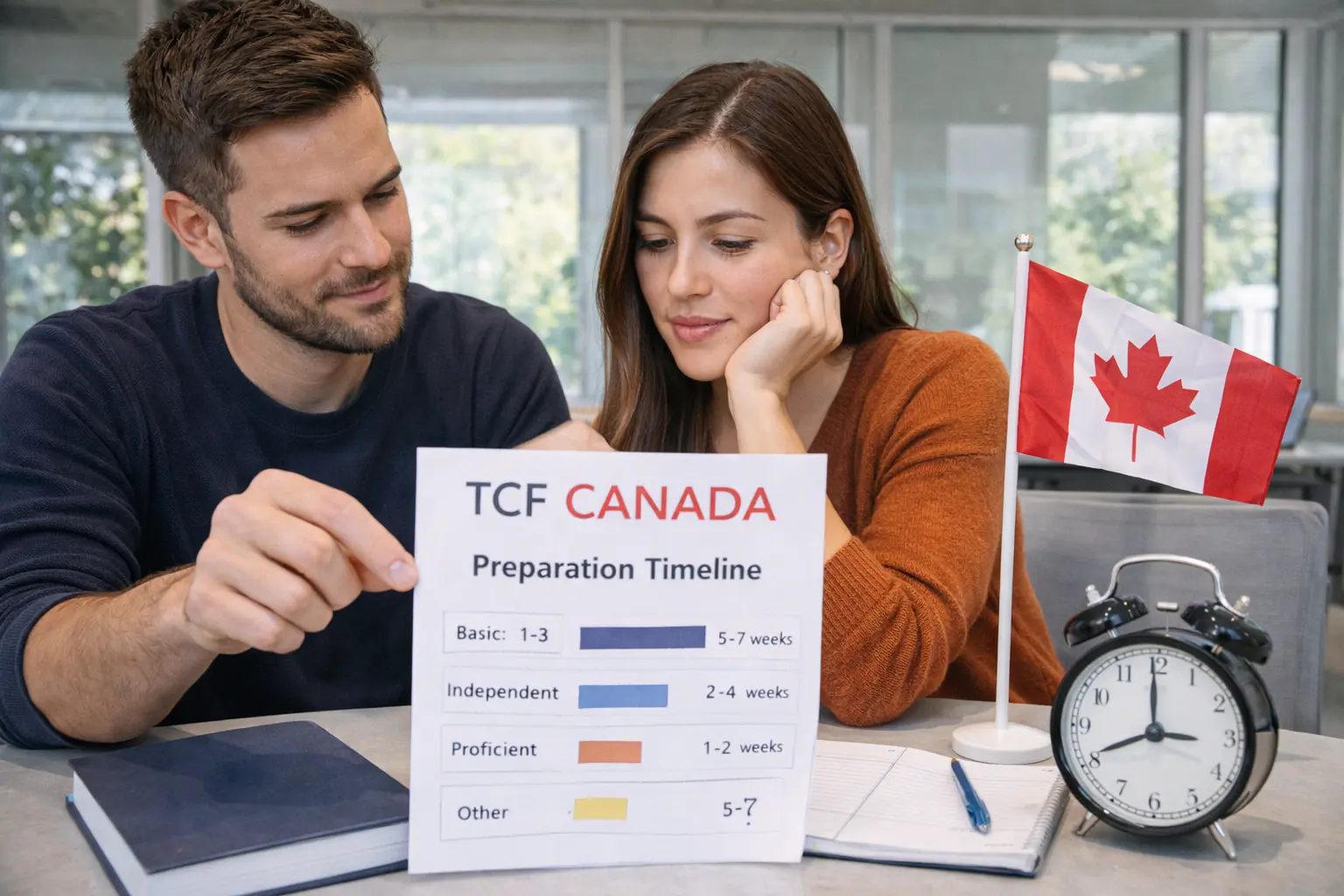
5. Sample Preparation Timeline: 12-Week Intensive Plan (2026 Optimized)
This enhanced timeline reflects 2026 best practices and includes Canadian context building, which has become essential. Adjust based on your starting proficiency level (add 4-8 weeks if starting below B1, reduce 2-4 weeks if already B2+).
Weeks 1-3: Foundation Building and Diagnostic Assessment
Week 1: Diagnostic and Resource Gathering
- Day 1-2: Take complete diagnostic practice test (timed) to establish baseline. Identify weakest competencies.
- Day 3-4: Gather resources: purchase preparation books, subscribe to online platforms, download apps, bookmark websites.
- Day 5-7: Create personalized study schedule based on diagnostic results. Set target scores for each competency.
- Daily: Begin French immersion—30 min reading, 45 min listening (Radio-Canada), 15 min vocabulary building.
Week 2: Grammar and Vocabulary Review
- Focus: Review essential grammar (verb tenses, agreements, pronouns, conjunctions, prepositions). Build core vocabulary (3,000-5,000 word target).
- Daily Schedule: 2 hours grammar exercises, 1 hour vocabulary (Anki flashcards), 1 hour reading practice, 1 hour listening (podcasts/news).
- Canadian Focus: Begin learning Canadian French vocabulary differences (create flashcard deck of 100+ Canadian terms).
Week 3: Establishing Daily Habits and Canadian Context Building
- Routine: Establish sustainable daily practice routine: Morning (1 hour reading + vocabulary), Afternoon (1 hour listening), Evening (1 hour writing + speaking practice).
- Canadian Context: Begin building database of Canadian references—research major cities, current policies, statistics, cultural values. Target: 20 references by week end.
- First Timed Practice: Complete one full section (reading or listening) under timed conditions to experience time pressure.
Weeks 4-6: Intensive Oral and Written Production Focus
Week 4: Oral Expression Launch
- Daily Oral Practice: 45-60 minutes minimum. Record responses to TCF-style prompts, self-evaluate, identify errors.
- Conversation Practice: Schedule 2-3 sessions with language exchange partners or tutors (30-60 min each).
- Shadowing: 20 minutes daily shadowing native speakers (Radio-Canada broadcasts) for pronunciation and fluency.
- Continue: Daily reading (45 min), listening (60 min), vocabulary (20 min).
Week 5: Written Expression Development
- Writing Practice: Complete 5-7 full written expression practice tests (all 3 tasks, 60 min) during week.
- Template Mastery: Study and internalize proven structural templates (SAFE for Task 1, STEEL for Task 2, Dialectical for Task 3).
- Canadian Integration: Practice incorporating Canadian context database references into all Task 2-3 responses. Target: Every practice includes 2-3 Canadian references.
- Feedback: Get professional correction on 2-3 best written samples to identify systematic errors.
- Continue: Daily oral (30 min), listening (60 min), reading (30 min).
Week 6: Balanced Skill Integration
- Equal Focus: All four competencies receive equal daily attention (1 hour each = 4 hours total daily study).
- Timed Practice: All practice now conducted under timed conditions simulating test pressure.
- Canadian Database: Expand to 35-40 Canadian references covering diverse topics (economy, environment, education, healthcare, immigration, culture).
- Midpoint Assessment: Complete full practice test (all 4 sections) to measure progress from Week 1 baseline.
Weeks 7-9: Advanced Development and Weak Point Targeting
Week 7: Listening Comprehension Intensification
- Listening Volume: Increase to 90-120 minutes daily across diverse sources (news, podcasts, debates, interviews).
- Quebec Accent: Dedicated exposure to Quebec French (minimum 40% of listening content). Watch Quebec films/series with French subtitles.
- Active Practice: Complete 5-7 full listening comprehension practice tests (timed). Focus on note-taking strategies and identifying key information rapidly.
- Continue: Oral (45 min), Writing (45 min), Reading (45 min) daily.
Week 8: Reading Comprehension Optimization
- Speed Reading: Practice reading rapidly while maintaining comprehension. Target: 250-300 words/minute with 80%+ comprehension.
- Diverse Texts: Exposure to all TCF text types (informative articles, argumentative texts, literary excerpts, practical documents, advertisements).
- Strategy Practice: Skimming, scanning, identifying main ideas vs. details, eliminating wrong answers systematically.
- Timed Tests: Complete 5-7 full reading comprehension practice tests at 60 minutes strict limit.
- Continue: Oral (45 min), Writing (45 min), Listening (45 min) daily.
Week 9: Weak Point Intensive Remediation
- Analysis: Review all practice test results from Weeks 1-8. Identify persistent weak areas (specific question types, skills, topics).
- Targeted Practice: Dedicate 60% of study time to weakest competency/skill. Use specialized exercises addressing specific weaknesses.
- Expert Help: Consider booking intensive tutoring sessions (3-5 hours total) focused specifically on weakest area.
- Canadian Context: Complete database to 50+ references. Practice rapid retrieval and integration.
Weeks 10-11: Full Test Simulations and Refinement
Week 10: Complete Test Simulations
- Full Tests: Complete 3 full-length tests this week (all 4 competencies, strict timing, realistic conditions—quiet room, no resources, timed breaks).
- Test Day Simulation: One test should fully simulate test day: wake at same time, eat same breakfast, travel to similar location, complete full test with breaks, self-score immediately after.
- Detailed Review: Analyze each test thoroughly—identify remaining errors, understand why each wrong answer was wrong.
- Score Tracking: Chart score progression across all practice tests. Verify you're consistently hitting target CLB levels.
Week 11: Refinement and Error Pattern Elimination
- Error Analysis: Create comprehensive list of all systematic errors from Weeks 1-10 (grammatical mistakes, vocabulary gaps, comprehension errors, time management issues).
- Targeted Correction: Dedicated practice eliminating each error pattern. Grammar drills for persistent mistakes, vocabulary review for gaps.
- Final Simulations: 2 additional full practice tests. Should consistently achieve target scores at this stage.
- Template Review: Refresh structural templates for written/oral expression. Ensure automatic execution without conscious thought.
Week 12: Final Preparation and Mental Readiness
Monday-Wednesday: Light Review
- Volume Reduction: Reduce to 2-3 hours daily to avoid mental fatigue before test.
- Review: Skim grammar notes, vocabulary lists, Canadian context database. No intensive new learning.
- Confidence Building: Review successful practice tests. Remind yourself of progress from Week 1 to Week 12.
- One Final Test: Complete one last full practice test Monday or Tuesday to stay sharp.
Thursday-Friday: Minimal Study, Maximum Rest
- Light Exposure: 30-60 minutes daily maximum. Listen to French podcasts, skim news articles—maintain language contact without stress.
- Physical Preparation: Adequate sleep (7-8 hours), healthy meals, light exercise, stress management.
- Logistics: Confirm test location/time, prepare required documents (passport, confirmation), plan transportation, pack water/snacks if permitted.
- Mental Preparation: Visualization exercises—imagine successfully completing each section calmly and competently.
Test Day
- Morning: Wake early, eat nutritious breakfast, arrive 30 minutes early, bring required documents, water, watch.
- Mindset: Confident, calm, focused. You've prepared thoroughly—trust your preparation.
- Strategy: Execute learned strategies automatically, manage time rigorously, stay calm if encountering difficult questions.
For detailed daily study schedules, exercise recommendations, and resource allocation across this 12-week timeline, download our Complete TCF Canada 12-Week Preparation Calendar 2026.
6. Understanding Canadian French Specifics (2026 Essential Knowledge)
One crucial aspect often overlooked by international candidates is the substantial difference between European French and Canadian French. TCF Canada explicitly includes Canadian French elements, and failure to prepare adequately for these differences is a common cause of unexpectedly low scores, particularly in listening comprehension.
Key Canadian French Characteristics in TCF Canada
Vocabulary Differences (High-Frequency Terms)
| Canadian French | European French | English Meaning | TCF Relevance |
|---|---|---|---|
| dépanneur | épicerie de proximité | convenience store | Very common in listening/reading |
| magasinage | shopping, courses | shopping | Frequent in everyday contexts |
| fin de semaine | week-end | weekend | Standard Canadian usage |
| char (Quebec informal) | voiture | car | May appear in informal dialogues |
| blonde/chum | copine/copain | girlfriend/boyfriend | Common in conversational contexts |
| souper | dîner | dinner/supper | Standard Canadian terminology |
| dîner | déjeuner | lunch | Important distinction |
| déjeuner | petit-déjeuner | breakfast | Different meal terminology |
| breuvage | boisson | beverage | Appears in service contexts |
| patate | pomme de terre | potato | Common colloquial term |
Pronunciation Differences (Quebec Accent)
- Vowel Sounds: Distinctive Quebec vowel pronunciation, particularly "i" sounds (often pronounced more closed/tense)
- "T" and "D" Before High Vowels: Often affricated in Quebec French ("tu" sounds like "tsu," "dire" sounds like "dzire")
- Nasal Vowels: Different quality than European French nasals
- Final Consonants: Sometimes pronounced where European French would be silent
- Overall Rhythm: Different intonation patterns and speech rhythm
- TCF Impact: 30-40% of listening comprehension audio features Quebec accents. Unfamiliarity causes significant comprehension difficulties.
Cultural References to Canadian Society
- Geography: Provinces (Quebec, Ontario, British Columbia, Alberta, etc.), major cities (Montreal, Toronto, Vancouver, Calgary, Ottawa, Quebec City)
- Government: Federal vs. provincial systems, Prime Minister, Parliament, provincial premiers
- Healthcare: Universal healthcare system, provincial health cards (e.g., carte soleil in Quebec)
- Education: CEGEP (Quebec college system), Canadian university structure
- Culture: Multiculturalism, bilingualism, Indigenous peoples, hockey, maple syrup, winter culture
- Climate: Long winters, seasonal activities, weather-related vocabulary
- Immigration: Express Entry, provincial nominee programs, permanent residence, citizenship
Practical Situations Specific to Life in Canada
- Common Topics: Apartment hunting, job searching, healthcare navigation, banking, education enrollment, winter preparation, public transportation
- Written Tasks: May ask you to write emails about Canadian-specific situations (requesting information about provincial programs, communicating with landlords, workplace communications)
- Oral Tasks: May involve role-plays set in Canadian contexts (doctor's appointments, job interviews, service interactions)
Preparation Strategies for Canadian French (2026)
- Daily Exposure: Minimum 40-50% of listening practice should be Canadian French sources (Radio-Canada, Quebec podcasts, Canadian French YouTube)
- Vocabulary Lists: Learn 150-200 high-frequency Canadian French terms and expressions. Create Anki deck specifically for Canadian vocabulary.
- Quebec Media: Watch Quebec films and TV series with French subtitles ("Les Parent," "19-2," "Unité 9," Quebec cinema)
- Accent Familiarization: Initially challenging but becomes natural with consistent exposure over 4-6 weeks
- Cultural Knowledge: Research Canadian society, geography, government structure, social systems. Build cultural context understanding.
- Canadian Context Database: As discussed in written expression guide—50+ Canadian references essential for production tasks
For comprehensive coverage of Canadian French distinctions with extensive vocabulary lists, pronunciation guides, and cultural knowledge resources, see our detailed guide Canadian French vs European French: Complete Preparation Guide for TCF Canada 2026.
Conclusion: Your Path to TCF Canada Success in 2026
Preparing for TCF Canada as an international candidate is entirely achievable through dedicated study, strategic use of available resources (language schools, online platforms, study materials, conversation practice), and consistent practice across all four competencies. The keys to success remain fundamentally unchanged but require enhanced emphasis in 2026:
The 2026 TCF Canada Success Formula:
- Early Strategic Planning: Book test 8-12 weeks in advance, create comprehensive study plan based on diagnostic assessment, allocate 12-16 weeks minimum preparation time
- Balanced Skill Development: Equal attention to all four competencies (25% each), with extra emphasis on typically weak areas (oral expression for most candidates)
- Canadian French Integration: Mandatory 40-50% Canadian French exposure in listening practice, mastery of 150-200 Canadian vocabulary terms, comprehensive Canadian cultural/contextual knowledge
- Consistent Daily Practice: Minimum 3-4 hours daily for 12+ weeks, maintaining momentum through all phases of preparation
- Timed Test Simulation: Regular full-length practice tests under realistic conditions, developing automatic time management strategies
- Professional Feedback: Expert correction and guidance for oral and written production, particularly in final 4-6 weeks
- Resource Optimization: Strategic use of best available resources (quality over quantity), combination of free and paid materials, leveraging technology effectively
- Error Pattern Elimination: Systematic identification and correction of recurring mistakes through comprehensive review
- Mental Preparation: Stress management, confidence building, visualization, adequate rest before test day
"I started preparation in September 2025 with B1 level French from university courses completed years ago. Following this systematic approach—12 weeks intensive study, balanced skill development, heavy Canadian French exposure, weekly tutoring for oral practice, and 8 full practice tests—I achieved CLB 9 overall in January 2026 (NCLC 9 listening/speaking, NCLC 10 reading/writing). The key was treating preparation like a serious project with daily discipline, not sporadic casual study. The investment paid off with maximum Express Entry points and ITA within 6 weeks."
Remember: With commitment, proper methodology adapted to 2026 requirements, consistent effort, and strategic Canadian French integration, reaching B2 or C1 levels (CLB 8-10) is absolutely attainable for motivated international candidates from any background and starting proficiency level.
Your TCF Canada success journey begins with a single decision to commit fully to systematic preparation. The tools, resources, and strategies outlined in this guide provide everything needed to achieve your target scores and advance your Canadian immigration goals.
Next Steps to Begin Your Preparation:
- Today: Take free diagnostic practice test to establish baseline proficiency (available on France Éducation international website)
- This Week: Book test date 8-12 weeks out, purchase essential preparation materials, create personalized 12-week study schedule
- Week 1: Begin daily immersion routine (reading, listening, vocabulary building), gather all resources, establish study environment
- Week 2: Launch systematic skill development following timeline, consider enrolling in structured course or scheduling weekly tutoring
- Ongoing: Maintain daily discipline, track progress weekly, adjust strategies based on practice test results, stay motivated through community support
* * *
Laissez un commentaire
Votreadresse email ne sera pas publie. Les champs obligatoires sont marque avec *

 TCF Canada Hub
0 Commentaires
aucun commentaire
Soyez le premier a partager votre avis !