-
Auteur :
 TCF Canada
- Mar 21, 2026
TCF Canada for Entrepreneurs and Self-Employed Workers 2026: The Start-Up Visa Program and Non-Salaried Immigration Strategies
- Blog
- /
- Article
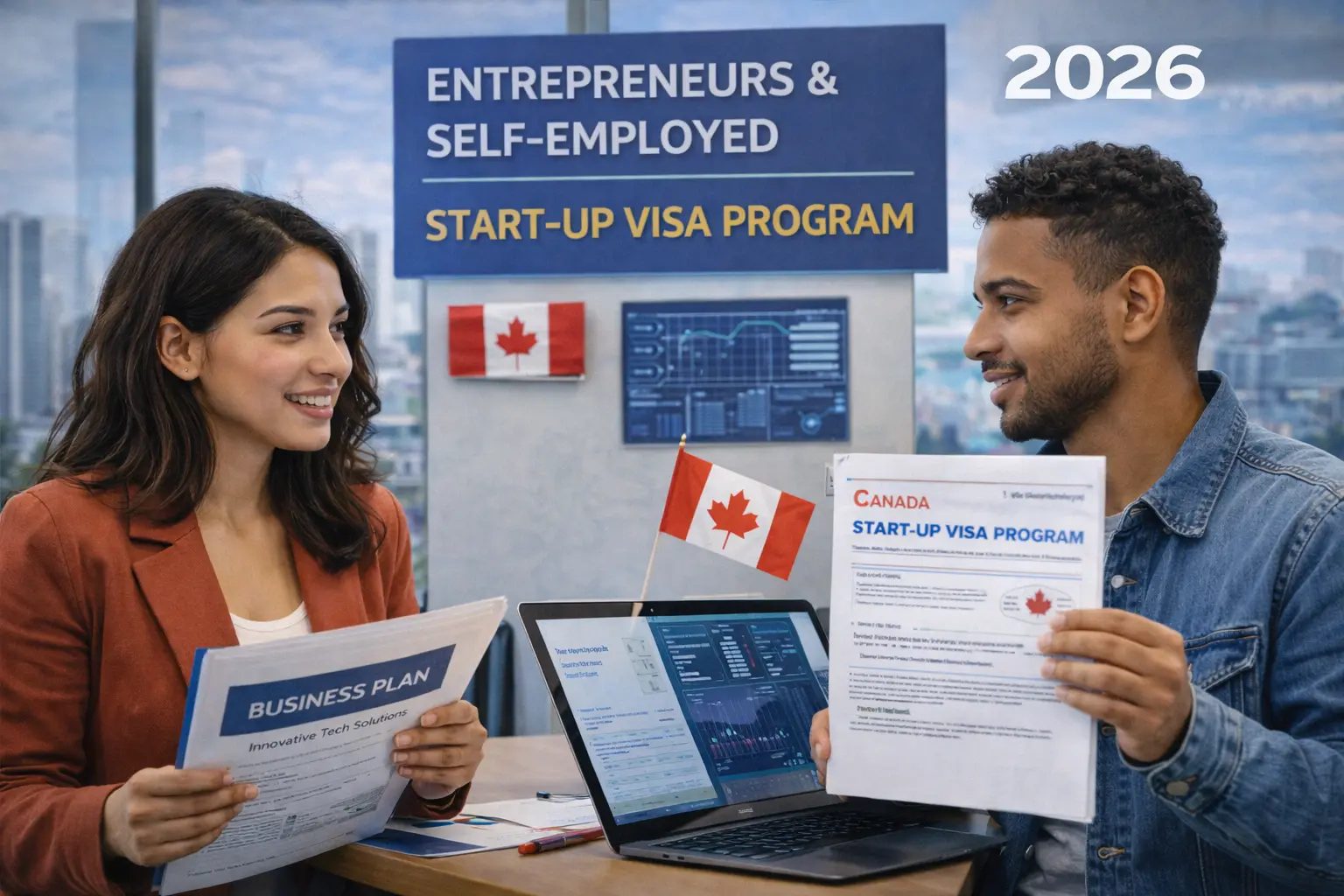
TCF Canada for Entrepreneurs and Self-Employed Workers 2026: The Start-Up Visa Program and Non-Salaried Immigration Strategies
When Sophia, a 38-year-old freelance digital marketing consultant based in Tunis with international clients (France, Belgium, Switzerland), began exploring Canada in early 2026, she assumed one thing: “Self-employed = immigration dead end.” Most of what she found online revolved around Canadian employers, job offers, LMIA steps, and closed work permits—almost nothing about freelancers, consultants, or founders.
“I thought I’d have to downgrade my business into a regular salaried job just to be ‘eligible,’” she explains from Vancouver, where she now runs a bilingual marketing agency with a growing team. “That idea was honestly depressing—my income was strong, my client base was stable, and I didn’t want to restart from zero.”
What changed everything was discovering that Canada has pathways where entrepreneurship is not a weakness—but a value signal. By building a credible business project, creating a Canadian corporate structure, and demonstrating real economic ties to Canada, Sophia positioned her profile around the one thing immigration programs love: measurable contribution. Her TCF Canada NCLC 9 wasn’t just a language certificate—it became a strategic tool to access francophone-friendly entrepreneurship ecosystems that many candidates never notice.
If you want to align your plan with the broader Express Entry logic, review: Canadian Immigration System and TCF Canada (Express Entry + language points) and How to Calculate Your TCF Canada Points for Immigration. Then come back here to see how entrepreneurs can build “non-salaried” pathways that still fit Canada’s rules.
The 3 Main Immigration Routes for Francophone Entrepreneurs (2026)
| Program | Best For | TCF Requirement | Minimum Investment | PR Timeline |
|---|---|---|---|---|
| 1) Federal Start-Up Visa | Innovative, scalable founders (often tech-driven) | NCLC 5+ (NCLC 7+ strongly recommended) | 0 CAD required as “capital” (key is support/validation) | 12–18 months (typical) |
| 2) Provincial Entrepreneur PNP Streams | Traditional businesses, local commerce, expansion projects | Varies (often NCLC 4–7 depending on province) | 150,000–600,000 CAD (province-dependent) | 24–36 months (typical) |
| 3) Self-Employed Hybrid Strategy | Freelancers/consultants who can build Canadian contracts | NCLC 7+ (competitive Express Entry standard) | 0 CAD (incorporation ~500 CAD) | 18–30 months (often via CEC-style logic) |
Route #1: The Start-Up Visa Program — The “Founder-First” Path
What Is Canada’s Start-Up Visa?
Core idea: If you have an innovative business concept that a designated Canadian organization agrees to support (typically an incubator/accelerator or approved investor group), you can apply for permanent residence before the company reaches full scale. In practice, the program rewards founders who can demonstrate structure, execution capacity, and market potential—not only “an idea.”
2026 Eligibility Criteria (Practical Breakdown)
| Criterion | Detailed Requirement | How You Prove It |
|---|---|---|
| Qualifying Business | Innovative + scalable, ideally with international growth potential | Business plan, pitch deck, early prototype/MVP if relevant |
| Letter of Support | Accepted by a designated Canadian incubator/accelerator or investor path | Official support letter issued after selection process |
| TCF Canada | Minimum NCLC 5 (all skills), but NCLC 7–8 improves credibility and execution confidence | Official TCF Canada results certificate |
| Settlement Funds | Approx. 13,310 CAD (single) up to 25,923 CAD (family 4+) | Bank statements (commonly 6 months) |
| Ownership Structure | At least 10% ownership (for multi-founder setups) | Shareholder agreement + incorporation records |
Francophone-Friendly Incubators Often Considered in Start-Up Visa Plans (2026)
| Incubator | City | Focus | Selectivity | Typical Support |
|---|---|---|---|---|
| Centech (ÉTS Montréal) | Montréal, QC | Deep tech, AI, IoT, cleantech | High (often 15–20% accepted) | Mentorship, seed ecosystem access, investor network |
| L-SPARK | Ottawa, ON | B2B SaaS, cloud, cybersecurity | Very high (often 10–15%) | Acceleration program, enterprise connections, funding pathways |
| Invest Ottawa | Ottawa, ON | General tech, health tech, fintech | Moderate (often 25–30%) | Workspace, mentorship, events and partnerships |
| Espace CDÉNÉ | Moncton, NB | Digital economy, e-commerce, mobile apps | Moderate (around 30%) | Bilingual FR–EN support, longer-term coaching |
| DMZ (Toronto) | Toronto, ON | Fintech, retail tech, media tech | Very high (<10%) | Large network, strong visibility, partner ecosystem |
Start-Up Visa: A Realistic End-to-End Timeline (Founder Workflow)
Phase 1: Build a “Pitchable” Project (Months 1–6)
- Months 1–2: Validate the problem (market research, user interviews, competitor mapping, early testing)
- Months 3–4: Create a strong pitch deck + business plan (if needed, hire help: 2,000–5,000 CAD)
- Months 4–5: Take TCF Canada (aim NCLC 7–8 to strengthen credibility and communication capacity)
- Months 5–6: Apply to multiple incubators (3–5 in parallel to diversify chances)
Phase 2: Selection and Support (Months 7–9)
- Month 7: Pitch interviews (virtual pitches via Zoom/Teams are often accepted)
- Month 8: Receive the letter of support (if accepted)
- Month 9: Incorporate in Canada (often online, ~500 CAD, ~2 weeks)
Phase 3: IRCC Application (Months 10–12)
- Submit the full application package (support letter + business docs + TCF + settlement funds proof)
- Fees: ~2,140 CAD (principal applicant) + ~1,040 CAD (spouse) + ~230 CAD/child
- Medical exams: typically 300–450 CAD per person
- Police certificates: commonly 50–150 CAD depending on country
Phase 4: Processing and Approval (Months 13–18)
- IRCC processing often falls in the ~12–16 month range (varies by case and volume)
- While waiting, a temporary work permit may be possible in some scenarios to start operations
- Receive COPR (Confirmation of Permanent Residence)
Typical Start-Up Visa Cost Structure
- Business plan / consultant support: 2,000–5,000 CAD
- TCF Canada: ~450 CAD
- Incorporation: ~500 CAD
- IRCC fees: ~2,140–4,000 CAD (family size dependent)
- Medical / police: ~500–1,000 CAD
- Settlement funds (proof, not “spent”): ~13,000–26,000 CAD
- Estimated out-of-pocket total: ~5,590–10,950 CAD (excluding settlement funds proof)
Route #2: Self-Employed Workers — The Hybrid Strategy (Freelancers & Consultants)
The Core Challenge for Self-Employed Profiles
Many immigration structures are built around the logic of paid employment. That doesn’t mean freelancers are excluded—it means you must translate your work into documentation that immigration systems recognize: contracts, invoices, structured payments, and clear role descriptions.
Strategy: “Canadian Incorporation + Canadian Clients”
Concept: Register a Canadian corporation, build Canadian contracts, generate trackable revenue through the corporation, and maintain strong documentation. The goal is to demonstrate real economic activity and professional continuity—without depending on a single employer.
Step 1: Incorporate in Canada (from abroad)
- Options: Ownr.co, LegalZoom.ca, or a Canadian lawyer (often 500–1,500 CAD)
- Choice: Federal corporation (operates nationwide) or provincial corporation (ON, BC, etc.)
- Typical timeline: 1–3 weeks
- You can formalize yourself as an employee/manager of your own Canadian corporation
Step 2: Acquire Canadian Clients
- Platforms: Upwork, Fiverr, LinkedIn services—filter for Canadian clients
- Network: industry groups, Canadian professional communities, niche forums
- Outbound strategy: targeted outreach to Canadian SMBs (expect modest conversion rates)
- Target: 3–5 major contracts over 12 months (10,000+ CAD each) to show serious activity
Step 3: Billing, Payments, and Proof
- Invoices issued by the Canadian corporation (professional letterhead)
- Payments received into a Canadian business account (some banks allow remote setup after incorporation)
- Canadian tax filings (corporate filings + personal payroll if you pay yourself a salary)
- Strongly recommended: a Canadian accountant (often 1,500–3,000 CAD/year)
Step 4: Immigration Application (when your proof is strong)
- After ~12 months of documented activity (e.g., 40,000+ CAD declared), you may be able to build a recognized “Canadian economic footprint”
- Potential routes include Express Entry logic or provincial alignment depending on where the business operates
- Evidence: client contracts, paid invoices, bank statements, tax documents, and client reference letters
Practical success factor: This strategy tends to work when you treat it like an audit—your documentation must be consistent, chronological, and hard to challenge. Strong French (NCLC 7–8) can significantly increase flexibility in francophone-focused streams.
Sophia’s Example (Simplified Case Table)
| Step | Timeline | Cost | Outcome |
|---|---|---|---|
| Incorporate “Sophia Digital Marketing Inc.” (BC) | January 2025 | 750 CAD | Legal entity operating in British Columbia |
| Open RBC Business account | February 2025 | 0 CAD (if minimum balance maintained) | Canadian business banking ready |
| Acquire 4 Canadian clients (LinkedIn + platforms) | Feb–May 2025 | 500 CAD (tools/subscriptions) | Contracts totaling ~85,000 CAD/year |
| Operate + accounting documentation | May 2025–May 2026 | 2,400 CAD | 12 months documented activity, ~92,000 CAD revenue |
| Provincial nomination strategy aligned to business | June 2026 | 3,500 CAD (fees + support) | Nomination (+600 CRS effect if applicable) |
| ITA step (Express Entry logic) | July 2026 | - | Invitation enabled by nomination boost |
| TOTAL | 18 months | ~7,150 CAD | Permanent Residence |
Why Entrepreneurship Can Be an Immigration Advantage (Not a Problem)
| Benefit | Traditional Employee | Entrepreneur / Self-Employed |
|---|---|---|
| Timeline Control | Depends on employer, LMIA, and hiring speed | You can create your own work structure and proof faster |
| Earning Potential | Often capped by salary band | Scales with business growth and clients |
| Geographic Flexibility | Usually tied to employer location | Remote-first options + broader province choice |
| Economic Contribution | One job (your role) | Potential to create Canadian jobs (highly valued) |
| Tax Structure | Limited deductions | More optimization options (legally) through business expenses |
Entrepreneurial Sectors Often Favored in 2026 (Practical Fit)
- B2B SaaS (subscription revenue, scalable models)
- Digital Agencies (marketing, design, web development)
- Specialized Consulting (IT, HR, finance, strategy)
- E-commerce (Shopify/Amazon brands, niche products)
- Cleantech / Greentech (environmental solutions, energy)
- Healthtech (telehealth tools, health platforms)
- Edtech (learning platforms, online training)
Entrepreneur Resources
Conclusion: Entrepreneurship Is a Lever—Not a Barrier
Sophia turned what many candidates view as a disadvantage (self-employment vs salaried work) into a strategic advantage. In 2026, entrepreneurship can support permanent residence through two powerful angles: Start-Up Visa logic (innovative projects supported by designated organizations) and hybrid self-employed strategies (Canadian incorporation + Canadian clients + documentation that survives scrutiny).
The winning formula is rarely “just an idea.” It’s execution: a credible plan, structured proof, and communication strength. Your TCF Canada score (NCLC 7–9) plays a real role because strong French improves access to francophone-focused ecosystems and strengthens how you pitch, negotiate, and integrate.
In 2026, entrepreneurship is not a closed door—it can be your fastest way to create your own Canadian work reality, control your timeline, scale your income, and build economic value that Canada wants. Your business can be your entry ticket—if you structure it properly. 🇨🇦
Related TCF Canada Hub Articles:
- Canadian Immigration System and TCF Canada: Understanding Express Entry & Language Points
- How to Calculate Your TCF Canada Points for Immigration
- Life in Canada: Cultural and Linguistic Context for Successful Integration
- TCF Canada Validity and Its Critical Impact on Your Immigration Timeline
- Complete TCF Canada Ultimate Guide 2026
- Strategic TCF Canada Planning: The Proven 3-Month Method
* * *
Frequently Asked Questions
The minimum required level is NCLC 5 in all four language skills (listening, speaking, reading, writing). However, aiming for NCLC 7 or higher is strongly recommended because it improves credibility with incubators and strengthens your overall immigration profile.
No. Self-employed professionals can use alternative strategies such as the Start-Up Visa or a hybrid model involving Canadian incorporation and Canadian clients. These pathways focus on economic contribution rather than traditional employer sponsorship.
There is no mandatory investment capital requirement. However, applicants must show settlement funds (approximately CAD 13,000 for a single applicant, higher for families) and cover processing, business preparation, and administrative costs.
Laissez un commentaire
Votreadresse email ne sera pas publie. Les champs obligatoires sont marque avec *




 TCF Canada Hub
0 Commentaires
aucun commentaire
Soyez le premier a partager votre avis !