-
Auteur :
 TCF Canada
- Mar 09, 2026
TCF Canada for Families 2026: Strategies for Spouse, Children, and Maximizing Family CRS Points
- Blog
- /
- Article

TCF Canada for Families 2026: Strategies for Spouse, Children, and Maximizing Family CRS Points
When Omar and Leila, a couple from Casablanca (Omar 36-year-old IT consultant, Leila 34-year-old French teacher), began their Canadian immigration project in early 2026, their first mistake was thinking "it's MY project, I'm the principal applicant, Leila just comes as an accompanying dependent." "I took my TCF Canada in February, obtained NCLC 8 everywhere, calculated my CRS: 445 points," Omar recounts from their home in Ottawa. "I was happy but worried - francophone draws oscillated 360-380 points, so technically sufficient, but not huge safety margin. It's my consultant who opened my eyes: 'Omar, your wife is a French teacher with a Master's in French Literature. If SHE takes TCF Canada and gets NCLC 9 (very likely given her profile), you gain +20 CRS points just for her accompanying spouse language competency. Even better: if you INVERT roles and LEILA becomes principal applicant and you accompanying spouse, her CRS will probably be 480-500+ because she has higher education + teaching experience + native-level French. You go from risky 445 CRS to ultra-comfortable 500+ CRS, just by strategically reorganizing who is principal vs accompanying.' We redid calculations: Leila principal applicant with TCF NCLC 10+ everywhere (she obtained near-perfect scores) + my TCF NCLC 8 as accompanying spouse + our 2 children = final CRS 512 points. Result: ITA received 3 weeks after profile creation, whereas if I had stayed principal applicant with 445 CRS, I might have waited 2-6 months. This strategic family reorganization saved us minimum 2-4 months waiting + increased ITA certainty from 70% to 99%. But here's the trap: 80% of families NEVER realize they can optimize their family configuration to maximize CRS. They traditionally leave 'the man of the family' as principal applicant even if wife has better linguistic/educational profile. This mistake costs on average 15-40 lost CRS points - difference between smooth immigration and blocked. Understanding TCF Canada 2026 family points mechanics isn't just 'a technical detail' - it's literally the hidden lever that transforms average family profile into competitive family profile."
Anatomy of Family CRS Points: Complete 2026 Demystification
The 3 Possible Family Configurations
| Configuration | Maximum Theoretical CRS Points | Spouse Impact | When to Use |
|---|---|---|---|
| 1. Principal Applicant Alone (Single) | 1,200 points | N/A | Single, divorced, widowed |
| 2. Principal Applicant + Accompanying Spouse | 1,200 points (BUT different distribution) | Spouse gives 0-40 pts by education/language | Married couple or common-law |
| 3. Principal Applicant + Non-Accompanying Spouse | 1,200 points (like single) | None (spouse immigrates separately later) | Rare - only if spouse decreases CRS |
CRS Points Detail - Principal Applicant WITH Spouse
| Category | Factor | Maximum Points | TCF Canada Impact |
|---|---|---|---|
| A. Human Capital Factors | Principal applicant age | 100 | Indirect (none) |
| Principal applicant education | 140 | Indirect (none) | |
| Principal applicant official language (1st language) | 150 | DIRECT - TCF scores here | |
| Principal applicant official language (2nd language) | 24 | DIRECT - English if bilingual | |
| B. Spouse Factors | Accompanying spouse education | 10 | Indirect |
| Accompanying spouse official language | 20 | DIRECT - Spouse TCF here! | |
| Spouse Canadian work experience | 10 | Indirect | |
| Total Possible Spouse Points | 40 | Up to 20 pts from spouse TCF | |
| C. Transferability | Education + Language + Experience combined | 100 | Indirect (main language boosts) |
| Canadian experience + Language | 100 | Indirect | |
| D. Other | Provincial nomination, job offer, Canadian study, sibling | 600+ | Indirect |
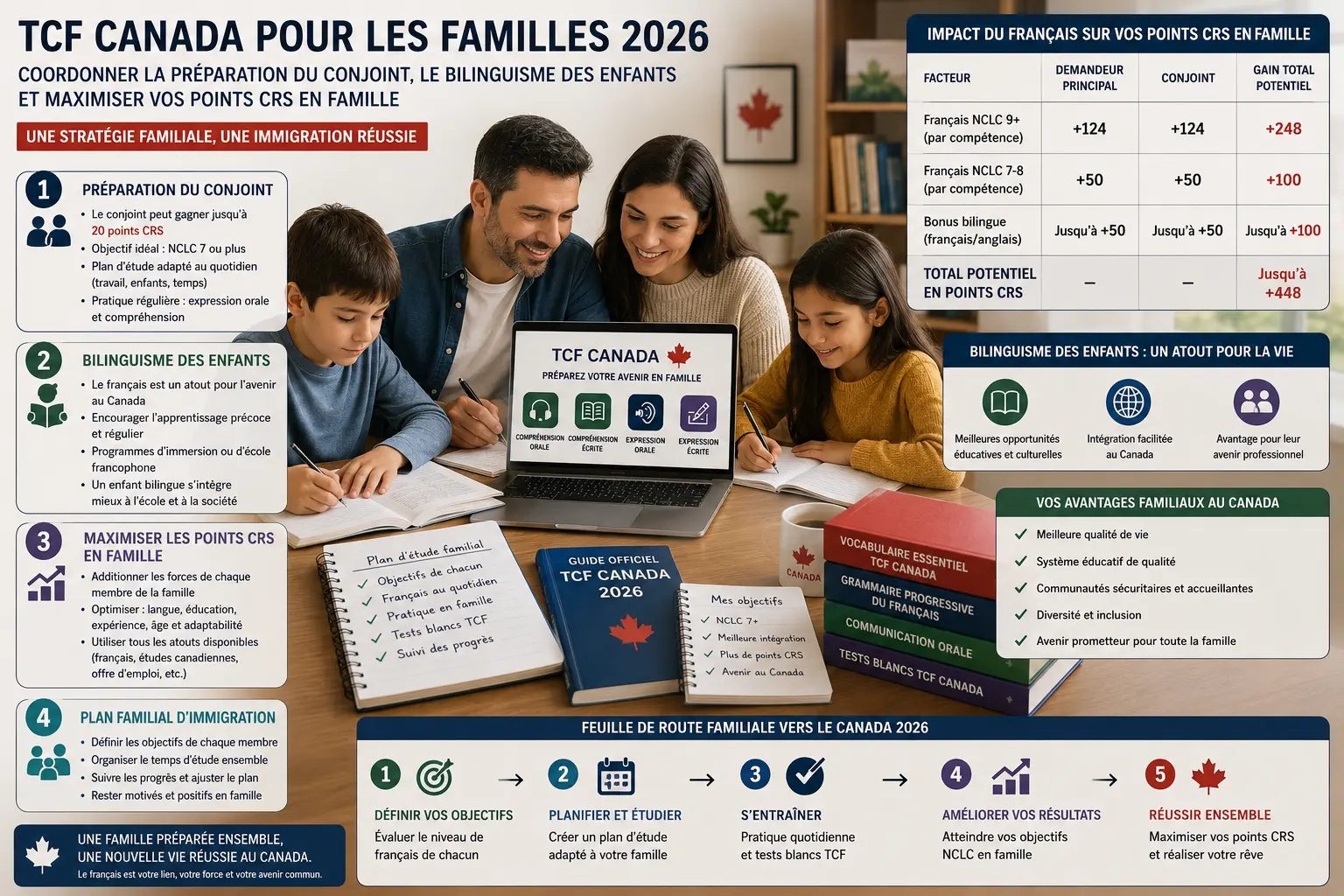
Critical Spouse Points Revelation: Many candidates think only the principal applicant counts for CRS. FALSE! The accompanying spouse can contribute up to 40 CRS points (10 pts education + 20 pts language + 10 pts Canadian experience). In 2026 context where francophone draws have thresholds 360-380 points, these 20-40 spouse points can literally make the difference between ITA or not.
For understanding the complete CRS calculation system, see: How to Calculate Your TCF Canada Points for Immigration.
Exact Calculation: How Many CRS Points Does Spouse's TCF Give?
Spouse TCF → CRS Points Conversion Table
| Spouse NCLC Level | Skills Required | CRS Points Earned | Approximate TCF Score Equivalent |
|---|---|---|---|
| NCLC 0-4 (None/Very Low) | No test OR very low scores | 0 points | < 300 TCF points |
| NCLC 5-6 (Basic) | Basic survival French | 1 point | 300-399 TCF |
| NCLC 7-8 (Intermediate-Advanced) | Functional professional French | 5 points | 400-499 TCF |
| NCLC 9+ (Advanced-Superior) | Academic/native French | 20 points | 500-699 TCF |
Spouse TCF ROI Analysis:
- Investment: CAD 450 exam + CAD 200-400 preparation = CAD 650-850
- Potential Gain: 0 to 20 CRS points (if spouse reaches NCLC 9+)
- ROI: In francophone draw context with threshold 370-380 pts, 20 additional pts = difference between immigration possible vs impossible = INFINITE ROI
- Verdict: If your spouse has intermediate-advanced French level (used French at work, studied in French, or native francophone), having spouse take TCF = mandatory investment, never optional
Optimization Strategy #1: Inverting Principal Applicant vs Accompanying Spouse
When to Invert Roles?
Traditionally, couples choose principal applicant based on "who has better job" or "who earns more" or "the man of the family". These criteria are OFF-TOPIC for CRS. Only relevant criteria: who maximizes CRS points?
Decision Calculator: Who Should Be Principal Applicant?
| Scenario | CRS Spouse A Principal | CRS Spouse B Principal | Optimal Decision |
|---|---|---|---|
| Spouse A: 35 yrs, Bachelor, 8 yrs exp, TCF NCLC 8 Spouse B: 33 yrs, Master's, 6 yrs exp, TCF NCLC 9 | 420 pts | 465 pts | B principal applicant (+45 pts!) |
| Spouse A: 28 yrs, Master's, 4 yrs exp, TCF NCLC 7 Spouse B: 29 yrs, Bachelor, 5 yrs exp, TCF NCLC 10 | 438 pts | 442 pts | B principal applicant (+4 pts marginal but counts) |
| Spouse A: 40 yrs, Doctorate, 15 yrs exp, TCF NCLC 9 Spouse B: 38 yrs, Bachelor, 10 yrs exp, TCF NCLC 8 | 495 pts | 448 pts | A principal applicant (higher education compensates) |
Quick Empirical Rule:
Compare these 4 factors between spouses (in order of importance):
- Age (29-35 yrs = optimal, <29 and >35 = progressive penalty)
- Education (Doctorate > Master's > 2 Bachelors > Bachelor > Diploma)
- TCF Score (NCLC 10 > NCLC 9 > NCLC 8 > NCLC 7)
- Canadian Experience (if applicable - 1+ year Canada = big bonus)
Spouse who "wins" on 3/4 criteria = optimal principal applicant.
Real Case Study - Strategic Inversion:
Benali Family (Tunisia):
- Initial Configuration (Traditional): Karim (husband) principal applicant
- Karim: 38 yrs, Bachelor engineering, 12 yrs exp, TCF NCLC 8-8-7-7 = CRS 412 points
- Salma (wife) accompanying: 36 yrs, Master's French literature, 10 yrs teaching exp, TCF NCLC 10-10-9-9
- Salma contribution as accompanying: +10 pts education + 20 pts language = +30 pts
- Total CRS Configuration 1: 412 + 30 = 442 points
Optimized Configuration (After Consultation): Salma principal applicant
- Salma principal: 36 yrs, Master's, 10 yrs exp, TCF NCLC 10-10-9-9 = CRS 488 points
- Karim accompanying: +10 pts education + 5 pts language (NCLC 7-8) = +15 pts
- Total CRS Configuration 2: 488 + 15 = 503 points
Net Gain: 503 - 442 = +61 CRS points just by inverting roles!
Immigration Impact: 442 pts = possible 2-6 month wait for francophone draws. 503 pts = guaranteed immediate ITA, even general draws accessible.
For understanding the complete immigration system and how CRS fits in, see: Canadian Immigration System and TCF Canada: Understanding Express Entry and Language Points.
Optimization Strategy #2: TCF for Adolescent Children (Special Case)
Children and CRS Points: Myths vs Reality
Common Myth: "My children count for CRS points."
Reality: Children give NO CRS points directly. BUT... they can impact CRS indirectly via 2 mechanisms:
Mechanism #1: Children Reduce Required Funds (Marginal)
- Family 2 adults: need CAD 17,075 settlement funds
- Family 2 adults + 1 child: need CAD 20,995
- CRS Impact: NONE (proof of funds doesn't give points, just requirement)
Mechanism #2: Child 18+ Years Can Be Co-Applicant (Rare but Powerful)
If you have child 18-21 years still dependent (studies, disability, etc.) AND they have excellent French (studied in French their whole life), they can take TCF Canada and contribute as "additional accompanying dependent" in certain PNP configurations (provincial programs).
Concrete Case:
- Family: Parents + 19-year-old daughter (French university student in Morocco)
- Daughter takes TCF Canada, obtains NCLC 9+ (easy given French studies)
- Ontario Francophone PNP values additional francophone family members → provincial nomination bonus points
- Result: Family receives Ontario NOI faster than families without francophone children
Recommendation: If child 18-22 years francophone, check specific provincial programs that value "complete francophone family" (Ontario, New Brunswick, Manitoba).
Advanced Family Strategies: Beyond Basic Configuration
Strategy #3: Leveraging Dual-Income Family for Canadian Job Offer
The Job Offer Multiplier Effect:
While most families focus solely on language points, a Canadian job offer (LMIA-supported) adds 50-200 CRS points depending on NOC level. For dual-income families, this creates strategic opportunities:
| Scenario | CRS Before | CRS After Job Offer | Strategy |
|---|---|---|---|
| Both spouses tech workers | 450 | 500-600 | One spouse targets Canadian remote work contract while other prepares TCF |
| One spouse healthcare, one business | 430 | 630 (NOC 0/A job) | Healthcare spouse pursues pre-arrival job offer (nursing agencies active in recruiting) |
| One spouse trades, one professional | 410 | 460 (NOC B job) | Trades spouse (electrician, plumber) often easier to get LMIA than professionals |
Family Job Offer Strategy:
- Identify which spouse has "easier" Canadian job offer pathway (trades, healthcare, tech often easier than finance/law/education)
- That spouse becomes job-seeking leader while other focuses on maximizing language scores
- Combine job offer points + optimized language configuration = CRS often 550-650 range
- Result: Not just francophone draw eligible, but GENERAL draw eligible with high certainty
Strategy #4: Timing Children's Birth for Immigration Advantage
Controversial but Mathematically Sound Strategy:
Families planning children face a CRS timing dilemma. While children don't add CRS points, the timing of their arrival impacts parental age (which DOES affect CRS):
| Timing Decision | Age Impact | CRS Impact | Recommendation |
|---|---|---|---|
| Have child before immigration process | Parents age 2-3 years during pregnancy/infant care | -10 to -20 points age penalty | Only if age still optimal (under 32) |
| Delay child until after landing in Canada | Maintain optimal age during critical CRS period | +10 to +20 points preserved | If currently age 29-34 with marginal CRS (440-470) |
| Already pregnant during process | N/A (situation is what it is) | Declare in application, adjust settlement funds | Proceed normally, pregnancy doesn't disqualify |
Key Insight: For couples age 29-34 with marginal CRS (440-470), delaying family expansion 1-2 years until AFTER Canadian landing can preserve 10-20 CRS points. For couples already 35+, age penalty already active, so family planning has minimal CRS impact.
Strategy #5: Extended Family Chains - Sibling in Canada
The 15-Point Sibling Bonus:
Having a sibling (brother or sister) who is a Canadian citizen or permanent resident living in Canada gives +15 CRS points. For families, this creates interesting dynamics:
Example: Two Siblings Immigrating in Sequence
- Year 1: Sibling A (single, high CRS) immigrates first, lands in Canada
- Year 2-3: Sibling A obtains permanent residence
- Year 3: Sibling B (married with children, marginal CRS 445) now gets +15 points = 460 CRS
- Result: Sibling B's family immigration dramatically easier thanks to sibling A's prior landing
Strategic Recommendation: If you have siblings also considering Canadian immigration, coordinate who goes first based on who has strongest independent CRS (typically younger, higher education, better language). First sibling's success creates pathway for subsequent family members.
Couple TCF Preparation: Logistical and Psychological Strategies
Challenge #1: Synchronize Test Dates or Stagger?
Option A: Simultaneous Tests (Same Date)
Advantages:
- Mutual motivation during preparation (3 months preparing together)
- Results arrive simultaneously → immediate EE profile creation
- Simplified logistics (1 trip to test center if same city)
Disadvantages:
- Doubled family stress (especially with young children)
- If children <6 years, need simultaneous childcare during 4h exam (cost/logistics)
- Unintentional competition between spouses can create tensions
Option B: Staggered Tests (1-2 Month Interval)
Advantages:
- Spouse A goes first, returns with practical exam experience, advises Spouse B
- Childcare facilitated (one parent available during other's exam)
- Financial spreading (CAD 900 over 2 months vs CAD 900 at once)
Disadvantages:
- EE profile creation delayed 1-2 months (waiting for Spouse B results)
- Less preparation synergy
General Recommendation: Simultaneous if children >6 years OR no children. Staggered if children <6 years OR tight financial situation.
For comprehensive preparation strategies for both spouses, see: Strategic TCF Canada Planning: The Proven 3-Month Method That Delivers Results.
Challenge #2: Preparation Time Distribution with Children
Realistic Scenario - Couple with 2 Children Ages 3 and 5:
| Time Period | Parent A (Principal Applicant) | Parent B (Accompanying) | Children |
|---|---|---|---|
| 5am-7am Morning | Study 1.5h (before children wake) | Sleep/Family preparation | Sleeping |
| 7am-9am | Family routine (breakfast, dressing, daycare) | Wake → Daycare | |
| 9am-5pm | Work | Daycare/School | |
| 5pm-8pm | Children routine (dinner, bath, bedtime) | Home, parental attention | |
| 8pm-10pm | Childcare (if wake-ups) | Study 1.5h | Sleeping (normally) |
| Weekend Sat/Sun | Study 2h during children's nap | Study 2h staggered (other parent watches children) | Family activities alternated with parent study |
Realistic Weekly Total:
- Parent A: 1.5h × 5 days + 2h × 2 weekend days = 11.5h/week
- Parent B: 1.5h × 5 days + 2h × 2 days = 11.5h/week
- Over 12 weeks preparation: 138h each (vs 180h singles, but sufficient with focus)
Couples with Children Tip:
Use "Sacred Time Block" principle: Each parent has 2h × 3 evenings/week where other parent has 100% child responsibility, NO interruptions allowed. Ex: Parent A Monday-Wednesday-Friday 8pm-10pm untouchable. Parent B Tuesday-Thursday-Saturday 8pm-10pm untouchable. Sunday = complete family, zero study. This creates structure, avoids stressful daily negotiations, gives each parent predictability.
Family Financial Aspect: Multi-Person TCF Budget
Total Cost - 2-Adult Family Taking TCF
| Expense Item | Adult 1 (Principal) | Adult 2 (Spouse) | Family Total |
|---|---|---|---|
| TCF Canada Exam | CAD 450 | CAD 450 | CAD 900 |
| Preparation Materials | CAD 150 | CAD 100 (share books) | CAD 250 |
| Teacher Lessons (optional but recommended for Spouse if medium level) | CAD 0 | CAD 400 (20h × CAD 20/h) | CAD 400 |
| Childcare Exam Day (if <6 yrs) | CAD 120 (babysitter 6h × CAD 20/h) | CAD 120 | |
| Transport to Test Center | CAD 150 (if same city, public transit) | CAD 150 | |
| TOTAL | CAD 1,820 | CAD 1,820 | |
Family Savings Strategies:
- Share Materials: 1 book set for 2 (save CAD 100-150)
- Mutual Study: Spouses correct each other's written expressions (save CAD 300-600 vs teacher for both)
- Family Childcare: Grandparents/extended family watch children exam day free (save CAD 120)
- Free Practice Tests: Prioritize free online resources vs paid (save CAD 100-200)
- Total Possible Savings: CAD 620-1,070 → Net Family Cost CAD 750-1,200
Psychological Dynamics: Managing Family Immigration Stress
Common Family Tensions During TCF Preparation
| Tension Type | Manifestation | Solution |
|---|---|---|
| Unequal Burden | One spouse feels they're doing "all the work" (study + childcare + household) | Explicit hour-tracking system, rotate childcare blocks, celebrate both contributions equally |
| Score Competition | Spouses compare practice test results, one feels inferior | Remember: You're on same team. Higher-scoring spouse's success directly benefits family CRS |
| Resentment of Investment | "Why are we spending CAD 2,000 and 6 months on this?" | Revisit why: CAD 2,000 investment → CAD 100,000+ lifetime earning difference in Canada |
| Children's Needs Neglected | Children act out for attention during intensive study period | Schedule "family only" time sacred (Sunday full day), quality over quantity with kids |
Family Communication Best Practices:
- Weekly Family Check-In: Every Sunday evening, 30-minute meeting - what's working, what needs adjustment in study/childcare balance
- Celebrate Milestones Together: Completed practice test? Reached B1 level? Both spouses booked exam dates? Mini-celebration (special dinner, movie night)
- Transparent Financial Tracking: Shared spreadsheet of TCF costs vs total immigration budget - removes money anxiety
- Exit Strategy Clarity: Agree upfront: What if one spouse scores poorly? Retake? Adjust timeline? Having plan B prevents panic
Resources Specific to Couples and Families
Conclusion: Family as Strategic Immigration Lever
Omar and Leila's story reveals a hidden truth of the 2026 Canadian immigration system: your family configuration is NOT fixed - it's an optimizable variable that can give you +20 to +60 CRS points simply by reorganizing who is principal applicant vs accompanying spouse, and strategically having spouse take TCF.
80% of couples immigrate with "default" configuration (husband as traditional principal applicant) without EVER calculating if inverting roles would give better CRS. This negligence costs on average 25-45 lost CRS points - in a system where 10-20 points separate "smooth immigration" from "indefinite waiting", this is catastrophic.
Investing CAD 450-850 to have your spouse take TCF Canada is NEVER optional if your spouse has intermediate or higher French level - it's mandatory investment with potentially infinite ROI (20 CRS pts = difference between ITA vs blocked). Your family isn't just "people accompanying you" - it's your strategic CRS optimization arsenal. Use it. 🇨🇦👨👩👧👦
Your Family Action Plan:
- Step 1: Calculate CRS with BOTH spouses as principal applicant (test both configurations)
- Step 2: Identify optimal configuration (who gives highest total family CRS)
- Step 3: Both spouses take French proficiency self-assessment
- Step 4: If spouse has B1+ French, mandatory TCF Canada booking (non-negotiable)
- Step 5: Create family study schedule respecting childcare/work balance
- Step 6: Budget CAD 1,200-1,800 total family TCF investment
- Step 7: Take exams (simultaneous or staggered based on children's ages)
- Step 8: Create Express Entry profile with optimized family configuration
- Step 9: Receive ITA 2-12 weeks faster than non-optimized families
- Step 10: Land in Canada as family with maximized CRS advantage 🇨🇦
The difference between families who succeed quickly and those who wait years often isn't luck - it's strategic optimization of the family unit as a CRS-maximizing system. Every spouse, every configuration choice, every language test matters. Don't leave 20-60 CRS points on the table because you didn't realize your family configuration was optimizable. Calculate. Optimize. Immigrate.
For additional family success stories and strategic insights, see: Inspiring Testimonials: How They Succeeded in Their TCF Canada.
* * *
Frequently Asked Questions
Yes. An accompanying spouse can contribute up to 20 CRS points for language proficiency and up to 40 points in total (education + language + Canadian experience). In francophone draws where thresholds may range around 360–380 points, these additional 20 points can significantly increase your chances of receiving an ITA.
You should calculate CRS scores with BOTH spouses as principal applicant and compare totals. The optimal principal applicant is the one who maximizes overall family CRS based on age, education, TCF score, work experience, and transferability factors—not based on income or traditional roles.
No, children do not directly provide CRS points. However, family structure can indirectly affect immigration strategy (for example, provincial programs valuing francophone families or timing decisions that affect parental age and CRS). The main CRS optimization lever remains the spouses’ language and education profiles.
Laissez un commentaire
Votreadresse email ne sera pas publie. Les champs obligatoires sont marque avec *


 TCF Canada Hub
0 Commentaires
aucun commentaire
Soyez le premier a partager votre avis !