-
Auteur :
 TCF Canada
- Mar 14, 2026
TCF Canada & Diploma Equivalency 2026: The Complete Playbook to Get Your Qualifications Recognized in Canada
- Blog
- /
- Article

TCF Canada & Diploma Equivalency 2026: The Complete Playbook to Get Your Qualifications Recognized in Canada
When Dr. Rachid, a 42-year-old general practitioner with 15 years of experience in Tunis, received his ITA in February 2026 (CRS 485, NCLC 9 across the board on TCF Canada, plus an Ontario nomination), he assumed the hardest part was behind him. “I had a medical degree, years of clinical practice, and international publications—so I thought I’d be able to work quickly,” he explains from Ottawa. What he discovered after landing in August 2026 was a reality many skilled immigrants learn too late: your foreign diploma is rarely “work-ready” in Canada without formal recognition.
2026 Update: With competition rising in Express Entry and Provincial Nominee Programs, more candidates are optimizing language scores (TCF Canada) to secure an ITA—yet many still underestimate the second battlefield: credential recognition and professional licensing. A strong immigration file doesn’t automatically translate into immediate career access.
Before you invest months chasing higher NCLC scores, make sure you understand the other half of the equation: how the Canadian immigration system uses TCF Canada points and how to calculate your TCF Canada points. Then align that strategy with your profession’s recognition pathway.
Understanding Canada’s Credential Equivalency Ecosystem in 2026
Why Canada Requires Credential Assessment
Canada does not “downgrade” foreign professionals for fun. It uses structured assessment for three practical reasons:
- Public protection: regulated professions (medicine, nursing, engineering, teaching, law, etc.) affect safety, health, and consumer rights—so standards must be consistent.
- Global education variation: a “Bachelor” (or equivalent) can differ significantly by country in duration, curriculum depth, and supervised practice.
- System credibility: Canadian credentials carry international weight partly because the validation process is strict and documented.
The Two Levels: Immigration ECA vs Professional License
| Equivalency Type | Purpose | Who Issues It? | Typical Timeline | Typical Cost |
|---|---|---|---|---|
| 1) ECA (Educational Credential Assessment) | Academic equivalency for immigration scoring (Express Entry / PNP) | WES, IQAS, ICAS, CES (designated organizations) | ~4–20 weeks | ~200–300 CAD |
| 2) Professional Licensing / Certification | Legal permission to practice a regulated profession in a province | Provincial regulators (e.g., CPSO, PEO, OCT, CNO) | ~3 months to 4+ years | ~500–15,000 CAD |
Common (and costly) confusion: an immigration ECA only helps you get CRS points. It does not grant the right to work as a doctor, engineer, nurse, teacher, lawyer, pharmacist, etc. Licensing is a separate track—usually longer, more expensive, and more demanding.
Level 1 (Immigration): ECA Step-by-Step in 2026
Designated ECA Organizations (Quick Comparison)
| Organization | Best For | Typical Timeline | Typical Cost | Practical Take |
|---|---|---|---|---|
| WES (World Education Services) | Most countries, most degrees | ~35–45 business days | ~267 CAD | Popular choice when you need predictable processing |
| IQAS | Alberta-based assessment, some regulated contexts | ~15–20 weeks | ~200 CAD | Often slower—avoid if your profile is time-sensitive |
| ICAS | Useful for certain provincial preferences | Varies | ~210 CAD | Good alternative if WES is not convenient for your file |
| CES (University of Toronto) | Shorter/technical programs in some cases | Varies | ~175 CAD | Often competitive on price |
| ICES (BCIT) | BC-focused usage in some profiles | Varies | Varies | Consider if your situation aligns with BC pathways |
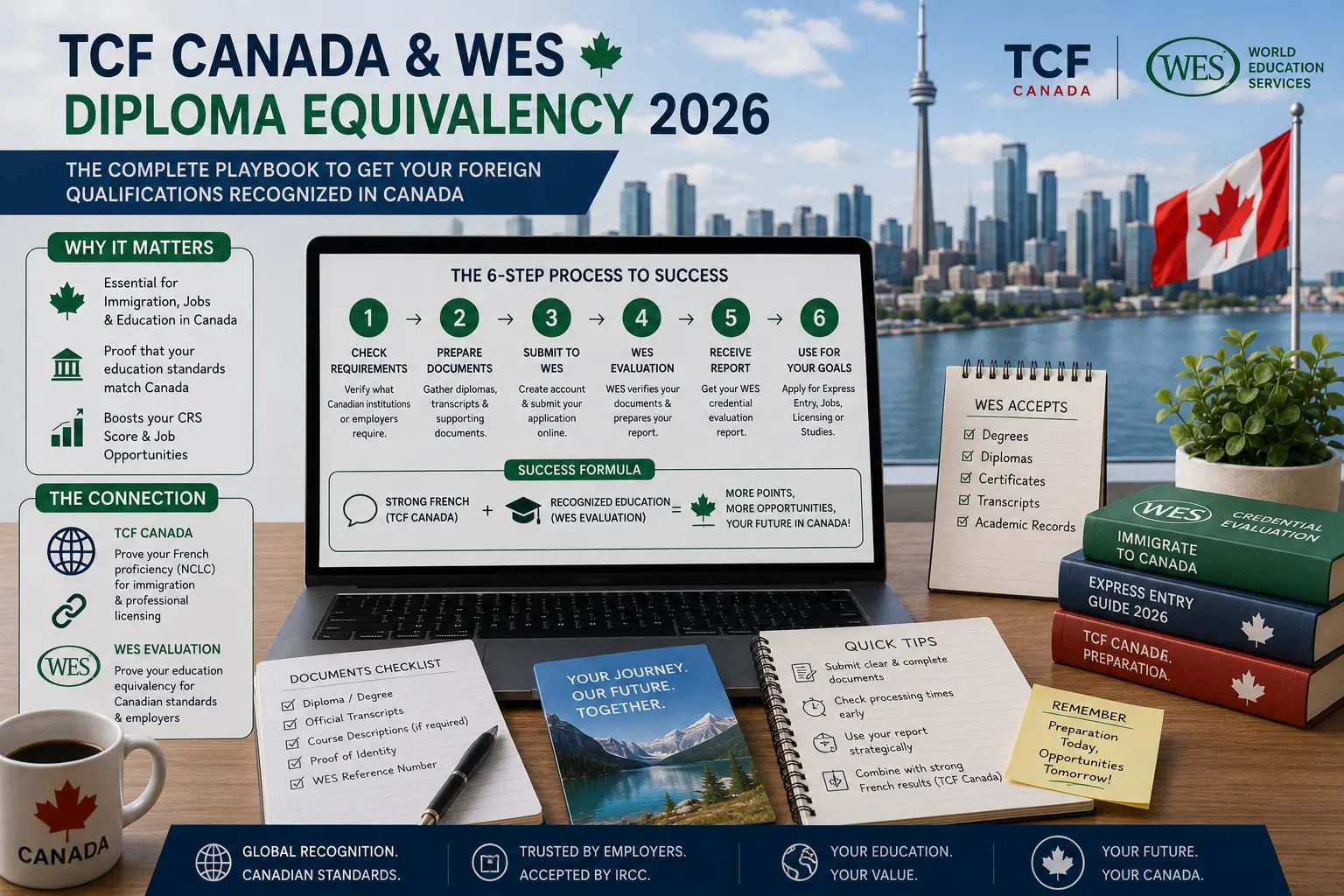
A Practical “WES-Style” Workflow (Recommended Planning Approach)
Step 1: Document readiness (start 2–4 weeks early)
- Official transcripts for all credentials you will claim (Bachelor/Master/PhD).
- Degree certificates (originals or certified true copies).
- Certified translations if documents are not in English/French (budget per document).
- If your university uses sealed envelopes: keep them sealed—many ECAs reject opened transcripts.
Step 2: Create an account + pay (30 minutes)
- Choose the ECA type for immigration (Express Entry).
- Enter your education history carefully (names, dates, institutions must match documents).
- If your immigration timeline is tight, consider faster processing options where available.
Step 3: Send documents (method depends on your institution)
- Some universities send directly; others require you to mail sealed transcripts.
- Use tracked shipping to reduce uncertainty and delays.
- Respond quickly if additional verification is requested (this is a common delay point).
Step 4: Receive your ECA and store the reference number
- Download and archive the PDF report.
- Enter the ECA reference number correctly in your Express Entry profile.
- Remember: ECA = immigration points, not permission to practice.
ECA Success Checklist (Fast Self-Audit)
- Claim only what you can document: missing transcripts can invalidate your timeline.
- Match names exactly: if your passport spelling differs, add supporting legal proof early.
- Plan around deadlines: an ECA delay can block profile submission or ITA readiness.
Level 2 (Licensing): Why Regulated Professions Feel Like a Marathon
Regulated Professions: High-Impact, High-Barrier (Examples)
| Profession | Regulator (Ontario Example) | Typical Recognition Components | Estimated Total Time | Difficulty |
|---|---|---|---|---|
| Physician | College of Physicians and Surgeons of Ontario (CPSO) | Degree verification + exams + supervised clinical training + provincial requirements | ~3–5 years | Extreme |
| Engineer (P.Eng.) | Professional Engineers Ontario (PEO) | Academic review + ethics/law exam + validated experience | ~1–3 years | Medium–High |
| Teacher | Ontario College of Teachers (OCT) | Credential evaluation + possible competency checks | ~6 months–2 years | Medium |
| Nurse (RN) | College of Nurses of Ontario (CNO) | NNAS-style review + exam + language/competency checks | ~8–18 months | Medium–High |
| Pharmacist | Ontario College of Pharmacists (OCP) | Evaluation + exams + supervised practice | ~1–2 years | High |
| Lawyer | Law Society of Ontario | NCA requirements + articling + bar exams | ~2–4 years | Extreme |
Mini Case Study: Engineers (One of the Most Common Immigrant Pathways)
Profile: Rachid, 34, electrical engineer, Bachelor from Morocco, 8 years of experience, targeting Ontario P.Eng.
Reality check: Rachid can immigrate with a strong TCF Canada + ECA profile, but becoming “P.Eng.” is a separate, provincial journey. The smartest strategy is to parallelize income + licensing steps from day one.
Phase 1: Immigration ECA (before landing)
- Get ECA for Express Entry scoring (timeline depends on organization + document flow).
- Use the ECA result to support your CRS/PNP pathway.
Phase 2: Apply to the regulator (after landing or when allowed)
- Submit degree documents, course descriptions (if required), and experience evidence.
- Wait for technical assessment outcome (this defines your next steps).
Phase 3: Possible outcomes
- Direct pathway: proceed to the professional practice (ethics/law) exam.
- Technical exams assigned: study part-time while working a bridge role.
- Bridging education required: complete Canadian coursework to close gaps.
Phase 4: Canadian experience (in parallel)
- Work in an adjacent title (e.g., engineering technologist) while building local references.
- Document projects and supervision properly—this often becomes the hidden bottleneck.
Result: once exams + validated experience are completed, Rachid earns the legal title “P.Eng.” and accesses a wider salary band and responsibility scope.
Non-Regulated Professions: The Faster Track
Good News for Many Candidates
If your profession is not regulated (many IT roles, marketing, data analysis, sales, HR, logistics, operations), you can usually work soon after arrival with your immigration documents and strong job-search positioning. In those cases, the ECA helps immigration, while employers focus more on skills, portfolio, and Canadian-style interview readiness.
- Software Developer / Programmer
- Data / BI Analyst
- Project Manager (depending on sector)
- General Accountant (CPA is optional unless you want the protected title)
- Marketing / Communications Specialist
- Sales / Business Development
- Administrative Coordinator
The “Bridge Profession” Strategy: Candidates in highly regulated careers often choose a related non-regulated role to earn income, build Canadian references, and reduce stress while licensing is in progress.
- Doctor → clinic coordinator / medical assistant (role-dependent)
- Lawyer → legal assistant / paralegal pathway (requirements vary)
- Engineer → technologist / CAD designer / project coordinator
Benefit: stable income + Canadian workplace experience + network = smoother final transition.
How TCF Canada Interacts with Credential Recognition
Language Proof: Immigration vs Regulator Requirements
TCF Canada can be perfect for immigration scoring, but some professional regulators require English-specific tests (or accept only certain language exams). Plan for this early so you don’t “win immigration” and then get blocked at licensing.
| Profession | Typical Language Expectation | Does TCF Canada Usually Help? | Common Alternative |
|---|---|---|---|
| Nursing | Often requires proof aligned with CLB standards | Sometimes (depends on regulator rules) | IELTS / CELPIP / profession-specific options |
| Teaching | Varies by province and training language | Often | Case-by-case |
| Pharmacy | Often English-heavy exams and practice environment | Not always sufficient alone | IELTS / CELPIP |
| Engineering | No universal language test, but professional exams are commonly in English | N/A | — |
Smart dual-language planning: If your immigration plan is francophone (TCF Canada) but your profession is English-dominant, consider preparing for both pathways early (TCF Canada for immigration + an English test if your regulator requires it). It costs more upfront but can prevent a dead-end later.
The Optimal Timeline: When to Start Credential Steps
A Strategic Calendar for Regulated Professions
| Timing | Action | Why It Matters |
|---|---|---|
| 12–18 months before landing | Identify your provincial regulator and read the full licensing roadmap | Prevents “surprise barriers” after arrival |
| 10–12 months before | Start ECA + request transcripts and sealed documents | ECA is needed for Express Entry scoring |
| 8–10 months before | Finalize TCF Canada attempt(s) + plan English testing if needed | Aligns immigration + professional reality |
| 6 months before | Begin any regulator pre-assessment (if allowed from abroad) | Early gap detection saves months later |
| 0–3 months after landing | Submit complete licensing file + start job search for bridge roles | Parallel income + licensing momentum |
| 3–24 months after | Exams, supervised experience, bridging programs as required | Most candidates succeed by staying consistent |
Bottom line: Starting early can reduce underemployment time and accelerate full professional recognition.
Essential 2026 Resources (ECA + Professional Regulators)
Conclusion: Anticipation Is Professional Acceleration
Dr. Rachid’s story highlights a key trap: confusing “successful immigration” (getting PR) with “successful professional integration” (working in your real career). Canada welcomes international talent through Express Entry and PNP—but then requires a structured recognition process before you can practice many regulated professions.
The difference between candidates who regain their professional level within 12–18 months and those who lose 3–5 years is rarely intelligence or motivation. It is usually one thing: starting the equivalency and licensing strategy early, while still preparing TCF Canada and building an immigration profile.
Your TCF Canada score can open the immigration door. Your ECA + licensing plan opens the door to your long-term Canadian career. Treat them as one integrated roadmap. 🇨🇦
* * *
Frequently Asked Questions
No. An ECA is used only for immigration purposes (Express Entry or PNP) to validate your education level and claim CRS points. To legally practice a regulated profession (medicine, engineering, nursing, teaching, law, pharmacy, etc.), you must complete a separate provincial licensing process.
Ideally 10–18 months before landing in Canada. Start with your ECA for immigration scoring, but also research your provincial regulator early. Early preparation helps you avoid underemployment and shortens the gap between landing and full professional recognition.
No. A strong TCF Canada score improves your CRS and helps you receive an ITA, but it does not automatically qualify you to practice your profession. Licensing bodies may have additional language, exam, supervised practice, or bridging education requirements.
Laissez un commentaire
Votreadresse email ne sera pas publie. Les champs obligatoires sont marque avec *




 TCF Canada Hub
0 Commentaires
aucun commentaire
Soyez le premier a partager votre avis !