-
Auteur :
 TCF Canada
- Mar 02, 2026
TCF Canada and Credential Equivalency 2026: Complete Guide to Getting Your Qualifications Recognized in Canada
- Blog
- /
- Article

TCF Canada and Credential Equivalency 2026: Complete Guide to Getting Your Qualifications Recognized in Canada
When Dr. Rachid, a 42-year-old general practitioner with 15 years of experience in Tunis, received his ITA (Invitation to Apply) in February 2026 thanks to his excellent profile (CRS 485, TCF Canada NCLC 9 across the board, Ontario provincial nomination), he was convinced his settlement journey would be smooth. "I had a medical doctorate from a recognized Tunisian university, 15 years of clinical practice, publications in international medical journals - I naively thought my qualifications would be automatically recognized in Canada," he recounts today from his medical office in Ottawa. "Reality hit me hard during my first week in Canada in August 2026: my Tunisian medical degree was NOT automatically recognized to practice in Canada. To become a licensed physician in Ontario, I had to go through a 2-4 YEAR process including: (1) Credential assessment by Medical Council of Canada ($450 CAD, 8-12 weeks delay), (2) Canadian equivalency exams MCCQE Part I and II (total cost $3,500 CAD, 40-60% failure rate for international candidates first attempt), (3) 2-year clinical residency in Canadian hospital (fierce competition, only 10-15% IMG - International Medical Graduate - candidates accepted annually), (4) Provincial College of Physicians Ontario exam ($1,200 CAD). Meanwhile, I could NOT practice medicine, so I worked 18 months as a medical assistant ($55,000 CAD/year vs $250,000+ CAD/year physician) before finally obtaining my full Canadian license in January 2028 - 28 months after arrival. My fatal mistake? Not understanding the Canadian credential recognition system BEFORE immigrating. If I had known, I would have started my assessment and exam process while still in Tunisia (2 years head start!), saving 18 months of underemployment and $80,000-100,000 CAD in lost income. Understanding the credential equivalency ecosystem is as critical as your TCF Canada score for your post-immigration professional success."
Understanding the Canadian Credential Equivalency System (ECA) 2026
Why Does Canada Require Credential Equivalency?
Unlike many countries that automatically accept foreign diplomas, Canada has a rigorous assessment system for 3 main reasons:
- Public Protection: Regulated professions (medicine, engineering, teaching, law, etc.) directly impact public safety → uniform standards mandatory
- Diversity of Educational Systems: "Bachelor" in Tunisia ≠ "Bachelor" in Morocco ≠ "Bachelor" in France ≠ "Bachelor" in Canada (duration, content, standards vary)
- International Credibility: Canadian system recognized worldwide BECAUSE of rigorous process (Canadian degree = high value everywhere)
The 2 Levels of Equivalency: ECA vs Professional License
| Equivalency Type | Purpose | Who Does It? | Timeline | Cost |
|---|---|---|---|---|
| 1. ECA (Educational Credential Assessment) | Academic assessment for immigration only (Express Entry, PNP) | WES, IQAS, ICAS, CES (accredited organizations) | 4-20 weeks | $200-300 CAD |
| 2. Professional License/Certification | Authorization to PRACTICE regulated profession in Canada | Provincial professional regulatory bodies (e.g., College of Physicians Ontario) | 3 months - 4 years (extreme variation) | $500-15,000 CAD |
Common Fatal Confusion: Many candidates think the immigration ECA (level 1) is enough to work in their profession in Canada. FALSE! The ECA only gives CRS Express Entry points. To PRACTICE a regulated profession (doctor, engineer, lawyer, teacher, nurse, etc.), you must THEN obtain provincial license (level 2) - completely separate process, much longer and more expensive.
For understanding how your TCF Canada scores contribute to your overall immigration profile, see: Canadian Immigration System and TCF Canada: Understanding Express Entry and Language Points.
Level 1: Immigration ECA - Detailed 2026 Process
The 5 IRCC-Accredited ECA Organizations
| Organization | Specialty | Standard Timeline | Cost | Recommendation |
|---|---|---|---|---|
| WES (World Education Services) | Generalist (all countries, all fields) | 35-45 business days | $267 CAD | Most popular, reliable, fast - recommended 80% of cases |
| IQAS (International Qualifications Assessment Service) | Alberta, regulated professions | 15-20 weeks | $200 CAD | Long timeline - avoid if urgent |
| ICAS (International Credential Assessment Service) | British Columbia, Ontario | 20-25 business days | $210 CAD | Fast for specific provinces |
| CES (Comparative Education Service) | Toronto, short/technical programs | 15-20 business days | $175 CAD | Economical, fast for technical diplomas |
| IQAS (University of Toronto) | Advanced academic (PhD, Post-Doc) | 20-30 days | $225 CAD | Recognized for academic research |
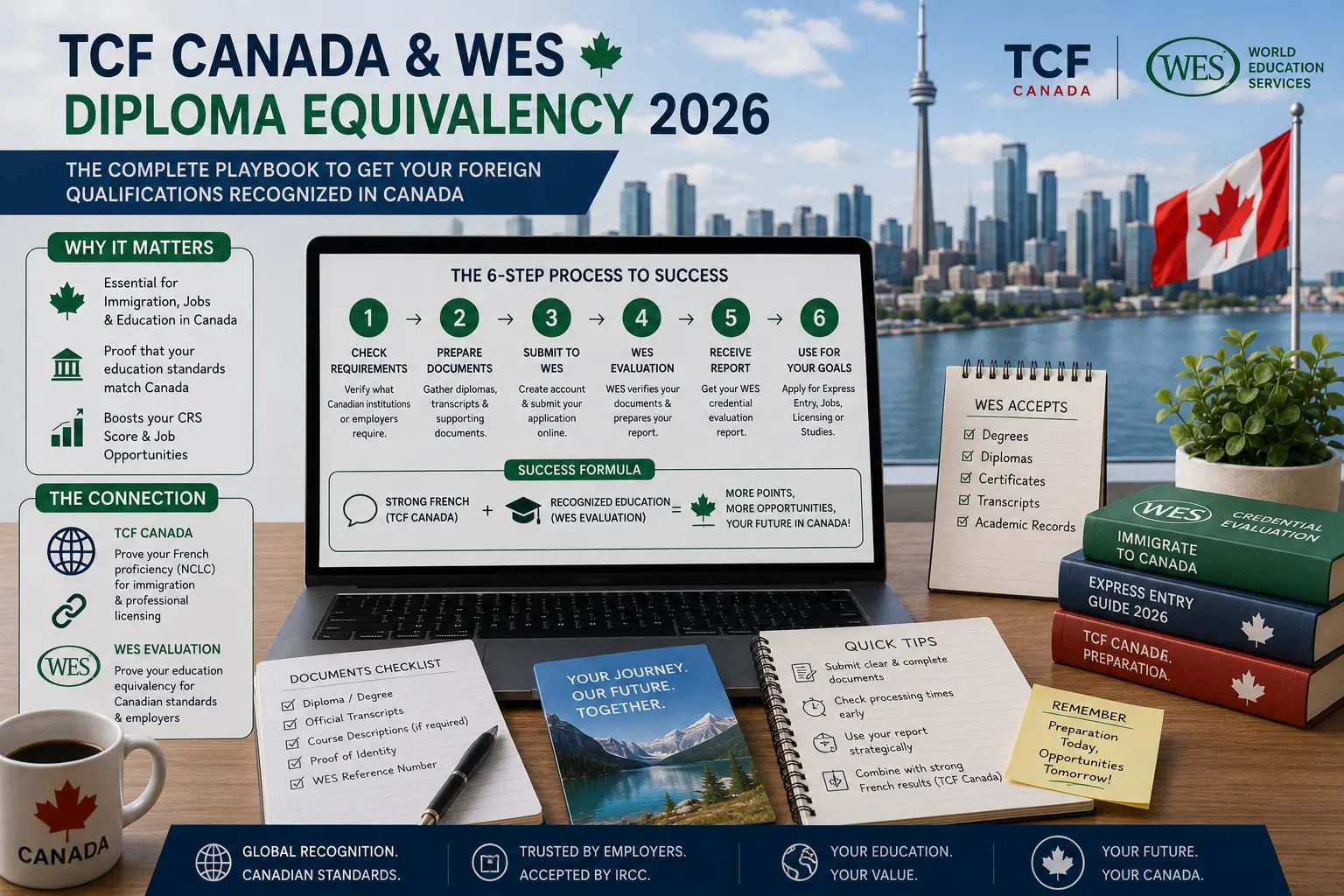
WES ECA Process Step-by-Step (Recommended 2026 Method)
Step 1: Document Preparation (2-4 weeks before submission)
- Official transcripts for ALL degrees (Bachelor, Master, Doctorate) - request from your university
- Original diplomas or certified true copies
- Official translations if documents not in French/English (sworn translator required, cost $50-150 CAD/document)
- For Morocco/Tunisia/Algeria diplomas: request SEALED transcripts from university (closed envelope with official stamp) - WES does NOT accept opened transcripts
Step 2: WES Account Creation + Payment (30 minutes)
- Website: wes.org/ca
- Select "WES Standard Application" ($267 CAD)
- Rush option available (+$115 CAD, timeline reduced to 20 days) - worth cost if immigration urgent
- Complete detailed online form: complete education history, precise dates, institution names
Step 3: Document Submission (method varies by country)
Option A: Direct Candidate Submission (Morocco, Tunisia, France, etc.)
- Original/certified documents + translations in sealed envelope with university stamp
- Send registered mail to: WES, 2 Carlton Street, Suite 1400, Toronto, ON M5B 1J3, Canada
- International shipping cost: $40-80 CAD depending on country
- Tracking mandatory (tracking number)
Option B: Direct University Submission (Algeria, some Cameroon/Senegal universities)
- University sends documents directly to WES (process varies by institution)
- Longer (6-12 weeks university delay) BUT safer (WES accepts 100%)
Step 4: WES Reception and Processing (35-45 business days)
- WES confirms document reception by email (check online account)
- Internal process: authenticity verification, comparison with global university database, program content analysis
- Possible request for additional documents (10% of cases) - respond quickly to avoid delays
Step 5: ECA Report Reception (digital + physical format)
- Downloadable PDF report immediately from WES account
- Physical copy sent by mail (2-4 additional weeks)
- Report states: "Your Bachelor in Computer Engineering (University of Tunis El Manar, 2015) is equivalent to Canadian Bachelor's Degree (4 years)"
- Unique ECA reference number to enter in Express Entry profile
For strategic planning of your entire immigration timeline including ECA processing, see: Strategic TCF Canada Planning: The Proven 3-Month Method That Delivers Results.
Regulated Professions: The Challenging Path
The 15 Most Regulated Professions in Canada 2026
| Profession | Regulatory Body (Ontario example) | Recognition Process | Total Timeline | Difficulty |
|---|---|---|---|---|
| Physician | College of Physicians and Surgeons Ontario (CPSO) | MCCQE I & II exams + 2-year Residency + Provincial exam | 3-5 years | Extreme (IMG success rate <15%) |
| Engineer | Professional Engineers Ontario (PEO) | Technical assessment + Exams (if required) + Confirmed experience | 1-3 years | Medium-High |
| Teacher | Ontario College of Teachers (OCT) | Credential assessment + Competency exam + Practicum (if required) | 6 months - 2 years | Medium |
| Nurse | College of Nurses of Ontario (CNO) | NNAS assessment + NCLEX-RN exam + Language assessment | 8-18 months | Medium-High |
| Pharmacist | Ontario College of Pharmacists (OCP) | Assessments + Exam + Supervised practical internship | 1-2 years | High |
| Lawyer | Law Society of Ontario | NCA exams + Articles (internship) + Bar | 2-4 years | Extreme |
| Architect | Ontario Association of Architects (OAA) | ExAC exams + IAP experience + Interview | 2-4 years | High |
| Chartered Accountant (CPA) | CPA Ontario | PEP program + CFE exams + Practical experience | 1.5-3 years | Medium-High |
Detailed Case Study: Engineers (Very Common Immigrant Profession)
Typical Profile: Rachid, 34, electrical engineer Bachelor Morocco, 8 years experience, wants to become P.Eng. (Professional Engineer) Ontario
Complete 2026 Journey:
Phase 1: Immigration ECA (BEFORE Canada arrival)
- WES ECA for Express Entry profile: $267 CAD, 6 weeks
- Result: "Bachelor Engineering equivalent to Canadian 4-Year Bachelor"
- Uses ECA to obtain immigration ITA
Phase 2: PEO Application (upon Canada arrival)
- PEO registration: $365 CAD
- Complete file submission: diplomas, transcripts, detailed course descriptions, employer reference letters, technical CV
- Assessment timeline: 4-6 months
Phase 3: PEO Assessment Result (3 possible scenarios)
Scenario A (35% candidates): Direct Approval
- Education 100% equivalent to Canadian standards
- Direct passage to Law and Ethics exam (Professional Practice Exam - PPE)
- Exam cost: $175 CAD
- Success rate: 75-80% first attempt
Scenario B (50% candidates): Technical Exams Required
- PEO identifies training gaps (e.g., missing Health-Safety course, insufficient Thermodynamics level)
- Must pass 2-5 Canadian technical exams ($200 CAD each)
- Preparation: 3-6 months part-time study
- After technical exam success → PPE exam
Scenario C (15% candidates): Complementary Training Required
- Major gaps → must take Canadian university courses (1-2 semesters)
- Cost: $4,000-10,000 CAD
- Duration: 4-8 months
Phase 4: Canadian Experience (PARALLEL)
- Rachid works as "Engineering Technologist" (not P.Eng. yet): $65,000 CAD/year
- Accumulates 12 months Canadian experience supervised by P.Eng.
- Documents experience monthly (technical reports)
Phase 5: P.Eng. License Obtainment
- After exam success + 12 months Canadian experience → final license application
- License fees: $480 CAD/year
- Final processing time: 2-3 months
- RESULT: Legal title "Professional Engineer (P.Eng.)" → salary increases to $85,000-110,000 CAD/year
Total Duration Rachid Scenario: 18-24 months from Canada arrival to P.Eng.
Non-Regulated Professions: The Fast Track
Good News for 60% of Professions
If your profession is NOT regulated (IT, finance, marketing, administration, HR, logistics, non-specialized construction trades, etc.), you can work IMMEDIATELY after Canada arrival with just your immigration ECA - no additional license required.
Common NON-Regulated Professions:
- Developer/Programmer (no license - very open market)
- Data Analyst/Business Intelligence
- Project Manager (IT, construction, etc.)
- General Accountant (unless wants CPA title - optional)
- Marketing/Communications Specialist
- Sales Representative/Commercial
- Administrative Assistant/Coordinator
"Bridge Profession" Strategy:
Candidates in difficult regulated professions (doctors, lawyers) often use related NON-regulated professions during recognition process:
- Physician → Medical assistant / Clinical coordinator ($40,000-65,000 CAD, no license) during exam preparation
- Lawyer → Paralegal / Legal agent ($55,000-75,000 CAD, short 1-year certification) during NCA exams
- Engineer → Engineering technologist / Draftsperson ($60,000-75,000 CAD, no license) during PEO process
Advantage: Decent income + Canadian sector experience + Professional network = facilitated final transition
For understanding employment opportunities across different Canadian regions, see: Life in Canada: Cultural and Linguistic Context for Successful Integration.
Maximizing Your TCF Canada for Credential Equivalency
The TCF - Regulated Professions Link
Your TCF Canada score DIRECTLY impacts your chances in certain regulated professions requiring separate language assessment:
| Profession | Regulatory Body Language Requirement | Does TCF Canada Suffice? | Alternative |
|---|---|---|---|
| Nurse | CLB 7 English + NCLC 7 French (if bilingual practice) | YES - CNO accepts TCF Canada directly | CELBAN (nurse-specific test) |
| Teacher | Variable by province (Ontario: no test if English/French training) | Often YES | Varies |
| Pharmacist | CLB 8 English (Ontario) | No (English required for exam) | IELTS/CELPIP |
| Engineer | No formal language requirement (but PPE exam in English) | N/A | - |
Strategic Double Language Certification: If targeting regulated profession requiring English (pharmacist, physician, etc.) AND francophone immigration, take TCF Canada (NCLC 7-9) FOR immigration + IELTS/CELPIP (CLB 7-8) FOR professional regulator. Extra cost $350-400 CAD, but avoids future blockage.
Optimal Timeline: When to Start Your Equivalency Process
Strategic Calendar for Regulated Professions
| Timing | Action | Why |
|---|---|---|
| 12-18 Months BEFORE Immigration | Research target province professional order, read complete requirements | Understand process reality, avoid surprises |
| 10-12 Months BEFORE | Immigration ECA request (WES) + university documents | Need ECA for Express Entry profile |
| 8-10 Months BEFORE | TCF Canada test + IELTS (if profession requires English) | Double language certification |
| 6 Months BEFORE | Preliminary professional order application (if possible from abroad - varies by profession) | Start assessment, identify gaps early |
| 3 Months BEFORE | Technical exam preparation (if identified), online courses | Time to study BEFORE arrival |
| Canada Arrival (Month 0) | Official professional order registration, complete file submission | Formal process launch |
| Month 1-12 | Bridge profession work + Exam preparation + Canadian experience accumulation | Parallelize income + license progression |
| Month 12-24 | Exams + License finalization | Complete recognition obtainment |
Time Saved by Starting Early: 12-18 months saved vs starting after arrival!
Provincial Variations in Professional Recognition
Understanding Inter-Provincial Differences
One critical aspect often overlooked: professional licensing requirements vary SIGNIFICANTLY by province. What's approved in Ontario may require additional steps in British Columbia or Quebec.
| Profession | Ontario | Quebec | British Columbia | Alberta |
|---|---|---|---|---|
| Teacher | OCT certification required | Must teach in French (for francophone schools) | BC Teacher Certification | Alberta Education certificate |
| Engineer | PEO P.Eng. | OIQ ing. (more exams typically) | EGBC P.Eng. | APEGA P.Eng. |
| Nurse | CNO RN | OIIQ (French mandatory) | BCCNM RN | CARNA RN |
| Physician | CPSO license | CMQ (Collège des médecins) | CPSBC license | CPSA license |
Strategic Implication: Choose your target province BEFORE starting professional recognition process. Switching provinces mid-process can add 6-12 months and $2,000-5,000 CAD in duplicate fees.
Mobility Agreements Between Provinces
Good news: Most regulated professions have inter-provincial mobility agreements. Once licensed in one province, transferring to another is easier (though not always automatic):
- Engineers: Generally smooth transfer between provinces (6-12 weeks, $300-500 CAD fees)
- Nurses: Good mobility, but may need additional language tests for Quebec
- Teachers: More complex, often requires additional provincial courses
- Physicians: Requires provincial exam even after obtaining first license
Financial Planning for Credential Recognition
Complete Cost Breakdown by Profession
| Profession | Assessment Fees | Exam Costs | Training/Courses | License Fees | Total Budget |
|---|---|---|---|---|---|
| Physician | $450-800 | $3,500-5,000 | $0-15,000 (review courses) | $1,200-2,000/year | $5,000-25,000 |
| Engineer | $365-600 | $175-1,400 | $0-10,000 (if courses needed) | $480-650/year | $1,000-13,000 |
| Nurse | $650-900 | $360-500 | $500-3,000 (bridging) | $350-500/year | $1,800-5,000 |
| Teacher | $300-500 | $200-400 | $0-8,000 (AQ courses) | $120-180/year | $600-9,000 |
| Accountant (CPA) | $400-600 | $3,500-4,500 | $8,000-15,000 (PEP) | $650-850/year | $12,000-21,000 |
Budget Tip: Many provinces offer immigrant loan programs specifically for credential recognition (0-2% interest, $5,000-15,000 available). Research provincial settlement agencies for details.
Success Stories and Realistic Expectations
What Success Actually Looks Like
Realistic Timeline Examples from Real Immigrants:
Case 1: Amina - Software Engineer (Morocco)
- Profession: Non-regulated
- Timeline: Started job search 2 weeks after arrival, employed 6 weeks later
- Salary: $75,000 CAD (similar to Moroccan equivalent purchasing power)
- Key: Built portfolio during ECA waiting period, networked on LinkedIn pre-arrival
Case 2: Hassan - Civil Engineer (Tunisia)
- Profession: Regulated (PEO)
- Timeline: Started PEO process from Tunisia (8 months before arrival), worked as technologist 14 months, obtained P.Eng. 22 months after arrival
- Salary Progression: $62,000 → $89,000 CAD upon P.Eng.
- Key: Early start, bridge employment, studied for exams during commute
Case 3: Leila - Pharmacist (Algeria)
- Profession: Highly regulated
- Timeline: Worked as pharmacy assistant 18 months ($45,000/year), completed exams, obtained license 24 months after arrival
- Salary Jump: $45,000 → $95,000 CAD
- Key: Bridge job in same sector maintained skills, employer sponsored exam prep time
Essential Resources for Credential Equivalency 2026
Conclusion: Anticipation = Professional Acceleration
Dr. Rachid's story illustrates a critical trap that thousands of qualified immigrants encounter every year: confusing "successful immigration" (obtaining permanent residence) with "successful professional integration" (practicing YOUR profession in Canada). Canada willingly accepts doctors, engineers, lawyers, teachers internationally via Express Entry - but then requires rigorous recognition process before being able to practice. The difference between candidates who navigate this system in 12-18 months vs 3-5 years? ANTICIPATION.
Starting equivalency process 12-18 months BEFORE immigration (during TCF Canada preparation and Express Entry profile) transforms your journey: you arrive in Canada with process already underway, exams partially completed, gaps identified and filled, professional network started. While others discover reality with shock after arrival, you're already 50-70% of the way toward complete recognition.
Your TCF Canada NCLC 7-9 opens the immigration door. Your ECA + anticipated professional recognition opens the door to your TRUE Canadian career. Both are inseparable for complete success. Plan them together.
Your Complete Credential Recognition Action Plan:
- Research Phase (12-18 months before): Identify if your profession is regulated, research provincial requirements, join professional associations
- ECA Initiation (10-12 months before): Start WES application, request university documents, arrange translations
- Language Testing (8-10 months before): Take TCF Canada + IELTS if profession requires both
- Professional Assessment Start (6 months before if possible): Begin professional order application from home country
- Bridge Strategy Development: Identify related non-regulated profession as fallback, research employers
- Financial Planning: Budget $2,000-25,000 for full recognition process depending on profession
- Network Building: Join LinkedIn groups, attend virtual events, connect with professionals in target province
- Exam Preparation (3-6 months before): Study materials, practice tests, online courses for required exams
- Upon Arrival: Complete professional order application, start bridge employment, continue exam prep
- Month 6-24: Complete exams, accumulate Canadian experience, obtain full license
Remember: Professional success in Canada isn't just about having qualifications - it's about having them recognized through the proper channels at the right time. Your proactive planning transforms a potential 3-5 year struggle into an 18-24 month strategic career launch. The immigrants who thrive aren't necessarily the most qualified - they're the best prepared. Be the latter. 🇨🇦
For additional insights and success stories from immigrants who successfully navigated credential recognition, see: Inspiring Testimonials: How They Succeeded in Their TCF Canada.
* * *
Frequently Asked Questions
No. The ECA is only used for immigration purposes (Express Entry, PNP) to validate your education level and claim CRS points. To practice a regulated profession (such as physician, engineer, nurse, teacher, lawyer, or pharmacist), you must also obtain a provincial professional license from the appropriate regulatory body. This second step is separate, longer, and often more expensive.
Ideally 12 to 18 months before immigrating to Canada. Starting early allows you to complete your ECA, take required language tests (TCF Canada and possibly IELTS/CELPIP), and even begin professional assessments before arrival. This can save 12–18 months of delays and reduce underemployment after landing.
No. Around 40% of professions are regulated and require licensing (medicine, engineering, nursing, teaching, law, etc.). However, many fields such as IT, marketing, sales, administration, and some finance roles are non-regulated. In those cases, you can work immediately after arrival with your ECA and permanent resident status.
Laissez un commentaire
Votreadresse email ne sera pas publie. Les champs obligatoires sont marque avec *



 TCF Canada Hub
0 Commentaires
aucun commentaire
Soyez le premier a partager votre avis !