-
Auteur :
 TCF Canada
- May 25, 2026
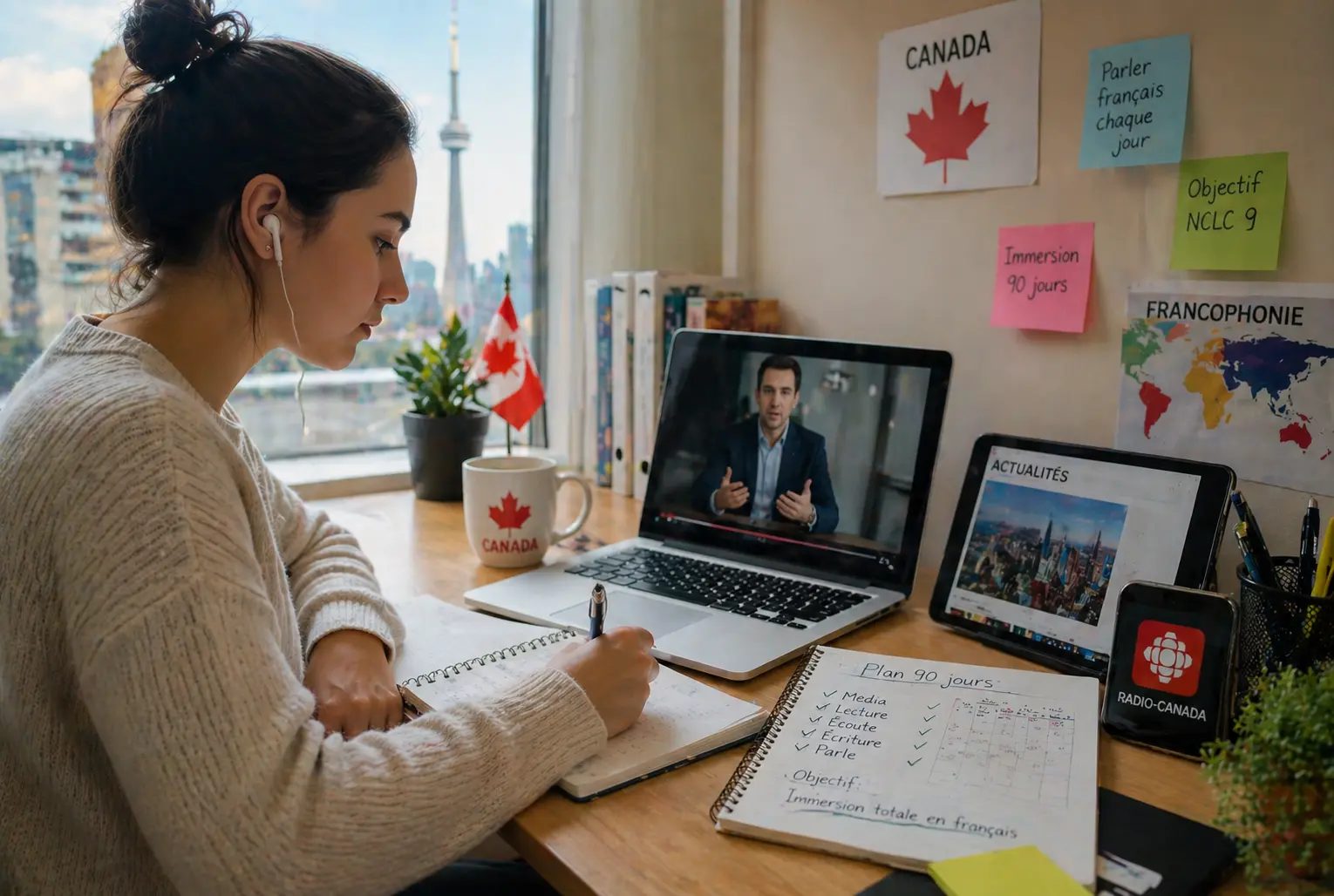
One pattern appears consistently in the testimonials of NCLC 9+ candidates regardless of their country of origin: daily exposure to authentic Canadian Francophone media. Not once a week. Not when they had time. Every day. Our guide to Canadian French Digital Resources for Authentic Preparation maps the available tools. Our article on Life in Canada: Cultural and Linguistic Context explains why this immersion matters beyond the exam itself. This article provides the operational link: a structured 90-day programme you can implement from anywhere in the world, for free, starting today.
The programme's transformative objective: In 90 days of structured media exposure, the TCF Canada audio documents should feel familiar in register and rhythm — not because you have heard them before, but because the voices, topics and linguistic patterns have become your daily environment. Familiarity reduces cognitive load on exam day, freeing resources for actual comprehension rather than phonological decoding.
Canadian Francophone Media Map by TCF Canada Skill
For Listening Comprehension — Radio and Podcasts
| Media | URL | Content | TCF Level | Daily Use |
|---|---|---|---|---|
| ICI Radio-Canada Première | radio-canada.ca/premiere | News, debates, interviews, variety | B2–C1 | 30 min (core) |
| RFI Français Facile | savoirs.rfi.fr | Simplified news with transcript | B1–B2 | 15 min (phase 1) |
| Radio-Canada OHdio — "Le 15-18" | radio-canada.ca/ohdio | Daily variety magazine | B2–C1 | 20 min |
| Radio-Canada OHdio — "Les années lumière" | Radio-Canada OHdio | Science and environment (TCF domain) | B2–C1 | Episode/week |
| Radio-Canada OHdio — "Futur proche" | Radio-Canada OHdio | Technology and society | B2 | Episode/week |
For Reading Comprehension — Press and Official Sources
| Source | URL | TCF Strengths | Free Access |
|---|---|---|---|
| La Presse | lapresse.ca | All 8 TCF domains, journalistic style, all text types | Full (free app) |
| Le Devoir | ledevoir.com | Formal register, deep analysis, opinion pieces | Partial |
| Radio-Canada Info | radio-canada.ca/info | All levels, transcripts often available | Full |
| Canada.ca | canada.ca/fr | Administrative documents, immigration vocabulary | Full |
| L'Acadie Nouvelle | acadienouvelle.com | New Brunswick Francophone context outside Québec | Partial |
The 90-Day Programme: Phase-by-Phase Structure
Phase 1 — Acclimatisation (Weeks 1–4): Building Phonological Tolerance
The objective of phase 1 is not comprehension — it is phonological tolerance. Your ear must learn to stop treating Quebec French rhythm and intonation patterns as foreign before it can efficiently decode content. This happens through accumulated exposure, not through analytical study of phonological rules.
Daily routine Phase 1: 15–20 min of Radio-Canada OHdio as passive background (during breakfast, commuting or exercise) + 15 min of RFI Français Facile with the written transcript displayed for comprehension anchoring. No active note-taking required. Total daily commitment: 30–35 minutes.
Weekend routine Phase 1: One full episode of "Découverte" (Radio-Canada science documentary series, available on YouTube) + note 10 new words from the episode. These longer formats develop the sustained listening attention that TCF Canada 4-minute audio documents require.
Phase 2 — Active Immersion (Weeks 5–8): Vocabulary and Structural Building
Daily routine Phase 2: 20 min active Radio-Canada listening with notepad — note main information (who, what, when, where) and 5 unfamiliar vocabulary items per session. Look each unfamiliar term up immediately. Add to your domain vocabulary Anki deck with the Radio-Canada sentence as the contextual example on the card.
3 times per week: Shadowing exercise on a 60-second Radio-Canada extract following the shadowing protocol from our TCF Canada Speaking: Advanced Techniques article. This bridges listening and speaking skill development within the media immersion routine.
Daily reading routine: 2 La Presse articles each morning (15 min). Extract and add domain vocabulary to Anki. Once per week: write a 100-word summary of one article — direct TCF Canada writing task 1 practice embedded naturally into the reading routine.
Phase 3 — Thematic TCF Canada Immersion (Weeks 9–13): Domain-Aligned Weekly Cycles
Align each week's media consumption to one TCF Canada thematic domain, cycling through all eight by the end of the programme. This creates concentrated exposure that simultaneously reinforces listening comprehension, domain vocabulary, and the text-type conventions each domain uses in TCF Canada documents.
| Week | Domain | Primary Sources | Vocabulary Target |
|---|---|---|---|
| Week 9 | Health | Radio-Canada Santé + RAMQ website | CLSC, RAMQ, Carte Soleil, médecin de famille |
| Week 10 | Housing | Kijiji.ca + La Presse Immobilier | Bail, loyer, plex, condo, Régie du logement |
| Week 11 | Employment | La Presse Carrières + Indeed.ca | AE, CNESST, taux horaire, période d'essai |
| Week 12 | Environment | Le Devoir Environnement + Radio-Canada Science | Bilan carbone, matières résiduelles, feux de forêt |
| Week 13 | Immigration | Canada.ca + IRCC pages + immigrant podcasts | ITA, PNP, permis ouvert, parrainage |
Building Your Permanent Digital Francophone Environment
One-time setup (30 minutes) that generates months of passive exposure:
- ☐ Set your smartphone's display language to French
- ☐ Set Radio-Canada Info as your browser homepage
- ☐ Follow @RadioCanada, @LaPresse, @LeDevoir on social media
- ☐ Join 3 Facebook groups of French-speaking Canadians for authentic unscripted exchanges
- ☐ Subscribe to Radio-Canada's French-language daily email newsletter
- ☐ Enable Radio-Canada breaking news push notifications
- ☐ Install Radio-Canada OHdio and download 5 podcast episodes for offline listening
- ☐ Add TV5MONDE to your streaming home screen favourites
"I started playing Radio-Canada ICI Première every morning over breakfast — just 20 minutes. At the start I understood maybe 40% of the content. By the end of the third month, I was at 85 to 90% without conscious effort. On TCF Canada test day, the audio documents felt almost familiar — not because I had heard them before, but because the voices, rhythm and vocabulary register had become my daily environment for 3 months. I scored 561 in listening comprehension — NCLC 9." — Walid, architect from Tunis, now in Ontario
 TCF Canada Hub
0 Commentaires
aucun commentaire
Soyez le premier a partager votre avis !