-
Auteur :
 TCF Canada
- Feb 27, 2026
Francophone Mobility Programs 2026: Faster Routes to Canadian Permanent Residence (PR)
- Blog
- /
- Article

Francophone Mobility Programs 2026: Faster Routes to Canadian Permanent Residence (PR)
When Yasmine, a 31-year-old registered nurse based in Rabat, started mapping out her Canada plan in early 2026, she assumed she had only one realistic option: the “classic” Express Entry pathway—despite a CRS score around 412, which typically leaves many candidates waiting for a long time. “An advisor told me to be patient for a couple of years and hope for lower cut-offs, or to invest in a Canadian master’s degree to raise my points,” she says from Ottawa, where she now works in a francophone healthcare environment.
What she discovered later completely changed the game: as a qualified francophone in a high-demand field, she could treat immigration like a strategy portfolio—not a single lottery ticket. Instead of relying only on general draws, she built a plan around three accelerators: (1) using the Francophone Mobility Program to secure a work permit without an LMIA, (2) leveraging Canadian work experience to unlock the Canadian Experience Class (CEC) with francophone-friendly selection dynamics, and (3) staying eligible for targeted federal selections that increasingly favor high-need occupations.
In her case, she landed a Canadian offer, applied for a work permit through Francophone Mobility, started working, and then used that “Canadian year” as a launching pad toward PR. “My TCF Canada NCLC 8 wasn’t just a result sheet—it became access to an ecosystem of options that most people don’t even know exists,” she concludes.
2026 Update: The francophone pathway ecosystem has become more visible and more structured. Employers outside Quebec increasingly recruit French-speaking profiles, and candidates who combine work-permit entry + Canadian experience + francophone eligibility often shorten their timeline dramatically compared to “Express Entry only” planning.
Before you choose a pathway, make sure you understand how language points interact with Express Entry and why timing your TCF Canada strategically can change your chances more than people think. :contentReference[oaicite:0]{index=0}
The Francophone Mobility Ecosystem in 2026: 5 Interconnected Routes
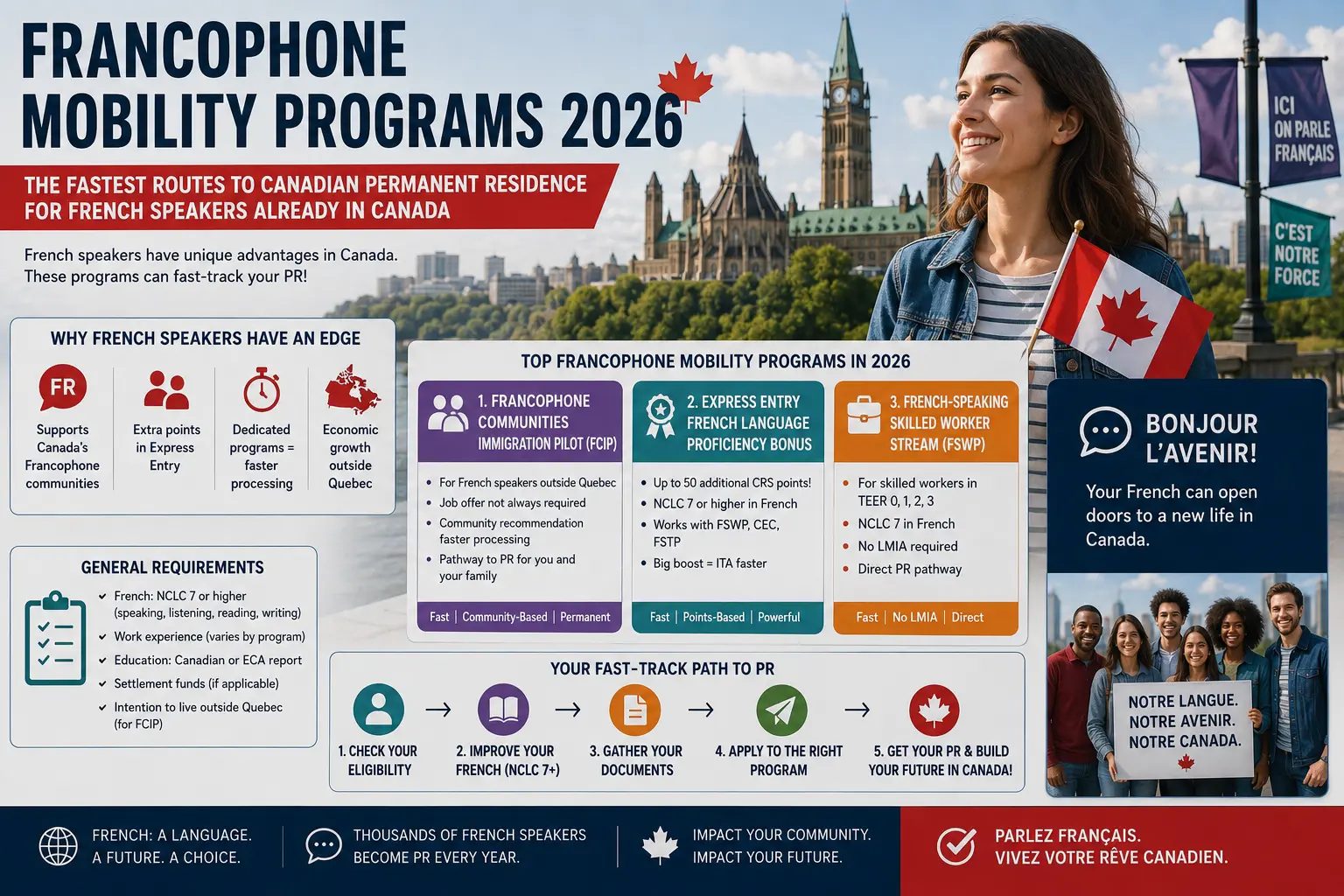
Contrary to the common belief that francophone immigration equals “Express Entry or nothing,” the 2026 landscape is more like a network of five routes. The smartest candidates don’t pick just one—they design a plan that keeps multiple doors open at the same time.
| Route | Core Idea | Typical Timeline | Main Advantage |
|---|---|---|---|
| 1. Francophone Mobility Program (FMP) | LMIA-exempt employer-specific work permit for francophones (outside Quebec) | Often weeks rather than months (varies by case/region) | Faster entry to Canada + direct access to Canadian work experience |
| 2. Canadian Experience Class (CEC) + Francophone Advantage | PR after one year of qualified Canadian work experience + language results | Several months after eligibility + processing time | Canadian experience improves competitiveness and unlocks more draw opportunities |
| 3. Federal Francophone Selections | Invitations focused on French-speaking candidates meeting language thresholds | Depends on draw frequency and pool profile | In many periods, francophone-focused selection can be significantly more accessible than general draws |
| 4. Francophone-Friendly Provincial Pathways | Provinces prioritize French-speaking talent through streams or targeted recruitment | Often months (province-dependent) | A nomination can strongly boost your federal competitiveness |
| 5. Targeted Occupation Selections + Francophone Profile | Occupation-focused invitations (e.g., healthcare, STEM, trades) combined with language strength | Periodic / depends on policy focus | “Double leverage”: labor-market demand + French-language value |
Key Strategy Insight: These five routes are not mutually exclusive. The strongest approach in 2026 is often a “portfolio plan”: enter quickly via a francophone work permit, accumulate Canadian experience, and stay eligible for both federal and provincial opportunities at the same time.
Route #1: Francophone Mobility Program (FMP) — The Underused Work-Permit Shortcut
What it is (in plain English)
The Francophone Mobility Program is designed to help employers outside Quebec hire French-speaking talent without the LMIA step (the labor-market approval process many employers avoid because it can be slow and costly). For candidates, this can translate into a simpler employer pathway—if you can secure an offer in the right location and job category.
Why employers like it (and why that matters to you)
- Less friction for HR: fewer administrative barriers compared to LMIA-heavy recruitment.
- Faster onboarding: easier to justify “we need you soon,” especially in healthcare and services.
- Practical result: more employers are willing to consider international francophone candidates when the process is easier.
FMP Eligibility Snapshot (2026)
| Requirement | What’s expected | Typical proof |
|---|---|---|
| French ability | Meeting the program’s language threshold (often aligned with recognized tests) | TCF Canada / TEF Canada (or eligible diploma where applicable) |
| Job offer | Skilled occupation, outside Quebec, with an employer ready to support the process | Signed offer letter and job details (NOC/TEER alignment) |
| Fit for the role | Education/experience matching the position | Degrees, licenses (if regulated), reference letters |
| Location rule | Job must be outside Quebec | Employer address and work location |
Reality check: “minimum language” vs hiring reality
Even if a program threshold sounds modest on paper, many employers—especially in regulated or client-facing roles—will still look for comfortable professional fluency. In practice, aiming for NCLC 7–8+ often makes you far more credible in interviews, improves workplace performance, and strengthens your later PR profile.
Finding a Canadian job offer as a francophone: what works in 2026
The job offer is the bottleneck—so focus on channels where employers already expect to hire bilingual or French-speaking talent.
- Job Bank (Canada): use filters like bilingual/French where available.
- Francophone recruitment events: virtual fairs and employer sessions often outperform random applications.
- LinkedIn targeting: search “bilingual / francophone / Ottawa / Moncton / Sudbury” + your role.
- Francophone institutions: hospitals, schools, community organizations, and public-facing services often need French capacity.
Route #2: CEC + Francophone Planning — Turning “1 Year in Canada” into PR Momentum
Think of CEC as the “conversion stage.” If you can legally work in Canada in a skilled role long enough to qualify, your profile changes: Canadian experience becomes a competitive asset, and your story becomes simpler to prove (employment records, pay slips, local references).
| Factor | Typical impact | Why it matters |
|---|---|---|
| Canadian work experience | Usually increases competitiveness | Helps across multiple routes (CEC, provincial streams, sometimes targeted selections) |
| Francophone profile | Can open specialized selections and employer demand | Creates “two engines”: labor-market + language policy priorities |
| Faster feedback loop | More frequent chances to be selected than waiting abroad | You can adapt quickly: retake language tests, adjust job, improve profile |
Practical Timeline: FMP → 12 Months Work → CEC Readiness
- Step 1: Secure TCF/TEF results that support your target pathway (ideally NCLC 7–9).
- Step 2: Obtain an offer outside Quebec and apply via Francophone Mobility where eligible.
- Step 3: Start work in Canada and document everything (contracts, pay stubs, duties).
- Step 4: When you reach the required experience threshold, build or update your PR profile and stay active for draws/streams.
Route #3: Francophone-Focused Federal Selections — Why French Can Change the Math
One of the biggest shifts of the last few years is that French-speaking candidates can sometimes receive attention through selection patterns that don’t mirror general draws. Instead of fixating on “general cut-offs,” francophone candidates should monitor the trend lines that apply to them—because policy priorities and draw types can create very different outcomes.
What to monitor (without getting lost in the noise)
- Draw type: general vs category-based vs francophone-focused.
- Your profile readiness: language validity, documents, work history consistency.
- Occupation leverage: healthcare roles often align with national shortages.
The “Portfolio” Strategy: Build 2–3 Paths at the Same Time
Case example (portfolio mindset): “Marc, 29, Web Developer”
Instead of betting everything on one route, Marc does three things in parallel:
- Primary path: keeps an active federal profile and stays draw-ready.
- Backup path: prepares for provincial options that value French capacity.
- Acceleration path: applies to francophone-friendly employers to enter faster through a work permit.
Why it works: one door can close, but the system still offers other entry points—especially when your French result is strong and your occupation is in demand.
Essential Resources for Francophone Mobility (2026)
Conclusion: French Is Not a “Bonus” — It Can Be a System Advantage
Yasmine’s story highlights a lesson many candidates learn late: in 2026, being a strong francophone is not just one advantage—it can be a multiplier across several systems at once. Where a candidate may wait indefinitely by relying only on general selection patterns, a francophone candidate can often create movement by combining:
- A faster employer route (Francophone Mobility where eligible)
- Canadian work experience that unlocks stronger PR positioning
- Eligibility for francophone-focused or category-focused opportunities
- Provincial pathways that value French capacity in communities outside Quebec
Your TCF Canada result can be more than a score—it can be your entry key to multiple routes. Build your plan like a portfolio, stay document-ready, and keep at least two pathways active at the same time. 🇨🇦
* * *
Frequently Asked Questions
It’s an LMIA-exempt employer-specific work permit option that helps employers outside Quebec hire French-speaking workers with less administrative friction. For candidates, it can mean a faster, more realistic path to enter Canada legally with a job offer.
No. You need to meet the program’s French-language expectations and demonstrate practical ability for the job. In real hiring situations, aiming for NCLC 7–8+ makes you more credible in interviews and stronger for later PR steps.
No. It is a work-permit route, not PR by itself. The strategy is to use it to enter Canada faster, gain skilled Canadian work experience, and then convert that advantage into PR through routes like CEC, francophone-focused draws, or provincial nominations.
Because Canadian work experience can improve your competitiveness and unlock additional PR pathways. It also gives you a faster feedback loop: you can adjust your profile, retake language tests, and build a stronger case while already in Canada.
Yes. A strong approach is a portfolio plan: keep your Express Entry profile active and draw-ready while you pursue a francophone employer route, and optionally add provincial pathways in parallel.
Roles with clear labor demand and bilingual service needs often perform best (e.g., healthcare, education support, client-facing services, some public-sector environments, and certain skilled trades/technical roles depending on province).
Yes. Francophone Mobility is specifically designed for employers and job locations outside Quebec. If your offer is in Quebec, you must look at other work permit routes.
Building only one path and waiting passively. The main advantage of francophone status is that it can open multiple doors—so you should keep at least two routes active (federal + employer + provincial) instead of relying on one outcome.
Laissez un commentaire
Votreadresse email ne sera pas publie. Les champs obligatoires sont marque avec *


 TCF Canada Hub
0 Commentaires
aucun commentaire
Soyez le premier a partager votre avis !