-
Auteur :
 TCF Canada
- Aug 03, 2026
Preparation Strategy
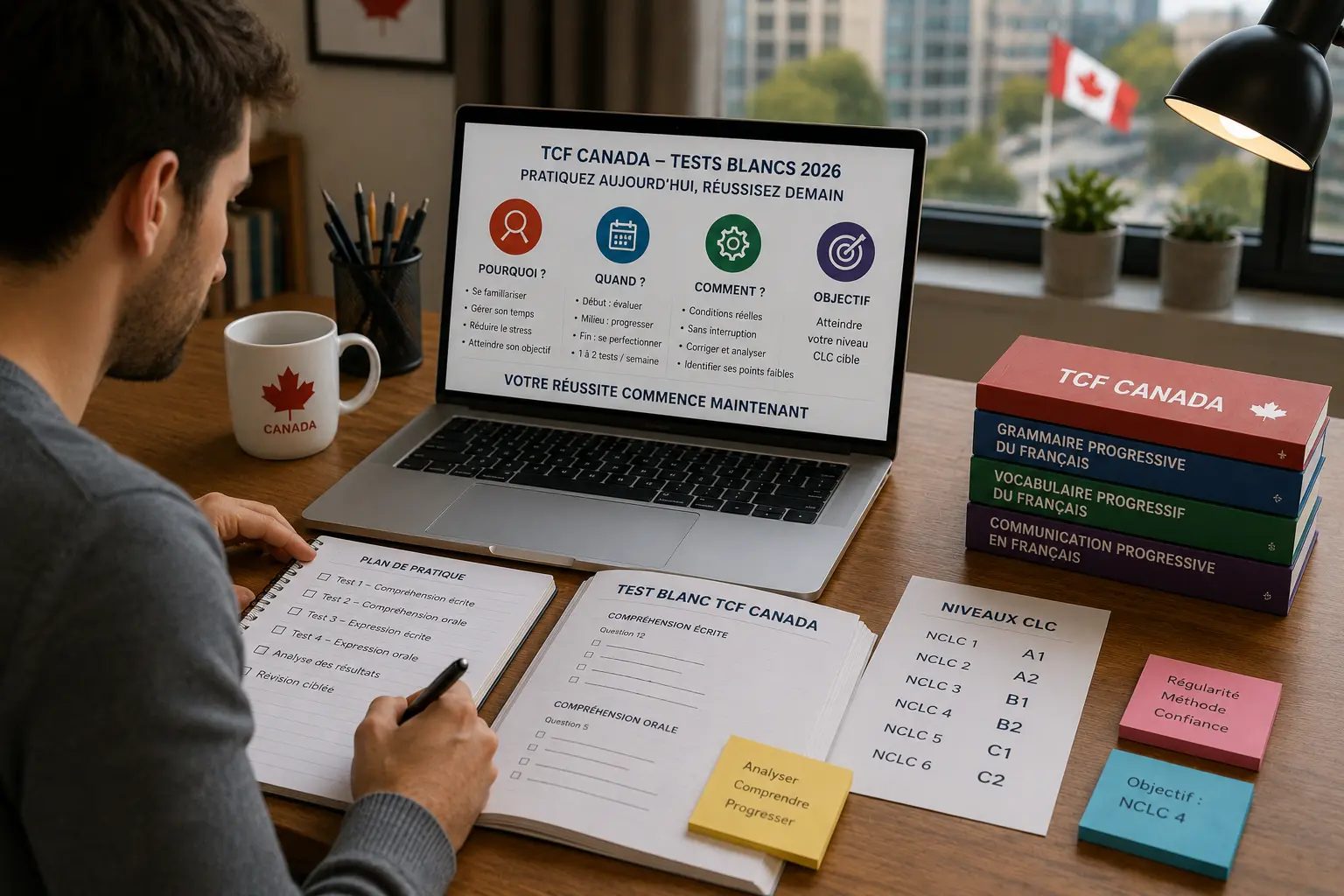
TCF Canada Mock Tests 2026: Why, When and How to Use Practice Exams to Guarantee Your Target NCLC Score
Mock tests are the single most underutilized tool in TCF Canada preparation. Candidates spend months on vocabulary lists, grammar exercises and listening practice — yet many skip or minimize mock testing, only taking one or two before the real exam. The result: NCLC scores that don't reflect their actual preparation level. This guide explains why mock tests are not just assessment tools but the most powerful skill-development mechanism available — and gives you the exact protocol to use them for maximum benefit.
The 4 Critical Functions of TCF Canada Mock Tests
What a mock test does that no other preparation tool can:
- Measures real performance under pressure: Your knowledge under calm conditions systematically overstates your exam-day performance. Mock tests reveal the gap between what you know and what you can produce under time constraints and exam stress.
- Builds timing automaticity: The ability to pace yourself across 60 minutes of reading, 35 minutes of listening, 60 minutes of writing without actively monitoring the clock requires practice. Mock tests build this timing instinct.
- Identifies systematic error patterns: One vocabulary gap revealed by a mock test is more valuable than 20 vocabulary items memorized from a list. Patterns only emerge from performance data.
- Reduces exam-day novelty stress: Candidates who have taken 4+ full mock tests report significantly lower test-day anxiety than those who haven't. Familiarity with the format converts unknown into known.
The 3-Phase Mock Test Protocol
Phase 1 — Diagnostic (Beginning of preparation, Week 1):
Purpose: Establish your true baseline NCLC, not your estimated level. Take one complete mock test under real conditions — no breaks, no dictionary, timed accurately. Analyze results by skill and by question type. This diagnostic shapes your entire preparation plan.
Phase 2 — Developmental (Mid-preparation, every 2-3 weeks):
Purpose: Track progress and identify whether your preparation is working. Take one complete or partial mock test every 2-3 weeks. After each test, spend 2 hours analyzing errors — not the correct answers, but why you made the mistakes you made. Group errors into categories: vocabulary gap, comprehension strategy failure, timing issue, register error.
Phase 3 — Validation (Final 3 weeks before exam):
Purpose: Confirm readiness and fine-tune. Take 2-3 complete mock tests under conditions as close to the real exam as possible: same time of day as your exam, same equipment (headphones, keyboard), same exam hall silence. Your target NCLC must appear consistently across at least 2 of these final tests before you can be confident about your exam-day performance.
Where to Find Validated TCF Canada Mock Tests
| Source | Type | Cost | Quality Level |
|---|---|---|---|
| tcfonline.com (official FEI) | Full mock exam, all 4 skills | €15-20 per test | ⭐⭐⭐⭐⭐ — Official, most accurate simulation |
| FEI preparation manuals (Hachette FLE) | Partial exercises + model exams | €20-30 per book | ⭐⭐⭐⭐ — High quality, official publisher |
| Preparation platforms (third-party) | Exercises and partial tests | €10-50/month | ⭐⭐⭐ — Variable quality, verify alignment |
| Free YouTube mock exercises | Partial exercises only | Free | ⭐⭐ — Supplementary only, not full simulations |
The 2-Hour Post-Mock Analysis Protocol
What to do after every mock test (2 hours):
- Hour 1 — Error categorization: For every wrong or uncertain answer, write: (a) why you chose your answer, (b) what information you missed, (c) what category of error this represents (vocabulary/strategy/timing/register)
- 30 min — Pattern analysis: Group your errors. Are most errors in a particular document type? A particular skill? A particular time window in the exam? The pattern tells you exactly where to focus next week.
- 30 min — Corrective action planning: For each error pattern, write one specific preparation activity to address it this week. "Work on listening to interview-format documents" is better than "improve listening comprehension".
The 3 biggest mock test mistakes that waste your preparation investment:
- Taking mock tests without analyzing errors: A mock test you don't analyze is just a measurement. Analysis is where the learning happens. Never take a mock test without allocating 90 minutes for post-test analysis.
- Reviewing correct answers instead of wrong ones: You already know what you know. Your development comes from understanding your errors. Spend 80% of analysis time on wrong or uncertain answers.
- Taking too many mocks too close together: More than one full mock test per week is counter-productive. Your brain needs consolidation time between performance measures. Quality of analysis beats quantity of tests.
The complete guide to integrating practice tests into your preparation strategy is at The Critical Role of Practice Tests. For the preparation study log system that helps you track your mock test progress systematically, read Your TCF Canada Study Log: The 5-Block System. The strategic 3-month preparation plan that incorporates mock tests at optimal intervals is at Strategic TCF Canada Planning: The 3-Month Method. The French companion guide covering practice test strategy at Le Rôle des Tests Blancs provides additional French-language guidance. For decoding your TCF Canada results after taking mock or real tests, read Decoding Your TCF Canada Results.

 TCF Canada Hub
0 Commentaires
aucun commentaire
Soyez le premier a partager votre avis !