-
Auteur :
 TCF Canada
- Dec 25, 2025
TCF Canada Level Assessment: How to Accurately Measure Your Current Skills
- Blog
- /
- Article
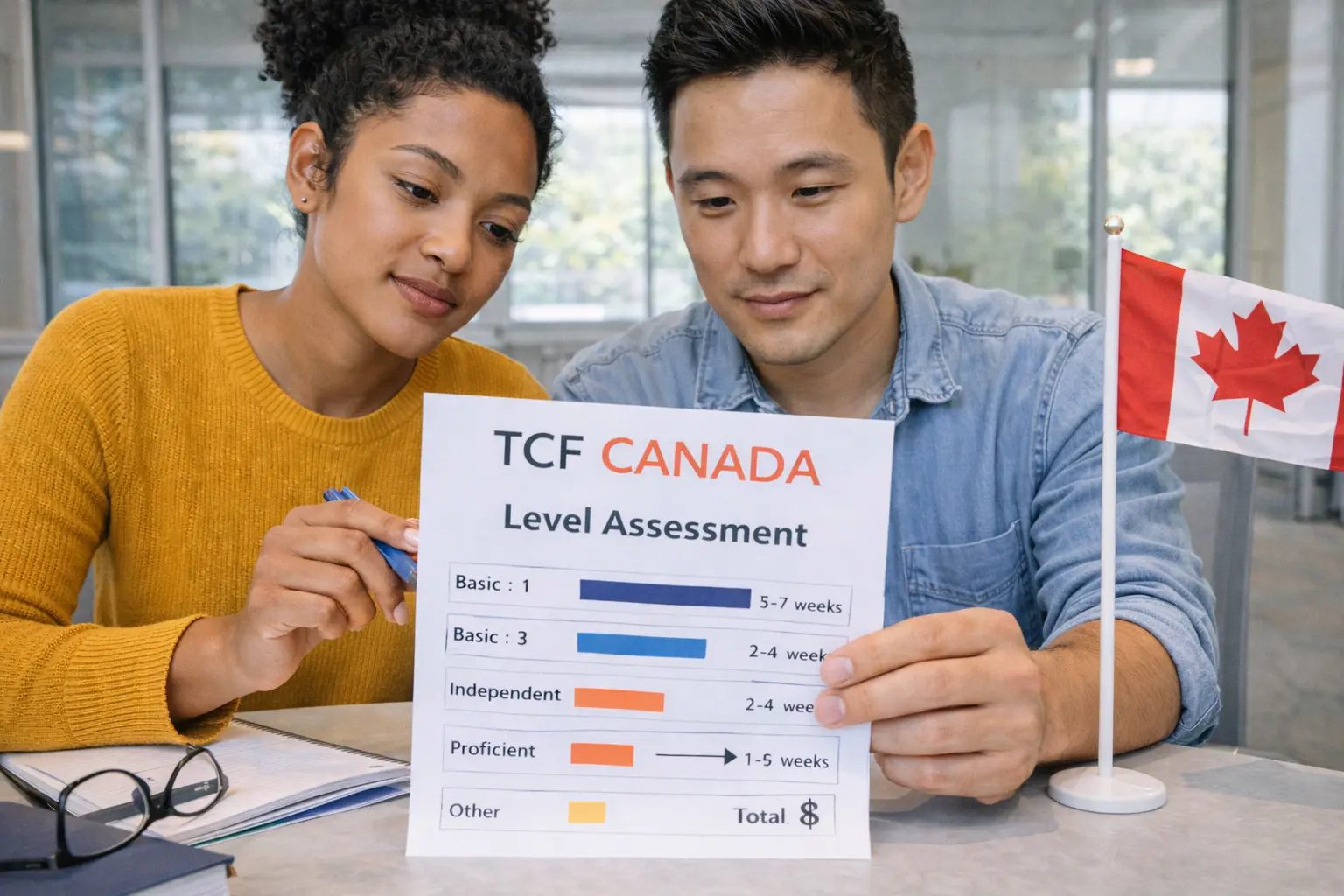
When Marc, a Lyon-based IT engineer with years of professional French-language work experience and solid educational French background, decided to undertake TCF Canada examination preparation, his very first logical step was searching online for a quick, convenient assessment test to "evaluate his current level" and establish his baseline proficiency. "I took three completely different online assessment tests within a rapid 30-minute period and received wildly contradictory results varying dramatically from intermediate B1 to advanced C1—a massive two-level discrepancy representing potentially years of skill difference," he recounts with evident irony and frustration. "I very quickly understood through this confusing experience that accurate, reliable level assessment specifically for TCF Canada preparation required an infinitely more rigorous, specialized, and systematic approach than the superficial generic online quizzes I had naively relied upon initially."
Why Accurate Assessment Is Your Preparation Foundation
Marc's frustrating story illustrates a pervasive and problematic reality facing virtually all TCF Canada candidates: the vast majority of easily available online assessment tools and generic French proficiency tests are fundamentally inadequate, misleading, and often counterproductive for accurately evaluating readiness and proficiency specifically for TCF Canada's unique requirements, format peculiarities, and Canadian context specifics. Yet paradoxically, precise, honest assessment of your actual current level—not your hoped-for or imagined level, but your demonstrated performance level—constitutes the absolute foundation of any effective, efficient preparation strategy. Without this exact, data-driven knowledge of your genuine strengths to leverage and critical weaknesses to address, you risk catastrophically wasting hundreds of precious preparation hours on skills you've already thoroughly mastered while simultaneously and unknowingly neglecting your true high-impact improvement areas that could make the crucial difference between immigration success and failure.
Critical Assessment Reality: Research on TCF Canada candidate preparation shows that candidates who invest 3-5 hours in comprehensive, accurate initial assessment before beginning preparation achieve 35-40% higher first-attempt success rates than those who skip assessment or rely on superficial quick tests. The time invested in thorough assessment returns exponentially through targeted, efficient preparation eliminating wasted effort.
Critical Limitations of Classic Generic French Assessments
Why Standard CEFR Tests Mislead TCF Canada Candidates
Sophie, a reconverted English teacher with decades of language teaching experience who successfully relocated to Montreal, shares her revealing and cautionary assessment experience: "I initially and confidently used multiple classic CEFR-based assessment tests that consistently indicated I possessed solid C1 advanced general French proficiency. Feeling reassured and confident about my strong baseline, I subsequently took my first authentic TCF Canada practice test expecting comparable results and was absolutely shocked to obtain scores equivalent to only NCLC 6 in certain critical competencies—nearly two full levels below my CEFR assessment predictions. The shock was brutal but ultimately salutary and transformative: I immediately understood that TCF Canada assessment requires evaluation against specific performance criteria, Canadian context familiarity, test format mastery, and time-pressure performance that generic CEFR tests completely ignore or inadequately measure."
The Five Critical Gaps Between Generic Tests and TCF Canada Reality:
Gap #1: Time Pressure Performance vs. Unlimited Time Accuracy
- Generic Tests: Usually allow unlimited or very generous time; measure knowledge in ideal conditions
- TCF Canada Reality: Strict, unforgiving time constraints; measures performance under significant pressure
- Impact: Candidates often score 1-2 levels lower under TCF timing than in untimed conditions
- Example: Reading comprehension that achieves 95% accuracy untimed may drop to 70% under TCF's strict timing
Gap #2: Specialized Canadian Vocabulary vs. General French Vocabulary
- Generic Tests: Evaluate standard international French vocabulary
- TCF Canada Reality: Extensively tests Quebec French particularities, Canadian administrative terminology, immigration-specific vocabulary, North American cultural context
- Impact: Strong standard French speakers may struggle with Canadian-specific terms and contexts
- Critical Examples:
- Daily life: "dépanneur" (convenience store), "magasinage" (shopping), "char" (car)
- Education: "cégep" (Quebec college), "maîtrise" (master's degree)
- Administration: "RAMQ" (Quebec health insurance), "NAS" (Social Insurance Number)
- Weather: "poudrerie" (blowing snow), "sloche" (slush)
Gap #3: Unique Question Format Strategies vs. General Comprehension
- Generic Tests: Straightforward comprehension questions testing understanding
- TCF Canada Reality: Specific MCQ formats with strategic traps, particular elimination strategies, format-specific techniques
- Impact: Test-taking strategy mastery can improve scores 15-25% independent of language level
- Examples:
- Listening: Must answer while audio plays; cannot review or backtrack
- Reading: Complex multi-part questions requiring strategic time allocation
- Writing: Specific task formats (personal message, article, argumentation) with precise requirements
- Speaking: Structured response formats with strict timing requiring strategic planning
Gap #4: Accent Diversity Exposure vs. Standard French
- Generic Tests: Usually standard France French with clear Parisian pronunciation
- TCF Canada Reality: Diverse authentic accents including Quebec, Acadian, African francophone, various French regional accents
- Impact: Listening comprehension can drop 20-40% when encountering unfamiliar Quebec accent for first time
- Preparation Need: Extensive exposure to Quebec French media essential for acclimatization
Gap #5: NCLC Assessment Criteria vs. CEFR European Standards
- Generic Tests: Evaluate against CEFR (Common European Framework) descriptors and standards
- TCF Canada Reality: Scored and converted to NCLC (Canadian Language Benchmarks) with different emphasis and criteria
- Impact: CEFR B2 doesn't perfectly align with NCLC 7; conversion isn't always predictable or linear
- Critical Difference: NCLC emphasizes practical communication competency and task completion over theoretical knowledge
Sophie's Assessment Gap Discovery:
| Competency | Generic CEFR Test Result | First TCF Canada Practice Test | Gap (Levels) | Primary Cause |
|---|---|---|---|---|
| Reading Comprehension | C1 (no time limit) | NCLC 7 (B2 equivalent) | -1 level | Time pressure performance degradation |
| Listening Comprehension | C1 (standard accent) | NCLC 6 (B1+ equivalent) | -2 levels | Quebec accent unfamiliarity + real-time processing |
| Written Expression | C1 (general topics) | NCLC 7 (B2 equivalent) | -1 level | Specific task format requirements + Canadian context |
| Oral Expression | C1 (conversational) | NCLC 6 (B1+ equivalent) | -2 levels | Structured format + strict timing + no interlocutor feedback |
Sophie's Critical Lesson: "The 1-2 level gap I discovered between generic assessment and TCF reality wasn't because my French was weaker than I thought—my linguistic knowledge was solid. The gap existed because TCF Canada tests different skills: performance under pressure, format mastery, Canadian context familiarity, and strategic test-taking. Generic tests measure knowledge; TCF Canada measures performance."
Comprehensive Seven-Dimension Assessment Protocol
Why Multi-Dimensional Assessment Matters
Antoine, a web developer from Nantes who successfully relocated to Calgary, developed a rigorous, comprehensive seven-dimension assessment protocol after experiencing several costly false estimations that wasted weeks of misdirected preparation effort: "I created my own systematic seven-dimension assessment system after realizing that unidimensional 'level tests' gave me incomplete, misleading snapshots. This multidimensional approach provided me with a precise, actionable picture of my real capabilities across all relevant performance dimensions and allowed me to target my limited preparation time with surgical precision for maximum impact."
Dimension 1: Pure Technical Linguistic Competence (Foundation Layer)
This first fundamental dimension measures your objective, demonstrable linguistic knowledge foundation: grammar accuracy and range, active and passive vocabulary breadth, syntactic complexity capability, and orthographic precision. This technical base constitutes the essential foundation upon which all other functional communication skills necessarily rest and develop.
Technical Competency Comprehensive Assessment (90 minutes total):
Grammar Mastery Test (30 minutes - 20 questions):
- Verb Conjugation (5 questions):
- Present, passé composé, imparfait, futur, conditionnel, subjonctif
- Irregular verb mastery
- Complex tense agreement and sequence
- Agreement Rules (5 questions):
- Subject-verb agreement in complex sentences
- Past participle agreement with avoir/être
- Adjective-noun agreement including position
- Complex Structures (5 questions):
- Relative pronouns (qui, que, dont, où, lequel, etc.)
- Subjunctive mood triggers and usage
- Conditional and hypothetical constructions
- Prepositions and Articles (5 questions):
- Correct preposition selection (à/de/en/dans/sur/pour/par, etc.)
- Definite/indefinite/partitive article usage
- Article contraction and elision
General Vocabulary Assessment (25 minutes - 25 questions):
- Synonyms and Antonyms (8 questions): Testing breadth of lexical knowledge
- Nuance and Precision (8 questions): Distinguishing similar words with subtle differences
- Idiomatic Expressions (5 questions): Common French idioms and figurative language
- Register Appropriateness (4 questions): Formal vs. informal vocabulary selection
Specialized Canadian Vocabulary (15 minutes - 15 questions):
- Immigration and Administration (5 questions):
- Express Entry, résidence permanente, évaluation des diplômes
- RAMQ, NAS/SIN, permis de travail
- Professional and Workplace (5 questions):
- Reconnaissance professionnelle, marché du travail, compétences
- CV, entretien, formation professionnelle
- Daily Life Quebec French (5 questions):
- Dépanneur, magasinage, char, fin de semaine
- Accommodations, weather, regional terms
Orthographic Accuracy (10 minutes - 10 questions):
- Complex word spelling (accents, double consonants, silent letters)
- Homophones (a/à, ou/où, ses/ces/c'est/s'est, etc.)
- Common spelling exceptions and irregularities
Syntactic Complexity (10 minutes - 10 questions):
- Complex sentence construction with multiple clauses
- Subordination and coordination mastery
- Sentence variety and sophistication
Dimension 1 Scoring and Interpretation:
| Total Correct (out of 80) | Percentage | Technical Level | CEFR Equivalent | Interpretation |
|---|---|---|---|---|
| 72-80 | 90-100% | Advanced | C1-C2 | Solid technical foundation; minimal grammar/vocabulary work needed |
| 64-71 | 80-89% | Upper-Intermediate | B2+ | Strong base; targeted refinement of weak areas |
| 56-63 | 70-79% | Intermediate | B2 | Functional competence; systematic improvement needed |
| 48-55 | 60-69% | Lower-Intermediate | B1+ | Basic foundation present; substantial development required |
| <48 | <60% | Elementary | A2-B1 | Fundamental gaps; extensive foundation building necessary |
Dimension 2: Performance Under Time Constraint (Pressure Test)
Many candidates discover with shock and surprise that their demonstrated proficiency level drops dramatically—sometimes by 30-50% or more—under the strict time pressure conditions that characterize actual TCF Canada testing. Lucie, an accountant from Bordeaux, provides this sobering testimony: "In completely normal, relaxed, untimed conditions, I demonstrated excellent reading comprehension with 90-95% accuracy and sophisticated understanding. However, when I took my first timed practice test under strict TCF Canada timing constraints, my performance plummeted catastrophically to barely 65% accuracy—a devastating 25-30 percentage point drop representing potentially multiple NCLC levels. This awareness of my time-pressure vulnerability completely reoriented my entire preparation focus toward speed-building and stress management rather than pure comprehension improvement."
Comprehensive Pressure Performance Assessment Protocol:
Phase 1: Baseline Establishment (Untimed Performance)
- Materials: Complete TCF Canada practice reading comprehension section (typically 50 questions)
- Conditions: No time limit; relaxed environment; ability to review and reconsider
- Instructions: Work carefully and thoroughly until achieving best possible accuracy
- Measurement: Record total correct answers and completion time
- Purpose: Establish your true comprehension ceiling in ideal conditions
Phase 2: Timed Performance Test (TCF Conditions)
- Materials: Equivalent difficulty practice reading section (different content, same format)
- Conditions: Strict 60-minute time limit (exact TCF timing); simulated test pressure
- Instructions: Complete as many questions as possible within time limit
- Measurement: Record total correct answers, total attempted, time utilization
- Purpose: Measure actual performance under realistic pressure
Phase 3: Pressure Coefficient Calculation and Analysis
- Accuracy Degradation: (Timed accuracy % ÷ Untimed accuracy %) × 100
- Speed-Accuracy Balance: Questions per minute vs. accuracy percentage
- Completion Rate: Percentage of questions attempted vs. total available
- Pressure Vulnerability Index: Percentage point drop from baseline
Lucie's Pressure Assessment Results:
| Test Condition | Questions Attempted | Correct Answers | Accuracy % | Time Used | Analysis |
|---|---|---|---|---|---|
| Baseline (Untimed) | 50/50 (100%) | 47/50 | 94% | 95 minutes | Excellent comprehension; slow careful processing |
| TCF Timed (60 min) | 42/50 (84%) | 28/42 | 67% | 60 minutes | Severe time pressure degradation; rushed errors; incomplete |
| Pressure Impact Analysis: Accuracy drop: 27 percentage points | Completion: Only 84% of questions | Pressure Coefficient: 0.71 (71% of baseline performance) | Conclusion: Critical time management weakness requiring intensive speed-building training | |||||
Critical Insight: If your Pressure Coefficient is below 0.80 (meaning you perform below 80% of your untimed baseline under time pressure), this represents a more urgent preparation priority than improving your baseline comprehension. TCF Canada tests performance, not just knowledge. Speed-building and stress management training should consume 30-40% of your preparation time.
Dimension 3: Familiarity with Canadian Cultural and Linguistic Ecosystem
This frequently underestimated dimension evaluates your practical knowledge of Canadian culture, Quebec French specificities, administrative systems, and contextual references that permeate virtually every TCF Canada exercise across all competencies. Thomas, an electrician from Toulouse who successfully relocated to Toronto, explains the surprising importance: "I was genuinely shocked by how significantly this dimension impacts comprehension and expression quality. Simply knowing Quebec linguistic particularities like 'dépanneur' vs. 'magasin,' understanding the Canadian education system structure with its cégeps and university distinctions, or recognizing cultural references to Canadian holidays, weather patterns, or social customs was often absolutely determining for correctly understanding exercise contexts, avoiding comprehension errors, and producing contextually appropriate responses."
Comprehensive Canadian Ecosystem Knowledge Assessment:
| Knowledge Domain | Essential Vocabulary Examples | Cultural Context Examples | TCF Impact Areas | Assessment Questions |
|---|---|---|---|---|
| Daily Life Vocabulary | Dépanneur, magasinage, char, fin de semaine, breuvage, souper | Quebec retail culture, meal timing, weekend structure | Listening comprehension dialogues; Reading everyday scenarios | 10 questions testing recognition and usage |
| Education System | Cégep, maîtrise, baccalauréat, formation professionnelle, université | Quebec pre-university colleges; degree nomenclature differences | Reading articles about education; Writing about academic background | 8 questions on system structure and terminology |
| Administrative & Immigration | RAMQ, NAS/NAS, permis de travail, résidence permanente, évaluation des diplômes | Healthcare system, social insurance, work authorization processes | Reading official documents; Understanding instructions | 10 questions on systems and procedures |
| Geography & Climate | Provinces, territoires, poudrerie, sloche, climat continental | Regional diversity, extreme weather vocabulary, geographic features | Listening to weather reports; Reading regional descriptions | 6 questions on geography and climate terms |
| Workplace Culture | Reconnaissance professionnelle, marché du travail, ordre professionnel, équité en emploi | Professional licensing, credential recognition, workplace equity | Speaking about career; Writing about professional experience | 8 questions on workplace systems |
| Social & Cultural | Multiculturalisme, bilinguisme, mosaïque culturelle, accommodation raisonnable | Canadian identity concepts, diversity policies, cultural debates | Reading opinion pieces; Speaking about social topics | 8 questions on social concepts |
Dimension 3 Scoring:
- 45-50 correct (90-100%): Excellent Canadian familiarity; minimal contextual barriers
- 38-44 correct (76-88%): Good foundational knowledge; some gaps to fill
- 30-37 correct (60-74%): Basic awareness; substantial learning needed
- <30 correct (<60%): Critical gap; intensive Canadian culture study essential
Thomas's Canadian Knowledge Impact: "After systematically building my Canadian ecosystem knowledge through 4 weeks of intensive Quebec media exposure (radio, TV, news, podcasts) and studying Canadian systems (education, healthcare, immigration), my reading and listening comprehension scores improved by 15-20 percentage points without any grammar or vocabulary study. Context familiarity eliminated comprehension barriers I hadn't even recognized existed."
Dimension 4: Mastery of TCF-Specific Question Formats and Strategies
TCF Canada employs highly specific, distinctive question formats and task structures that require particular strategic approaches fundamentally different from general French communication or even other standardized French tests. Marie, a pharmacist from Lille who successfully relocated to Montreal, shares this crucial realization: "My critical first error was naively assuming that speaking fluent, correct French naturally and confidently would automatically be sufficient for TCF Canada success. In sobering reality, each distinct TCF Canada question format—from listening MCQs to speaking structured tasks to writing specific text types—requires its own specific mastered technique and strategic approach. Systematically learning, practicing, and automatizing these format-specific techniques gained me approximately 20% improved performance across all competencies without any improvement in my underlying French proficiency—purely through strategic test-taking skill development."
Comprehensive Format Mastery Self-Assessment (4 hours total):
Reading Comprehension Format Mastery (60 minutes):
- Question Type 1: Fact-Finding (Simple Information Retrieval)
- Strategy: Keyword scanning; rapid location; minimal re-reading
- Assessment: 10 questions; measure speed and accuracy
- Target: 90%+ accuracy at 1 minute per question average
- Question Type 2: Inference and Implicit Meaning
- Strategy: Context analysis; author intention recognition; "reading between lines"
- Assessment: 10 questions requiring inference
- Target: 75%+ accuracy at 1.5 minutes per question
- Question Type 3: Global Comprehension (Main Idea, Purpose, Tone)
- Strategy: Skim-reading for gist; structural analysis; synthesis
- Assessment: 8 questions on overall meaning
- Target: 80%+ accuracy with rapid initial assessment
- Question Type 4: Detail Verification (True/False/Not Stated)
- Strategy: Careful elimination; trap recognition; precise verification
- Assessment: 12 questions testing attention to detail
- Target: 85%+ accuracy avoiding trap answers
Listening Comprehension Format Mastery (60 minutes):
- Task 1: Real-Time Processing (Answer While Listening)
- Challenge: No pause, no review, no backtracking
- Strategy: Anticipatory question reading; instant decision-making; move forward without dwelling
- Assessment: 15 questions with audio playing once
- Target: 70%+ accuracy under real-time pressure
- Task 2: Accent Diversity Recognition
- Challenge: Quebec, Acadian, African, various French regional accents
- Strategy: Accent familiarization training; focus on content not pronunciation
- Assessment: Mixed accent samples (30% Quebec, 40% France, 30% other)
- Target: <10% accuracy degradation vs. standard France French
- Task 3: Note-Taking While Listening
- Challenge: Simultaneous listening and writing
- Strategy: Abbreviated note system; key word capture; symbol usage
- Assessment: Long dialogues requiring note-based question answering
- Target: Effective notes supporting 75%+ question accuracy
Written Expression Format Mastery (90 minutes):
- Task 1: Personal Message (60-80 words, 15 minutes)
- Format: Email/letter responding to specific situation
- Requirements: Appropriate register; complete task fulfillment; correct format
- Assessment: Write 3 different message types; evaluate against rubric
- Target: NCLC 7+ level with complete requirements met
- Task 2: Informative Article (120-150 words, 30 minutes)
- Format: Objective article presenting information on topic
- Requirements: Objectivity; organization; information accuracy; appropriate tone
- Assessment: Write 2 articles; evaluate structure and content
- Target: Clear organization with NCLC 7+ expression
- Task 3: Argumentative Text (160-180 words, 45 minutes)
- Format: Structured argument defending position
- Requirements: Clear thesis; developed arguments; counterargument; conclusion
- Assessment: Write 2 argumentations; evaluate logic and expression
- Target: Sophisticated argumentation at NCLC 8+ level
Oral Expression Format Mastery (60 minutes assessment):
- Task 1: Personal Presentation (2 minutes)
- Format: Introduce yourself; explain Canada motivation; discuss experience
- Strategy: SALP structure (Salutation-Announcement-Link-Perspective)
- Assessment: Record 3 different presentations; evaluate structure and fluency
- Target: Smooth 2-minute delivery with clear organization
- Task 2: Problem-Solving Interaction (5.5 minutes with 2 min prep)
- Format: Negotiate solution to presented problem
- Strategy: SCORE method (Situation-Constraints-Options-Recommendation-Evaluation)
- Assessment: Practice 3 scenarios; evaluate completeness and persuasiveness
- Target: Complete SCORE framework executed confidently
- Task 3: Viewpoint Expression (4.5 minutes)
- Format: Defend position on controversial topic
- Strategy: PEEL argumentation (Point-Evidence-Explanation-Link)
- Assessment: Argue 3 different positions; evaluate logic and expression
- Target: Sophisticated argumentation with examples at NCLC 8+ level
Format Mastery Scoring Matrix:
| Competency | Formats Assessed | Mastery Level | Impact on Score | Priority Action |
|---|---|---|---|---|
| Reading | 4 question types | 85%+ average accuracy | High mastery | Maintain with light practice |
| Listening | 3 task types | 65% average accuracy | Moderate weakness | Intensive accent exposure + real-time practice |
| Writing | 3 text types | Task 1&2: Strong | Task 3: Weak | Selective weakness | Focus 80% effort on argumentation mastery |
| Speaking | 3 task types | Task 1: Strong | Task 2&3: Weak | Critical weakness | Structure training + daily practice on weak formats |
Dimension 5: Stress Resistance and Performance Consistency
This psychologically crucial dimension measures your capacity to maintain stable, predictable performance quality even under significant emotional stress, physical fatigue, environmental disruption, and psychological pressure—conditions that inevitably characterize high-stakes examination experiences. Caroline, a teacher from Marseille who successfully relocated to Ottawa, shares her consistency challenge: "I discovered through systematic testing that I had extremely variable, unpredictable performances depending heavily on my emotional and physical state. Some days under optimal conditions I performed brilliantly at NCLC 9 level; other days when tired, stressed, or distracted, I collapsed to barely NCLC 6. This wild performance irregularity and inconsistency proved more handicapping and problematic than my actual average skill level. I realized I needed to work specifically and systematically on stress management, emotional regulation, and consistent performance stabilization regardless of circumstances."
Comprehensive Seven-Day Consistency Assessment Protocol:
Test 1: Day 1 - Optimal Baseline Conditions
- Conditions: Well-rested (8+ hours sleep); calm, quiet environment; high motivation; peak energy time (usually morning)
- Measurement: Complete reading comprehension practice section (40 questions, 60 minutes)
- Purpose: Establish your ceiling performance under ideal conditions
- Scoring: Record total correct, accuracy percentage, subjective difficulty rating
Test 2: Day 3 - Post-Fatigue Performance
- Conditions: After full intense workday; mental/physical fatigue; sub-optimal energy
- Measurement: Equivalent difficulty reading section (different content, same format)
- Purpose: Measure fatigue impact on cognitive performance
- Analysis: Calculate performance degradation percentage vs. baseline
Test 3: Day 5 - Environmental Distraction Impact
- Conditions: Deliberately introduce realistic distractors (background noise, interruptions, suboptimal location)
- Measurement: Equivalent reading section with distraction simulation
- Purpose: Assess distraction resistance and focus maintenance
- Analysis: Quantify concentration fragility under imperfect conditions
Test 4: Day 7 - Artificial Stress Simulation
- Conditions: Extreme time pressure (reduce time by 25%); high-stakes framing ("this determines your immigration")
- Measurement: Equivalent section under maximum pressure simulation
- Purpose: Measure psychological stress impact on performance
- Analysis: Identify stress vulnerability and coping capacity
Caroline's Seven-Day Consistency Assessment Results:
| Test Day | Conditions | Questions Correct | Accuracy % | vs. Baseline | Performance Analysis |
|---|---|---|---|---|---|
| Day 1 | Optimal (baseline) | 37/40 | 92.5% | — | Excellent performance; represents true capability ceiling |
| Day 3 | Post-fatigue | 29/40 | 72.5% | -20 points | Severe fatigue degradation; concentration problems evident |
| Day 5 | Distractors | 31/40 | 77.5% | -15 points | Moderate distraction vulnerability; focus issues |
| Day 7 | Stress simulation | 27/40 | 67.5% | -25 points | Critical stress vulnerability; anxiety severely impairs performance |
| Consistency Analysis: Performance range: 67.5%-92.5% (25 point spread) | Standard deviation: 10.8 percentage points | Conclusion: Highly inconsistent performance; stress management and fatigue resistance training essential preparation components | |||||
Critical Consistency Principle: If your performance standard deviation exceeds 8-10 percentage points across varied conditions, consistency improvement should be a major preparation focus. On test day, you cannot control conditions—you might be fatigued from travel, distracted by noise, stressed by importance. Your preparation must build resilient, stable performance independent of circumstances. Candidates with high consistency (low standard deviation) significantly outperform higher-ceiling but inconsistent candidates.
Advanced Multi-Source Comparative Assessment Methods
Julie's Triangulation Assessment Strategy
Julie, an HR manager who successfully relocated to Vancouver, developed a sophisticated comparison-based self-assessment methodology after recognizing that single-source assessments provide incomplete, potentially misleading snapshots: "I systematically used multiple tests from fundamentally different sources and methodologies, then carefully analyzed convergences revealing true skill levels and divergences indicating specific weaknesses or measurement artifacts. This deliberate triangulation approach gave me infinitely more precise, reliable, and actionable vision of my actual capabilities than any isolated test could possibly provide, however thorough that single test might be."
Julie's Complete Multi-Source Assessment Matrix:
| Assessment Source | Listening (LC) | Reading (RC) | Speaking (OE) | Writing (WE) | Source Reliability | Notes/Observations |
|---|---|---|---|---|---|---|
| France Éducation Official Sample | B2 | C1 | B2 | B2 | High | Authoritative but not Canada-specific; untimed comprehension sections |
| TCF Canada Full Simulation | B1 | B2 | B1 | B2 | Very High | Most realistic; strict timing; Canadian context; Quebec accents |
| CEFR Self-Assessment Grid | B2 | B2 | B2 | B1 | Medium | Subjective; tendency toward overestimation; useful for self-perception check |
| Commercial Platform Test (GlobalExam) | B1+ | B2 | B1 | B2- | Medium-High | Good practice tool; adaptive difficulty; some format differences from official |
| Tutor Professional Assessment | B1+ | B2+ | B1 | B2 | High | Expert human evaluation; identifies subtle weaknesses; expensive but valuable |
| CONSENSUS ESTIMATE | B1+ | B2/B2+ | B1 | B2 | — | Conservative estimate based on convergence; prioritize weakest assessments as more realistic |
Triangulation Analysis Methodology:
Step 1: Convergence Identification
- Look for levels where 3+ sources agree within half a level
- These convergences represent your most reliable skill estimates
- Example: RC shows B2-C1 range with 3 sources at B2+ → Realistic estimate: B2+
Step 2: Divergence Analysis
- Identify competencies with wide variation (1+ full levels)
- Analyze WHY sources diverge:
- Different assessment focus (general vs. TCF-specific)
- Time constraint differences (timed vs. untimed)
- Context familiarity (Canadian vs. general French)
- Self-assessment bias (over/underestimation)
- Example: LC shows B1-B2 range → Likely cause: Quebec accent unfamiliarity in realistic test vs. standard French in generic test
Step 3: Conservative Consensus Formation
- When sources diverge, adopt the LOWER estimate as planning baseline
- Rationale: Better to exceed conservative target than fail optimistic one
- Weight TCF-specific and timed assessments more heavily than generic or untimed
- Professional tutor assessments typically most accurate for production skills
Step 4: Confidence Interval Assignment
- High confidence: Convergence within half level; assign ±0 levels
- Medium confidence: Convergence within full level; assign ±0.5 levels
- Low confidence: Divergence >1 level; assign ±1 level; requires additional assessment
Julie's Final Assessment Profile with Confidence Intervals:
Listening Comprehension: B1+ (range B1 to B2-) | Confidence: Medium | Priority: High improvement need
Reading Comprehension: B2+ (range B2 to C1-) | Confidence: High | Priority: Maintenance with light practice
Oral Expression: B1 (range B1- to B1+) | Confidence: High | Priority: Critical weakness; maximum effort allocation
Written Expression: B2 (range B1+ to B2+) | Confidence: Medium-High | Priority: Moderate improvement; refinement focus
Progressive Multi-Day Assessment Methodology
Laurent's 14-Day Gradual Assessment Protocol
Laurent, an architect from Paris who successfully relocated to Quebec, opted for an extended progressive approach rather than single comprehensive test: "Instead of overwhelming myself with one exhaustive assessment marathon, I strategically spread my multidimensional evaluation over 2 full weeks with manageable daily short tests building toward complete picture. This patient, progressive approach gave me valuable progression curve data, better understanding of my daily performance variability patterns, reduced assessment fatigue and stress, and ultimately more accurate baseline through multiple measurement points rather than single potentially aberrant snapshot."
Complete 14-Day Progressive Assessment Schedule:
Phase 1: Foundation Technical Assessment (Days 1-3)
- Day 1: Grammar and verb conjugation test (20 minutes)
- Focus: Present, passé composé, imparfait, futur, conditionnel
- 30 questions; timed; record accuracy and areas of error
- Day 2: Vocabulary breadth and precision (20 minutes)
- Synonyms, antonyms, register appropriateness
- 25 questions; identify lexical gaps
- Day 3: Canadian-specific vocabulary and culture (20 minutes)
- Quebec French, administrative terms, cultural references
- 25 questions; measure familiarity deficit
Phase 2: Competency-Specific Timed Assessments (Days 4-7)
- Day 4: Reading comprehension under time pressure (30 minutes)
- 20 questions; strict 30-minute limit
- Measure speed-accuracy balance
- Day 5: Listening comprehension with varied accents (30 minutes)
- Mix of France, Quebec, African French audio
- 15 questions; assess accent adaptation
- Day 6: Written expression all three task types (30 minutes)
- Brief versions: 1 personal message, 1 short article, 1 argument paragraph
- Self-evaluate against NCLC descriptors
- Day 7: Oral expression recording and self-assessment (30 minutes)
- Record all 3 speaking tasks
- Self-evaluate fluency, organization, expression quality
Phase 3: Partial Realistic Simulations (Days 8-10)
- Day 8: Combined reading + listening simulation (45 minutes)
- Partial test combining both comprehension competencies
- Strict timing; realistic test conditions
- Day 9: Combined writing + speaking simulation (45 minutes)
- Partial test combining both production competencies
- Focus on time management across multiple tasks
- Day 10: Integration analysis and gap identification
- Review all previous results; identify patterns
- Create preliminary skills profile
- Define areas requiring full test validation
Phase 4: Complete Practice Test Battery (Days 11-14)
- Day 11: First complete TCF Canada simulation (4 hours)
- All competencies; exact timing; realistic conditions
- Record detailed performance data
- Day 12: Rest and recovery; preliminary analysis
- Detailed error analysis from Day 11 test
- Identify systematic weaknesses vs. random errors
- Day 13: Second complete TCF Canada simulation (4 hours)
- Different content, same format and timing
- Measure consistency vs. Day 11 performance
- Day 14: Final analysis and skills profile creation
- Synthesize all 14 days of assessment data
- Create comprehensive skills profile with confidence levels
- Define precise preparation objectives and priorities
Laurent's Progressive Assessment Benefits:
Advantages Over Single-Day Assessment:
- Fatigue Reduction: 20-45 minute daily tests vs. exhausting 4+ hour marathon
- Performance Stability Data: 14 measurement points reveal consistency patterns vs. single potentially anomalous result
- Progressive Skill Building: Early days' tests serve as learning preparation for later comprehensive simulations
- Stress Management: Lower-stakes daily tests reduce anxiety vs. high-pressure comprehensive assessment
- Detailed Gap Identification: Granular data on specific question types, formats, and skill subcomponents
Laurent's Reflection: "The 14-day assessment gave me not just levels but understanding. I knew exactly which grammar points were weak, which question formats were problematic, how my performance varied by time of day and fatigue level, and where my preparation needed to focus. This depth of insight was impossible from any single-day test."
Results Interpretation and Strategic Preparation Planning
Creating Your Comprehensive TCF Canada Skills Profile
The ultimate objective of thorough multidimensional assessment is creating your personalized, detailed "TCF Canada Skills Profile"—a comprehensive data-driven document capturing your strengths to leverage, weaknesses to address, format mastery status, consistency patterns, and strategic preparation priorities. Émilie, a nurse from Nantes, explains the transformative power of clear visualization: "My completed skills profile revealed a dramatic, significant imbalance I had never consciously recognized: excellent, near-native in reading comprehension (C1 level, NCLC 9), solidly correct and functional in listening comprehension (B2 level, NCLC 7), but surprisingly and problematically weak in oral expression production (B1 level, NCLC 5). This stark visual representation and quantitative clarity immediately oriented my entire 5-month preparation strategy toward massive speaking practice investment while maintaining but not over-developing my already-strong comprehension skills."
Émilie's Complete Skills Profile Template:
| Competency | Current Level | NCLC Equivalent | CRS Points | Strength/Weakness | Priority | Time Allocation % |
|---|---|---|---|---|---|---|
| Reading Comprehension | C1 (480-523) | NCLC 9 | 24 points | Major Strength | Low (Maintenance) | 5% |
| Listening Comprehension | B2 (398-457) | NCLC 7 | 18 points | Good Level | Medium (Refinement) | 20% |
| Written Expression | B2 (10-13/20) | NCLC 7 | 18 points | Correct Level | Medium (Optimization) | 25% |
| Oral Expression | B1 (6-9/20) | NCLC 5 | 8 points | Critical Weakness | Highest (Absolute Priority) | 50% |
Detailed Subskill Breakdown (Oral Expression - Priority Competency):
| Subskill Component | Current Performance | Target Performance | Gap Analysis | Specific Action Plan |
|---|---|---|---|---|
| Fluency & Rhythm | Frequent hesitations; irregular rhythm | Smooth delivery; natural pauses only | Lack of automatization; translation thinking | Daily 20-min speaking practice; shadowing exercises |
| Pronunciation & Accent | Generally clear; some L1 interference | Native-like clarity; minimal accent acceptable | Specific phonemes problematic | Targeted phonetic drills; recording analysis |
| Vocabulary Range | Adequate but repetitive; basic words overused | Varied, precise, sophisticated expression | Limited active vocabulary deployment | Daily 50 advanced words; active integration practice |
| Grammatical Accuracy | Frequent minor errors (agreements, tenses) | Consistent accuracy; rare errors only | Production accuracy lags comprehension knowledge | Intensive speaking with immediate correction feedback |
| Discourse Organization | Weak; rambling; poor transitions | Clear structure; logical flow; effective connectors | Lack of strategic frameworks mastery | Memorize SALP/SCORE/PEEL; drill until automatic |
| Task Completion | Partial; often runs out of time or content | Complete all requirements within time limits | Poor time management; insufficient preparation | Timed practice daily; strategic planning training |
Defining SMART Objectives Based on Assessment Data
Precise, comprehensive assessment enables defining Specific, Measurable, Attainable, Realistic, and Time-bound (SMART) objectives that transform vague aspirations into concrete, actionable targets. Maxime, a sales professional from Lyon, testifies to the power of precision: "Thanks to my detailed multidimensional assessment, I could establish precise, quantified objectives: progress from current NCLC 6 (16 CRS points) to target NCLC 8 (23 CRS points) in oral expression within a focused 4-month preparation period. This numerical precision allowed me to calculate exactly the required weekly progression rate, calibrate my daily practice intensity appropriately, measure actual vs. planned progress monthly, and make strategic adjustments when falling behind or racing ahead of schedule."
Maxime's Complete SMART Objective Framework:
| Competency | Current Level (Baseline) | 3-Month Target | CRS Points Gained | Required Effort Allocation | Success Metrics |
|---|---|---|---|---|---|
| Oral Expression | NCLC 5 (8 CRS pts) | NCLC 7 (18 CRS pts) | +10 points | 60% of study time (2.4h daily) | Weekly practice test >NCLC 6 by Month 2; >NCLC 7 by Month 3 |
| Listening Comprehension | NCLC 6 (16 CRS pts) | NCLC 7 (18 CRS pts) | +2 points | 20% of study time (0.8h daily) | Practice test accuracy >75% by Month 2; >80% by Month 3 |
| Written Expression | NCLC 6 (16 CRS pts) | NCLC 7 (18 CRS pts) | +2 points | 15% of study time (0.6h daily) | All 3 task types consistently NCLC 7+ by Month 3 |
| Reading Comprehension | NCLC 7 (18 CRS pts) | NCLC 7 (18 CRS pts) | 0 points (maintain) | 5% of study time (0.2h daily) | Maintain >80% accuracy through light practice |
| TOTAL CRS GAIN TARGET | 58 points total | 72 points total | +14 points | 4 hours daily average | Achieve competitive Express Entry score |
Monthly Milestone Tracking Framework:
Month 1 Milestones (Foundation Building):
- Oral: NCLC 5+ consistently; reduced hesitations; basic structure mastery
- Listening: 70% practice test accuracy; improved Quebec accent comprehension
- Writing: Reliable NCLC 6 performance; experimenting with NCLC 7 techniques
- Reading: Maintained NCLC 7; 80%+ accuracy with light practice
Month 2 Milestones (Skill Development):
- Oral: Breakthrough to NCLC 6+; smooth SALP/SCORE execution; growing confidence
- Listening: 75% accuracy; comfortable with accent diversity; faster processing
- Writing: Solid NCLC 7 in Tasks 1&2; improving Task 3 argumentation
- Reading: Maintained NCLC 7; exploring NCLC 8 materials
Month 3 Milestones (Final Push to Target):
- Oral: Consistent NCLC 7; sophisticated expression; strategic framework automatization
- Listening: 80%+ accuracy; accent-independent comprehension
- Writing: Reliable NCLC 7 across all tasks; occasional NCLC 8 performances
- Reading: Maintained NCLC 7 minimum; ready for test
Common Assessment Errors and Their Consequences
Error #1: The Overestimation Trap
"I dramatically overestimated my oral expression level by approximately 2 full NCLC levels based on my conversational French ease and professional presentation skills. This massive error caused me to waste nearly 2 precious months on inadequate, misdirected preparation focusing on advanced refinement when I actually needed fundamental structure building and fluency development. When I finally confronted my true baseline weakness through honest assessment, it was almost too late relative to my Express Entry application deadline—I had to compress 3 months of necessary work into 5 frantic weeks."
- Pierre, Engineer, now in Calgary
Overestimation Pattern Analysis:
Who Is Most Vulnerable:
- Candidates with strong academic French background (excellent grammar knowledge but limited production practice)
- Professionals using French regularly at work (domain-specific proficiency doesn't transfer to general TCF contexts)
- Native speakers of Romance languages (comprehension often far exceeds production capability)
- Candidates comparing themselves to non-native peers rather than native standards
Why Overestimation Occurs:
- Comprehension-Production Gap: Understanding French (passive) much easier than producing French (active)
- Format Unfamiliarity: General competence doesn't equal test performance mastery
- Self-Serving Bias: Psychological tendency to overrate own abilities
- Limited Comparison Points: Lack of objective external feedback and evaluation
- Dunning-Kruger Effect: Insufficient expertise to recognize own incompetence
Consequences:
- Wasted preparation time on wrong competencies or inappropriate difficulty level
- False confidence leading to premature test registration
- Examination failure requiring costly retake
- Immigration timeline delays (3-6+ months typically)
- Psychological demoralization from unexpected failure
Error #2: The Underestimation Trap
"I severely underestimated my actual capabilities, convinced through years of insecurity and educational trauma that my French was barely functional A2-B1 level. During my comprehensive assessment process, I discovered with absolute shock that I already possessed solid, reliable B2 proficiency across most competencies. This empowering discovery completely transformed my immigration strategy—instead of settling for minimum NCLC 6-7 scores just to qualify, I could confidently and realistically target competitive NCLC 8-9 scores that dramatically improved my Express Entry ranking and timeline."
- Sarah, Science Teacher, now in Montreal
Who Is Most Vulnerable:
- Candidates with academic anxiety or previous language learning trauma
- Perfectionists who focus on errors rather than overall competence
- Self-taught learners without formal validation of progress
- Candidates comparing themselves to native speakers rather than CEFR standards
Consequences:
- Unnecessarily extended preparation timelines
- Wasted effort on already-mastered foundational skills
- Opportunity cost from delayed test registration
- Suboptimal immigration strategy (targeting lower scores than achievable)
- Reduced confidence undermining test performance
Warning Signs of Inaccurate Assessment:
Red Flags Indicating Assessment Problems:
- ❌ Large gap (>1 level) between self-perception and objective test results
- ❌ High variance (>1 level) between different assessment tools measuring same competency
- ❌ Shock or complete surprise during first authentic TCF Canada practice tests
- ❌ Inability to clearly identify and articulate specific strengths and weaknesses
- ❌ Relying exclusively on single assessment source without triangulation
- ❌ Skipping production competency assessment due to difficulty/discomfort
- ❌ Avoiding timed assessment in favor of untimed "knowledge" tests
- ❌ Dismissing negative assessment results as "inaccurate" without investigation
From Assessment to Action: Building Your Strategic Preparation Plan
Transforming Assessment Data Into Actionable Strategy
A comprehensive assessment possesses value only if it directly and systematically leads to targeted, strategic action. The ultimate objective is transforming your detailed assessment data into a personalized, prioritized action plan that maximizes your TCF Canada success probability while minimizing wasted effort on low-impact activities.
Five-Step Assessment-to-Action Transformation Process:
Step 1: Competency Prioritization by Impact
- Methodology: Rank competencies by potential CRS point gains and current weakness severity
- Formula: Priority Score = (Target Points - Current Points) × Improvement Feasibility Factor
- Example Calculation:
- Speaking: (18 target - 8 current) × 0.8 feasibility = Priority Score 8.0 (Highest)
- Listening: (18 target - 16 current) × 0.7 feasibility = Priority Score 1.4 (Medium)
- Writing: (18 target - 16 current) × 0.8 feasibility = Priority Score 1.6 (Medium)
- Reading: (18 target - 18 current) × 1.0 feasibility = Priority Score 0 (Maintenance only)
Step 2: Strategic Time Allocation Based on Priority
- Principle: Allocate study time proportionally to priority scores, not equally across competencies
- Allocation Example (4 hours daily total):
- Speaking (Priority 8.0): 2.0 hours (50%) - Maximum impact focus
- Writing (Priority 1.6): 1.0 hour (25%) - Moderate development
- Listening (Priority 1.4): 0.8 hours (20%) - Targeted improvement
- Reading (Priority 0): 0.2 hours (5%) - Light maintenance only
Step 3: Resource Selection Matched to Specific Weaknesses
- Assessment-Driven Resource Matching:
- If weakness = Quebec accent comprehension → Resource: Quebec podcasts, ICI Première radio
- If weakness = speaking structure → Resource: Framework drilling, tutor for feedback
- If weakness = writing argumentation → Resource: Model text analysis, PEEL practice
- If weakness = time pressure → Resource: Timed practice tests, speed drills
- Avoid Generic Resources: One-size-fits-all courses waste time on irrelevant content
Step 4: Detailed Preparation Calendar with Milestones
- Timeline Structure:
- Weekly objectives: Specific, measurable micro-goals
- Monthly milestones: Major progression checkpoints
- Quarterly review: Comprehensive reassessment and strategy adjustment
- Example Weekly Objectives (Month 1, Speaking Priority):
- Week 1: Master SALP structure; record 7 different presentations; reduce hesitations by 50%
- Week 2: Master SCORE negotiation framework; practice 7 scenarios; tutor feedback session
- Week 3: Master PEEL argumentation; record 7 different arguments; evaluate logic flow
- Week 4: Integration practice; complete speaking section simulation; measure NCLC level
Step 5: Progress Monitoring and Adaptive Adjustment
- Weekly Self-Assessment: Brief evaluation of progression toward weekly objectives
- Monthly Comprehensive Testing: Full practice test measuring actual level gains
- Strategic Adjustment Protocol:
- If ahead of schedule: Increase difficulty or shift focus to secondary priorities
- If behind schedule: Increase time allocation, simplify objectives, or seek additional support
- If stagnating: Change methods, add external feedback, or reassess approach
Conclusion: Assessment as the Foundation of Success
Precise, honest, comprehensive assessment of your current TCF Canada capabilities represents not merely a preliminary administrative step but rather the absolute essential foundation upon which all effective preparation necessarily builds. Without accurate baseline knowledge, preparation becomes directionless wandering—potentially working hard on wrong things while neglecting critical gaps.
Marc's Final Wisdom from Montreal: "Investing 5 intensive hours in rigorous, multidimensional assessment before beginning any preparation was the single most important decision in my entire TCF Canada journey. That assessment prevented me from catastrophically wasting hundreds of hours on my already-strong reading comprehension while my critical speaking weakness languished unaddressed. The assessment allowed me to concentrate my limited time and energy with surgical precision where efforts would generate maximum impact. Without that rigorous assessment foundation phase, I almost certainly would have failed my first attempt, delaying my immigration by 6+ months and costing thousands in opportunity costs. Proper assessment doesn't delay your preparation—it accelerates your success."
Your Assessment Action Plan:
- Allocate Time: Schedule dedicated 5-8 hour assessment block or 14-day progressive protocol
- Multi-Source Approach: Use minimum 3 different assessment tools for triangulation
- Seven-Dimension Protocol: Assess technical skills, time pressure performance, Canadian familiarity, format mastery, consistency, and all competencies
- Honest Analysis: Accept results objectively; don't dismiss negative findings or inflate positive ones
- Create Profile: Build comprehensive skills profile with levels, confidence intervals, and priorities
- Define SMART Objectives: Establish specific, measurable, time-bound targets for each competency
- Strategic Planning: Transform assessment into prioritized action plan with appropriate time allocation
- Resource Matching: Select preparation materials specifically addressing your identified gaps
- Monitor Progress: Reassess monthly; adjust strategy based on actual progression
- Stay Honest: Continuous self-awareness throughout preparation prevents drift from reality
Your path to TCF Canada success begins with honest assessment today. The candidates who invest upfront time in rigorous self-evaluation consistently outperform those who skip directly to generic preparation. Assessment isn't delay—it's acceleration through precision targeting.
* * *
Laissez un commentaire
Votreadresse email ne sera pas publie. Les champs obligatoires sont marque avec *
 TCF Canada Hub
0 Commentaires
aucun commentaire
Soyez le premier a partager votre avis !