-
Auteur :
 TCF Canada
- Mar 12, 2026
TCF Canada in Spain 2026: Madrid/Barcelona Test Centers, Spanish --- >French Challenge, Latin American Diaspora
- Blog
- /
- Article
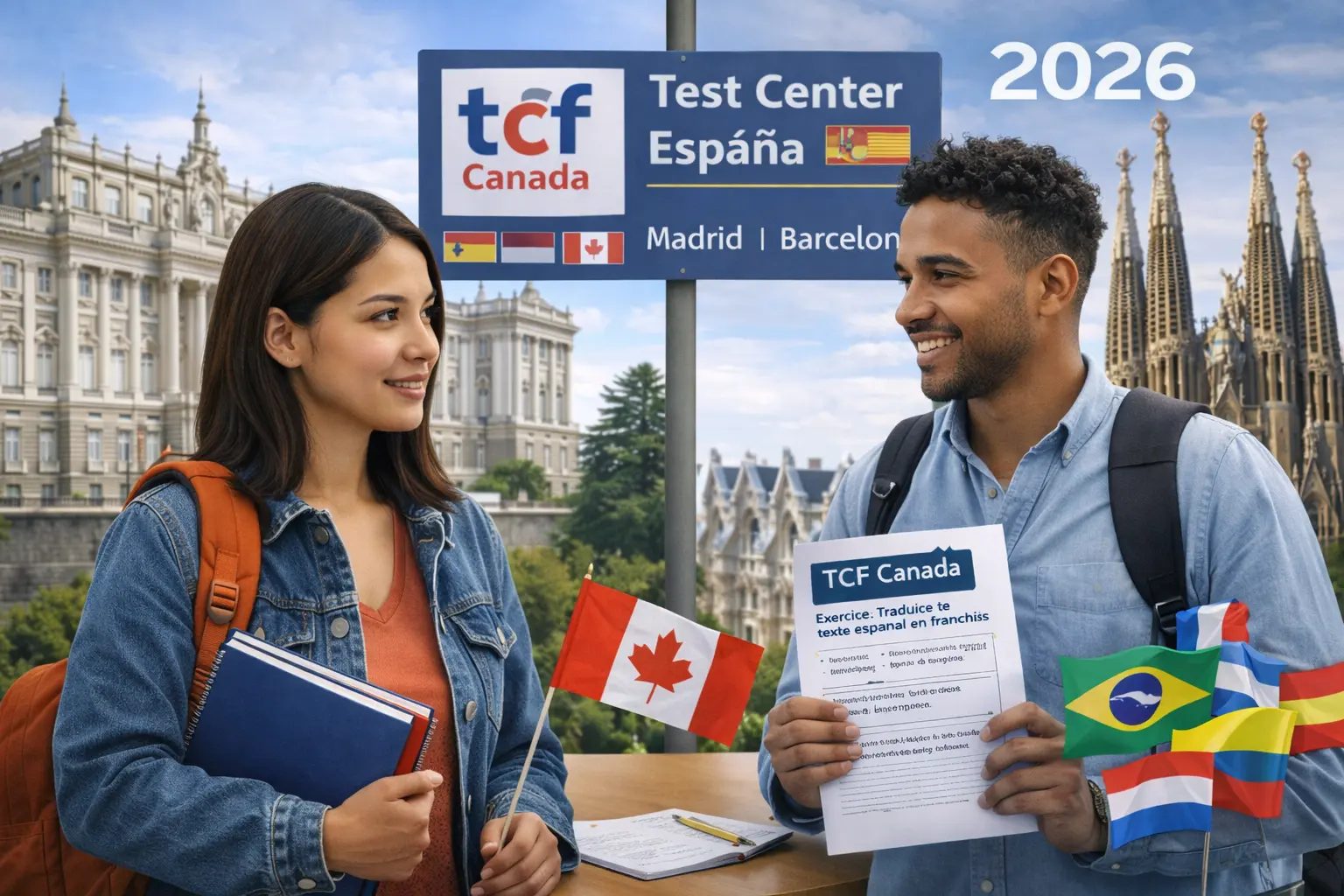
TCF Canada in Spain 2026: Madrid/Barcelona Test Centers, Spanish→French Challenge, Latin American Diaspora
When Carlos, a 29-year-old industrial engineer from Madrid, began learning French in January 2024 for TCF Canada, his family thought he was crazy: "Why learn French from scratch when you already speak English at B2 level? IELTS would be easier!" His answer, 18 months later after obtaining NCLC 7-7-8-7 in March 2026: "IELTS B2 would have given me maximum CRS 410. With anglophone draw competition (thresholds 485-495), impossible to get ITA. French NCLC 7-8 = CRS 395 BUT francophone draws threshold 360-380 = I received ITA June 2026, only 3 months after TCF. Investment 18 months French learning = bypass of 100 CRS points anglophone competition. Massive strategic ROI." Carlos represents growing profile of Spanish candidates: non-native francophones investing 18-24 months intensive French learning to access less competitive francophone immigration pathway. This guide explores Spanish test centers, specific Spanish→French challenges, accelerated learning strategies, and particularities of Latin American diaspora naturalized Spanish (Venezuelans, Colombians, Argentinians) targeting Canada.
TCF Canada Test Centers Spain 2026
Major Cities
| City | Center | Frequency | Price EUR | Particularities |
|---|---|---|---|---|
| Madrid | Alliance Française Madrid | 3-4 sessions/month | 410 | Largest center in Spain |
| Madrid | Institut Français Madrid | 2-3 sessions/month | 420 | Official cultural center |
| Barcelona | Alliance Française Barcelona | 3 sessions/month | 410 | Bilingual Catalan ES-CA clientele |
| Valencia | Alliance Française Valencia | 1-2 sessions/month | 410 | Moderate saturation |
| Seville | Alliance Française Sevilla | 1 session/month | 410 | Advance booking necessary |
| Bilbao | Alliance Française Bilbao | 1 session/month | 410 | Basque clientele |
Resources: Alliance Française Spain
For understanding how the francophone pathway works in the Canadian immigration system, see: Canadian Immigration System and TCF Canada: Understanding Express Entry and Language Points.
Linguistic Challenge: Spanish → French
Advantages of Romance Language Similarity
Spanish-French Lexical Proximity:
- 60-65% common vocabulary (Latin roots)
- Similar grammatical structures (gender, conjugations)
- Identical alphabet (no new writing system to learn like Chinese)
Lexical Transparency Examples:
| Spanish | French | Similarity |
|---|---|---|
| Universidad | Université | 95% identical |
| Importante | Important | 95% |
| Problema | Problème | 90% |
| Familia | Famille | 85% |
Specific Challenges for Spanish Speakers
1. Pronunciation (Strong Spanish Accent)
- "R" Sound: Spanish rolled R vs French guttural R = major difficulty
- Nasal Vowels: French "on", "an", "in" non-existent in Spanish
- French "U" Sound: (as in "tu") vs Spanish "U" = "oo"
2. False Friends (Similar Words, Different Meanings)
| Word | Spanish | French | Confusion |
|---|---|---|---|
| Embarazada | Pregnant (woman) | Embarrassed | Frequent humorous error |
| Constipado | With a cold | Constipated | Medical confusion |
| Éxito | Success | Exit (sortie) | Opposite meaning |
Realistic Timeline to NCLC 7-8 (From Beginner Level)
Carlos's Learning Timeline (Typical Case):
| Period | Level Reached | Study Hours/Week | Activities |
|---|---|---|---|
| Months 1-6 | A1-A2 | 6-8h | Alliance Française courses 2×/week (4h) + Daily Duolingo (1h) + Podcasts (2-3h) |
| Months 7-12 | B1 | 8-10h | Intensive courses (6h) + Tandem language exchange (2h) + French series with subtitles (2h) |
| Months 13-18 | B2-C1 (NCLC 7-8) | 10-12h | Advanced courses (6h) + Weekend immersion (francophone meetups Madrid) + Daily reading (2h) + Writing (2h) |
18-Month Training Cost:
- Alliance Française courses: €180/month × 18 = €3,240
- Books/materials: €200
- Premium apps (Babbel, etc.): €150
- Total training: €3,590
For comprehensive French learning strategies optimized for Spanish speakers, see: Strategic TCF Canada Planning: The Proven 3-Month Method That Delivers Results.
Typical Spanish Profiles for Canadian Immigration
Profile #1: Young Tech Professionals (Madrid/Barcelona)
Characteristics:
- Age 25-35, graduates of Spanish universities (Politécnica Madrid, Universidad Barcelona)
- IT/Software sector (Madrid startups, Barcelona tech hub)
- Spain salaries €35,000-50,000 vs Canada CAD 70,000-95,000 (double potential)
Motivation: Career opportunities + higher salaries + quality of life (vs 25% youth unemployment in Spain)
Profile #2: Latin American Diaspora Naturalized Spanish
Context:
- Venezuela crisis 2015-2025: 500,000+ Venezuelans immigrated to Spain
- Colombians, Argentinians, Peruvians: 800,000+ in Spain
- Naturalization after 2-5 years residence = Spanish EU passport
Dual Immigration Strategy:
| Declared Nationality | Advantages | Disadvantages |
|---|---|---|
| Spanish (EU) | Excellent credential recognition, powerful passport, administrative ease | No specific PNP programs |
| Venezuelan/Colombian | Possible targeted humanitarian programs (rare) | Variable credential recognition, administrative complications from country of origin |
Recommendation: Declare Spanish nationality = optimal 95% of cases
The Spanish Advantage: Romance Language Foundation for French
Why Spanish Speakers Learn French Faster Than Expected
Comparative Learning Speed Data:
| Native Language | Timeline to French B2 (NCLC 7-8) | Spanish Speaker Advantage |
|---|---|---|
| Spanish (Romance) | 15-20 months (800-1,000 hours) | Baseline |
| English (Germanic) | 18-24 months (900-1,200 hours) | Spanish 20% faster |
| Mandarin (Sino-Tibetan) | 24-36 months (1,300-1,800 hours) | Spanish 40-50% faster |
| Arabic (Semitic) | 22-30 months (1,100-1,500 hours) | Spanish 30% faster |
Key Accelerators for Spanish Speakers:
- Grammatical Transfer: Subjunctive mood exists in both (unlike English) = Spanish speakers naturally understand French subjunctive
- Gender System Familiarity: Already accustomed to masculine/feminine nouns (el/la → le/la) = cognitive advantage
- Verb Conjugation Complexity: Spanish has 14+ verb tenses, French has 16 = similar complexity means pattern recognition transfers
- Cognate Recognition: 60%+ vocabulary overlap means reading comprehension develops rapidly
Strategic Learning Plan for Spanish Speakers
Optimized 18-Month Pathway (Carlos Model):
| Phase | Duration | Focus Areas | Key Strategies |
|---|---|---|---|
| Phase 1: Foundation | Months 1-6 | A1-A2, pronunciation correction | Emphasize French R sound, nasal vowels, avoid Spanish interference |
| Phase 2: Acceleration | Months 7-12 | B1, leverage cognates strategically | Read extensively (60% comprehension from cognates), focus listening on non-cognate vocabulary |
| Phase 3: Refinement | Months 13-18 | B2-C1, eliminate false friends | Master false friends list, TCF-specific preparation last 2 months |
Cost-Effective Learning Resources for Spanish Speakers:
- Alliance Française Madrid/Barcelona: €180/month group classes (optimal value)
- Instituto Cervantes French programs: €150/month (sometimes available, good for government employees)
- Online platforms: Babbel Spanish→French track €12/month (AI optimized for Spanish speakers)
- Tandem Madrid/Barcelona: Free language exchange meetups (2-3 times weekly, practice with native French speakers)
- French film clubs: Free at Institut Français, weekly French movies with Spanish subtitles initially
Spanish Credential Equivalency in Canada
| Spanish Diploma | Canadian Equivalency (WES) | CRS Points |
|---|---|---|
| Bachillerato (Spanish Baccalaureate) | Secondary School Diploma | 28 pts max |
| Grado (Bachelor's 4 years post-Bologna) | Bachelor's Degree (four years) | 120 pts |
| Máster (5 years total) | Master's Degree | 126 pts |
| Doctorado | Doctorate | 140 pts |
Prestigious Spanish Universities:
- Universidad Politécnica Madrid (UPM): Top engineering Spain = excellent recognition
- Universidad Autónoma Madrid/Barcelona: Very good recognition
- IE Business School: MBA globally recognized
ECA Process: WES CAD 267 (≈€240), timeline 4-6 weeks
For complete guidance on credential recognition, see: TCF Canada and Credential Equivalency 2026: Complete Guide to Getting Your Qualifications Recognized in Canada.
Complete Immigration Budget Spain → Canada
Candidate - French Beginner (Carlos Case)
| Item | Cost EUR |
|---|---|
| 18-Month French Training | 3,590 |
| TCF Canada | 410 |
| Credential ECA | 240 |
| Police Certificate Spain | 0 (free online) |
| IRCC Fees | 1,150 |
| Medical Exam | 250 |
| TOTAL | €5,640 |
Candidate - Intermediate French B1 (6-Month Training)
| Complementary 6-month training | 1,200 |
| TCF + ECA + IRCC + Medical | 2,050 |
| TOTAL | €3,250 |
For calculating your exact CRS score with French proficiency, see: How to Calculate Your TCF Canada Points for Immigration.
ROI: Francophone Strategy vs Anglophone Strategy
Scenario A: Anglophone Route (IELTS)
- Carlos current English level B2 → IELTS 6.5-7.0 easy (2 months preparation, €300)
- Resulting CRS: 410-420 points
- 2026 general draws threshold: 485-495 points
- Result: Zero chance of ITA (-70 point deficit)
Scenario B: Francophone Route (TCF Canada)
- 18 months French learning → TCF NCLC 7-8 (€3,590 + €410 = €4,000)
- Resulting CRS: 395-405 points
- 2026 francophone draws threshold: 360-380 points
- Result: Near-guaranteed ITA (+15-45 point surplus)
ROI Conclusion:
- Additional investment: €3,700 (French vs English)
- Gain: Immigration possible vs impossible
- ROI: INFINITE (€3,700 buys G7 permanent residence = priceless value)
Latin American Spanish Citizens: The Double Migration Phenomenon
Understanding the Spain-as-Stepping-Stone Strategy
Migration Pattern Analysis:
| Origin Country | Spain Population | Naturalization Timeline | Canada Immigration Pattern |
|---|---|---|---|
| Venezuela | 500,000+ (2015-2025 crisis wave) | 2 years residence → Spanish citizenship | High Canada interest (political stability seeking) |
| Colombia | 400,000+ | 2 years (Ibero-American agreement) | Moderate (some return Colombia after EU passport) |
| Argentina | 250,000+ | 2 years | High (economic instability push factor) |
| Peru | 150,000+ | 2 years | Moderate-High |
Why Spanish Citizenship Matters for Canadian Immigration:
- Credential Recognition: Spanish degrees (even from Latin American with Spanish credentials) get smoother WES evaluation than original country diplomas
- Police Certificates: Spanish police certificate (free, instant online) much easier than Venezuelan/Colombian certificates (bureaucratic, slow, expensive)
- Travel Freedom: Spanish passport = visa-free Canada entry for biometrics/medical exam (vs Venezuelan passport requiring visa)
- Proof of Funds: Spanish bank accounts more trusted than Latin American accounts during IRCC verification
Venezuelan Case Study: Triple Migration Pathway
Profile: María, 32, Venezuelan IT professional
- 2019: Fled Venezuela crisis → Spain with Central University of Venezuela engineering degree
- 2021: Obtained Spanish citizenship after 2 years
- 2022-2024: Worked Madrid tech company, saved €12,000, learned French part-time (18 months)
- 2024: TCF Canada NCLC 8-7-7-8
- 2024: WES evaluated her Venezuelan engineering degree as "Bachelor's Degree (four years)" = 120 CRS pts (easier with Spanish citizenship presenting)
- 2025: CRS 445 (age 32, Bachelor, 6 years experience, TCF NCLC 8, Spanish citizen) = ITA francophone draw threshold 375
- 2026: Landed Toronto, now software developer CAD 95,000/year
Key Success Factor: Spanish citizenship eliminated Venezuelan document complications. All credentials, police certificates, financial proofs processed through Spanish system = dramatically simpler than direct Venezuela→Canada immigration.
Spain Resources
Conclusion: The Spanish Romance Language Advantage
Spanish candidates make a bold bet: invest 18-24 months French learning (vs 2 months IELTS English) to bypass ferocious anglophone competition. Carlos demonstrates strategy viability: 18 months + €4,000 = immigration pathway opened vs anglophone route blocked. Spanish-French similarities facilitate learning (vs Asian languages). With strong motivation + discipline 10h/week for 18 months, NCLC 7-8 accessible to Spanish beginners. Francophone strategy = intelligent bypass of CRS system. 🇪🇸🇫🇷🇨🇦
The mathematics are undeniable for Spanish candidates: investing €3,700 and 18 months to learn French transforms a completely blocked immigration pathway (CRS 410 vs threshold 490 = -80 points) into a near-guaranteed pathway (CRS 395 vs threshold 375 = +20 points). This 100-point effective CRS swing represents the difference between "maybe in 5-10 years if rules change" and "ITA within 3-6 months of profile creation."
Your Spanish Candidate Action Plan:
- Month 0: Calculate current anglophone CRS (likely 380-430 for typical Spanish professional) - confirm blocked status
- Month 0: Research Spanish government subsidies for French training (some autonomous communities offer language learning grants)
- Month 1: Enroll Alliance Française Madrid/Barcelona intensive track (€180/month)
- Month 1-6: Reach A2 level (foundation phase, cognate recognition, pronunciation correction)
- Month 7-12: Reach B1 level (acceleration phase, leverage grammatical similarities)
- Month 13-18: Reach B2-C1 (NCLC 7-8 equivalent, exam-specific preparation last 2 months)
- Month 19: Take TCF Canada, receive results 7-10 days
- Month 20: Create Express Entry profile with French scores
- Month 21-23: Receive ITA from francophone draw (near-certain with CRS 395+, threshold 360-380)
- Month 24-30: PR application processing
- Month 31: Land in Canada as permanent resident 🇪🇸🇨🇦
For Spain's youth facing 25% unemployment, stagnant wages, and limited career mobility, Canadian immigration via French represents not just a backup plan - it's often the primary pathway to achieving professional and financial goals that are structurally blocked in the Spanish economy. The 18-month French investment isn't a detour; it's the most direct route to a Canadian future.
For additional success stories and strategic insights from Spanish and Latin American immigrants, see: Inspiring Testimonials: How They Succeeded in Their TCF Canada.
* * *
Frequently Asked Questions
For many Spanish candidates, yes. Even with strong IELTS scores, anglophone CRS thresholds (often 485–495) remain unreachable for profiles scoring 380–430. Achieving NCLC 7–8 in French can unlock francophone category-based draws with thresholds around 360–380, making immigration realistically attainable.
Due to the Romance language similarity between Spanish and French, most motivated Spanish learners can reach B2 (NCLC 7–8) within 15–20 months with 8–12 hours of weekly study. Vocabulary overlap (60%+ cognates) and similar grammar structures significantly accelerate progress compared to non-Romance languages.
In most cases, yes. Spanish citizenship simplifies police certificates, financial documentation, credential evaluation, and travel logistics. It also reduces administrative complications compared to using documentation from countries facing bureaucratic delays.
Laissez un commentaire
Votreadresse email ne sera pas publie. Les champs obligatoires sont marque avec *


 TCF Canada Hub
0 Commentaires
aucun commentaire
Soyez le premier a partager votre avis !