
-
Auteur :
 TCF Canada
- Jul 29, 2026
Immigration as a couple is not simply two individual applications bundled together — it is a strategic optimization problem. In Express Entry, the designation of principal applicant vs accompanying spouse determines which person's age, education, work experience and language scores form the primary basis of the CRS calculation. For couples with different French levels, the TCF Canada strategy must be co-designed from the beginning, not decided separately. The wrong principal applicant choice can cost 40-60 CRS points — equivalent to 12-18 months of waiting time.
How Express Entry Scores Couples
In Express Entry, the principal applicant (PA) receives the bulk of the CRS points. The accompanying spouse contributes additional points in two ways: their own language test scores can add up to 40 points to the PA's total, and their education adds up to 10 points. Understanding this asymmetry is the starting point for all couple-level TCF Canada strategy.
| Factor | Principal Applicant | Accompanying Spouse Contribution |
|---|---|---|
| Age | Up to 100 points | Not scored separately |
| Education | Up to 150 points | Up to 10 additional points |
| French language (TCF Canada) | Up to 136 points (NCLC 9) | Up to 40 points (if NCLC 7+) |
| Work experience | Up to 80 points | Up to 10 additional points |
| Total language potential | 136 (French) + 24 (English) | Up to 40 additional language points |
The key strategic insight for couples:
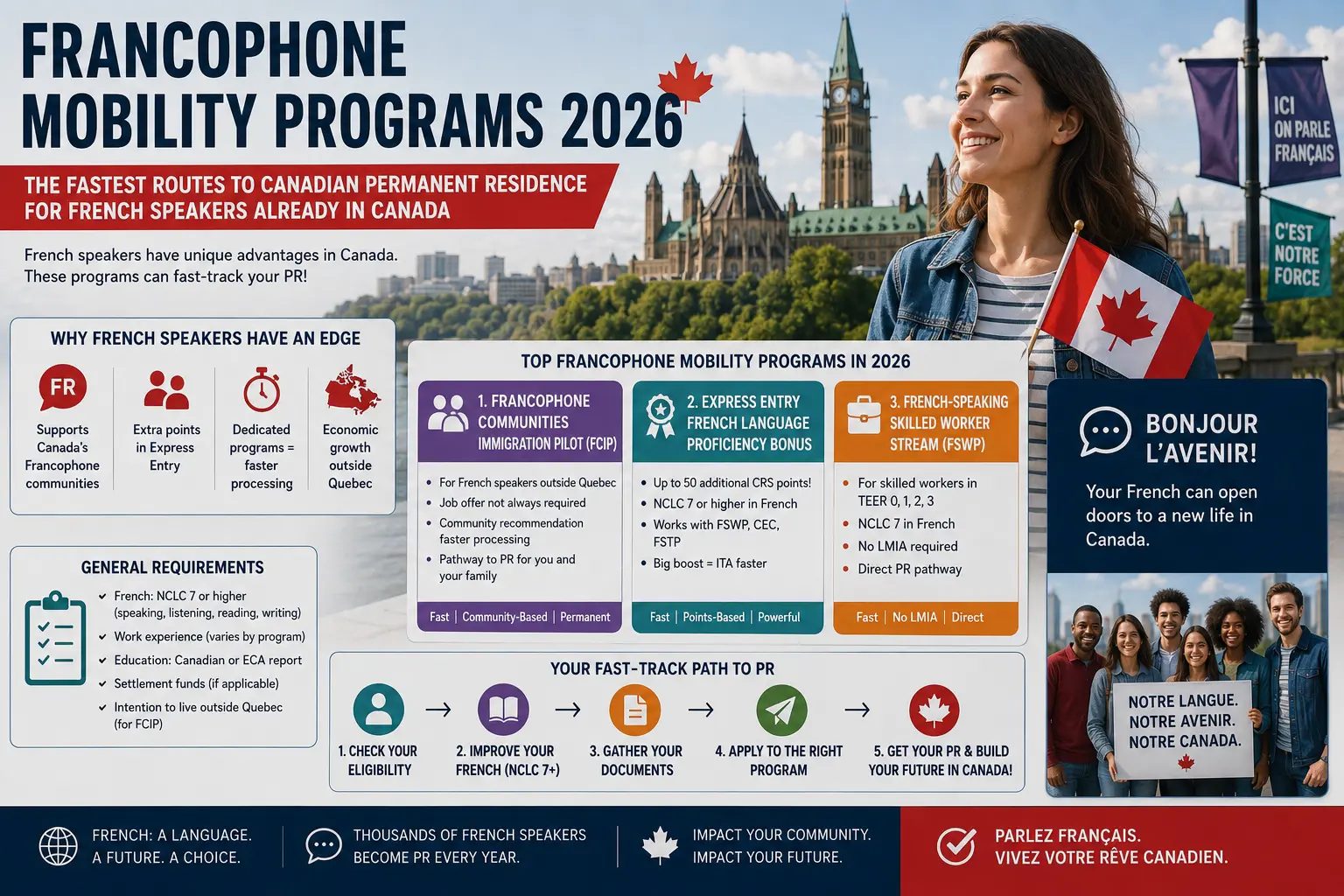
A spouse's TCF Canada NCLC 7+ score adds up to 40 CRS points to the principal applicant's total — regardless of whether the PA speaks French or not. For a couple where only one person speaks French well, designating the non-French speaker as PA with the French speaker as spouse can unlock these 40 additional points while the PA's overall profile (age, education, work experience) drives the primary score.
The 4 Couple Scenarios and Optimal TCF Canada Strategy
Scenario 1: Both Speak Excellent French (Both B2-C1)
Strategy: Choose PA based on whichever profile generates the highest primary CRS (typically: younger age + higher education + more work experience). Both should pass TCF Canada targeting NCLC 9. The spouse's NCLC 9 adds the maximum 40 points to the PA's total.
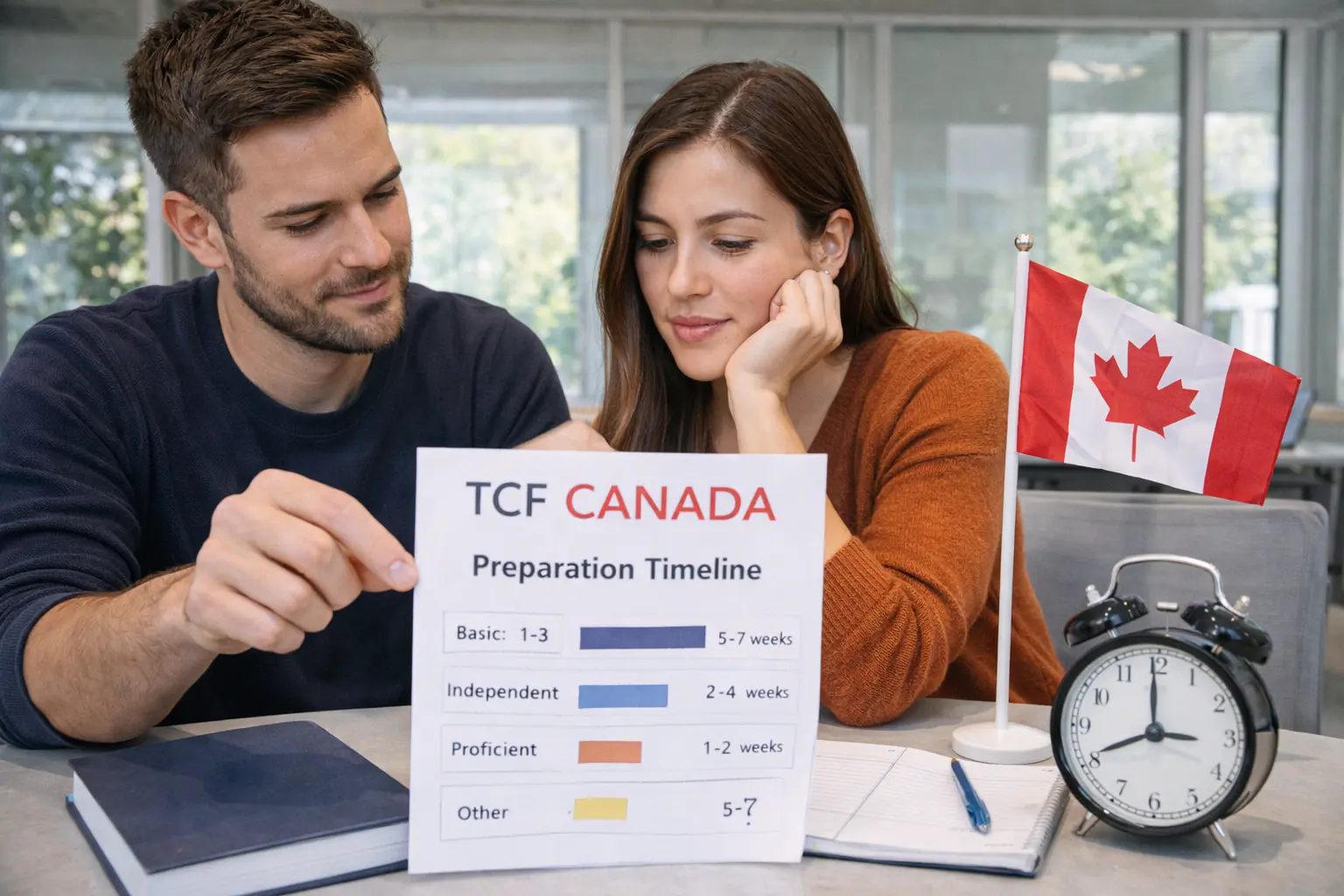
Preparation approach: Study together — share resources, practice oral tasks with each other, mock test on the same schedule. This approach typically saves 30-40% of preparation time through mutual correction and motivation.
Scenario 2: Only One Speaks French (Other Speaks None)
Strategy: The French speaker is almost always the PA — their language points are the primary language contribution and they can access francophone streams. The non-French spouse contributes through their education and work experience supplementary points.
Alternative: If the non-French spouse has a significantly stronger CRS profile (much younger, higher degree, more Canadian-relevant work experience), consider: non-French spouse as PA (with English IELTS as their language score) + French spouse as companion (TCF Canada adding 40 points). Simulate both configurations in the official IRCC calculator.
Scenario 3: Mixed Levels (One B2, One A1-B1)
Strategy: The B2 speaker passes TCF Canada first as PA. The A1-B1 speaker prepares over 8-14 months to reach NCLC 7, then passes TCF Canada, adding 40 additional points. In the interim, file with the B2 speaker's scores alone — many francophone draws are competitive at that level.
Timeline advantage: Filing early with one TCF Canada score, then updating the profile when the second score becomes available, is better than waiting for both to be ready simultaneously.
Scenario 4: The Spouse Has No Canadian Immigration Intent
Strategy: File without spouse. Without an accompanying spouse, the PA receives the single-applicant CRS scoring (typically higher for age and education factors). TCF Canada NCLC 9 as PA generates the maximum language contribution without sharing points.
Co-Preparation: The Couple Study Protocol
How couples prepare for TCF Canada together efficiently:
- Shared listening practice: Watch Radio-Canada news and OHdio podcasts together — discuss content in French afterward (even broken French for beginners). This creates conversation practice without needing a language partner.
- Mutual oral expression practice: Take turns timing each other on oral tasks. The observer uses the NCLC scoring criteria as a checklist. This generates twice the practice at zero additional cost.
- Different weakness focus: If one partner struggles with listening and the other with writing, they can study different skills simultaneously in the same room, then teach each other strategies.
- Independent mock tests: Take mock tests separately and on the same day, then compare scores and error patterns. Competition and accountability double motivation over 3+ months of preparation.
"My wife and I both needed TCF Canada but started at different levels — I was B2, she was A2. We made a strategic decision: I would file first as PA with my TCF Canada scores while she prepared. 4 months after my filing, she passed TCF Canada at NCLC 7. I updated my profile immediately — 35 additional CRS points. A francophone draw selected us the following month. The key was that we planned the timeline together from the start, not independently." — Rachid and Samira, Montreal QC
For the complete family TCF Canada guide covering children, spouses and extended family CRS optimization, read TCF Canada for Families 2026. The CRS score calculator guide for running couple-configuration simulations is at CRS Score Simulator for TCF Canada. The French companion guide covering the same couple strategy is at TCF Canada en Famille 2026. For understanding the express entry draws relevant to couples with francophone profiles, read IRCC Category-Based Draws 2026. After both TCF Canada scores are obtained, the 90-day action plan is detailed at After Your TCF Canada Results.


 TCF Canada Hub
0 Commentaires
aucun commentaire
Soyez le premier a partager votre avis !