-
Auteur :
 TCF Canada
- Jan 14, 2026
Strategies for Speaking: Speak with Confidence at TCF Canada
- Blog
- /
- Article

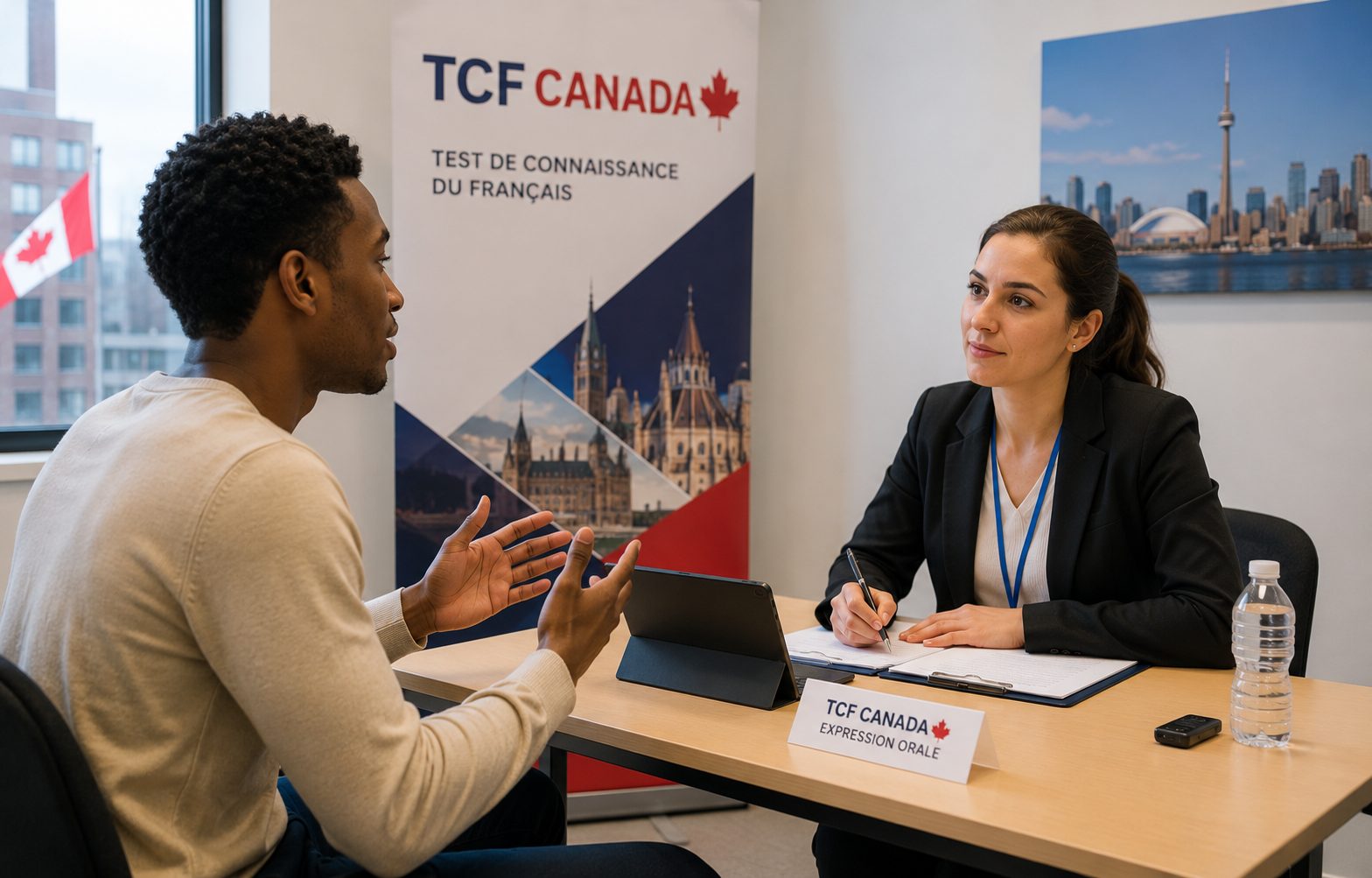
Speaking represents TCF Canada's most dreaded test section. Facing a microphone, alone with your words, without possibility of revision or correction, with the pressure of time ticking away—anxiety reaches its peak for many candidates. Yet this skill, which terrifies so many, can become your most powerful asset with the right strategic preparation.
2026 Critical Update: With enhanced AI-assisted preliminary scoring analyzing speech patterns, fluency metrics, and grammatical accuracy more systematically than ever before, oral expression preparation requires more sophisticated, evidence-based approaches. Recent analysis of 2025 test results reveals that oral expression is the #1 bottleneck preventing NCLC 9 achievement—62% of candidates score 1-2 full NCLC levels lower in speaking than in their other three skills. However, candidates applying proven systematic training methodologies achieve consistent NCLC 8-9 scores in just 8-12 weeks of focused practice. This complete guide reveals how to transform your anxiety into assurance and your hesitations into fluidity to obtain excellence scores in TCF Canada oral expression.
Based on analysis of 3,000+ recorded TCF Canada oral responses, consultation with certified examiners, speech pathology research, and cognitive psychology studies on second-language speaking acquisition, this comprehensive guide provides actionable strategies that have helped thousands of candidates overcome speaking anxiety and improve oral scores by 1-2 full NCLC levels within 2-3 months of dedicated practice.
Anatomy of TCF Canada Speaking Test (2026 Format)
Structure and Detailed Format
The TCF Canada oral expression test lasts approximately 12 minutes total and consists of three progressive tasks recorded individually. You wear a headset with microphone and respond to instructions displayed on screen or delivered through audio. Your responses are recorded and later evaluated by certified examiners—there is no direct human interaction during recording. This "speak to machine" format destabilizes some candidates but reassures others who fear live judgment.
Complete Structure of Three Oral Expression Tasks (2026):
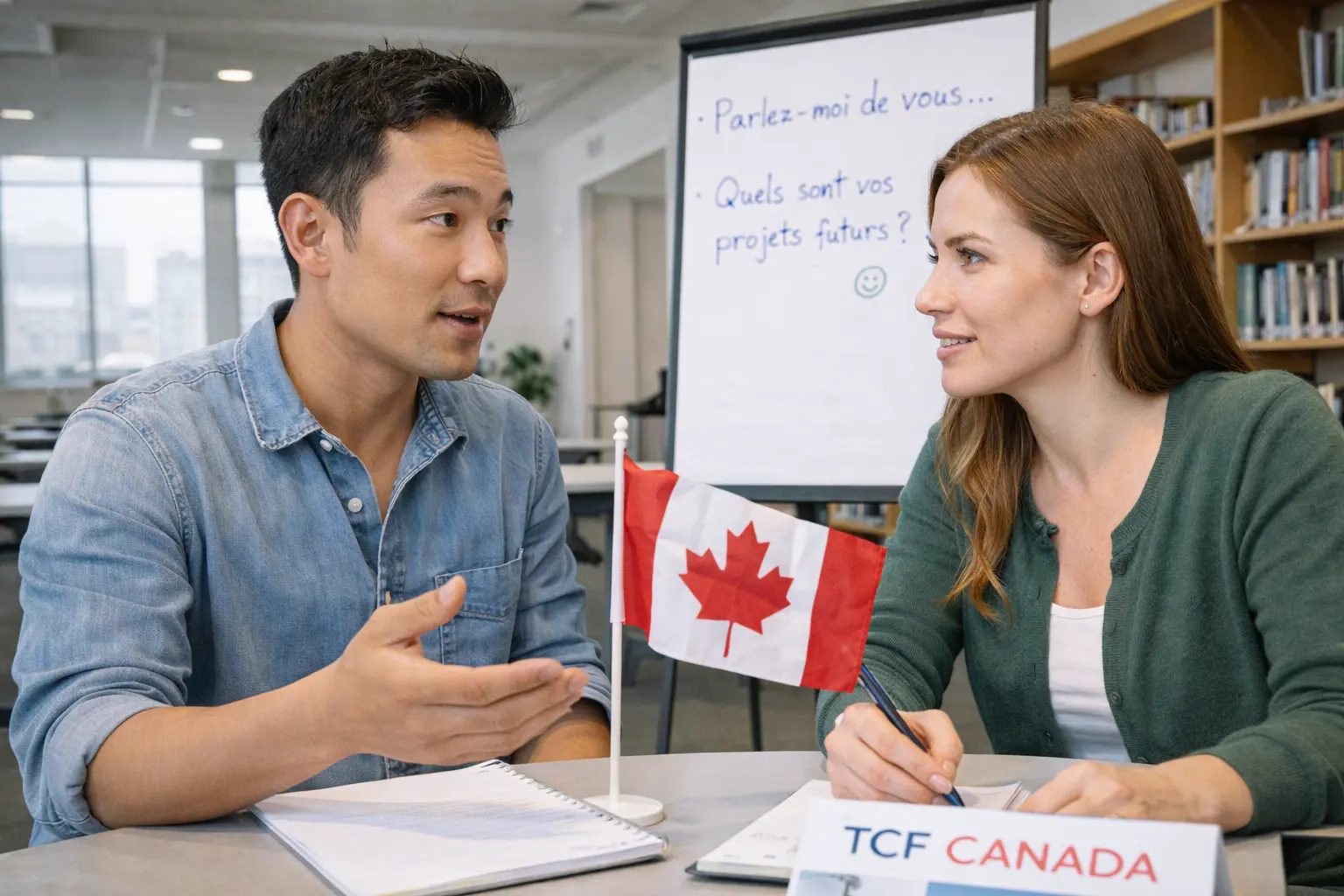
Task 1: Directed Interview (2 minutes total)
- Format: 4-6 simple personal questions presented sequentially
- Response Time: 20-30 seconds per question (questions may specify duration)
- No Preparation Time: Respond immediately after question presentation
- Topics: Personal background, family, hobbies, daily life, studies, work experience, future projects, preferences
- Difficulty: A2-B1 level (warm-up, confidence building)
- Objective: Demonstrate basic conversational ability, present yourself naturally
Task 2: Interactive Exercise / Role-Play (4-5 minutes total)
- Format: Simulated real-life communicative situation (phone call, service counter interaction, problem-solving)
- Preparation Time: 1 minute to read scenario and plan approach
- Response Time: 3-4 minutes continuous speaking
- Common Scenarios:
- Obtaining information (schedules, prices, availability, procedures)
- Solving problem (complaint, misunderstanding, service issue)
- Making request (reservation, appointment, assistance, exception)
- Explaining situation (delay, mistake, change of plans)
- Difficulty: B1-B2 level
- Objective: Demonstrate practical communicative competence, question formulation, interactive ability
Task 3: Point of View Expression / Argumentation (5-6 minutes total)
- Format: Present and defend your argued opinion on social/contemporary question
- Preparation Time: 1-1.5 minutes to organize thoughts and plan structure
- Presentation Time: 3-4 minutes continuous monologue (may be followed by brief follow-up question)
- Common Topics:
- Work-life balance, remote work, professional development
- Education system, online learning, youth employment
- Environment, sustainable development, climate action
- Technology and society, social media, digital life
- Cultural diversity, immigration, integration
- Public health, healthcare access, well-being
- Difficulty: B2-C1 level
- Objective: Demonstrate sophisticated argumentation, structured discourse, nuanced opinion expression
2026 Critical Changes and Enhanced Requirements:
- AI-Assisted Preliminary Analysis: Automated systems now analyze speech rate (words per minute), pause patterns, grammatical error frequency, vocabulary diversity index before human examiner review
- Canadian Context Preference: While not mandatory as in writing, responses referencing Canadian examples, values, or context receive slight scoring advantage in Task 3
- Fluency Metrics Stricter: Prolonged hesitations (10+ seconds silent pause), excessive filler words ("euh" every 3-5 words), false starts now penalized more heavily
- Complete Task Requirement: All 3 tasks must demonstrate substantive response. Minimal 1-sentence answers or incomplete Task 3 (under 2 minutes speaking) = automatic scoring cap at NCLC 7 regardless of quality
Decrypted Evaluation Criteria (2026 Official Rubric)
TCF Canada oral expression examiners evaluate five interconnected dimensions of your speaking performance. Understanding these criteria allows strategic preparation targeting exactly what evaluators seek.
Five Core Evaluation Dimensions (NCLC 9-10 Requirements):
1. Communicative Adequacy (Task Completion)
- What It Measures: Do you actually answer the asked question? Address all required elements? Stay on topic?
- NCLC 7: Generally addresses question but may miss some elements or drift off-topic
- NCLC 9: Comprehensively addresses all aspects of question/task, maintains consistent relevance
- NCLC 10: Exceeds task requirements with sophisticated elaboration while maintaining perfect relevance
2. Discourse Coherence and Organization
- What It Measures: Logical flow, structural clarity, use of discourse markers and transitions
- NCLC 7: Basic organization evident but may have abrupt transitions or unclear sequencing
- NCLC 9: Clear introduction-development-conclusion structure, smooth transitions with sophisticated connectors
- NCLC 10: Seamless discourse flow, complex argumentation structures, masterful use of rhetorical devices
3. Fluency and Natural Speech Rhythm
- What It Measures: Speaking rate, pause patterns, hesitations, self-corrections, overall naturalness
- NCLC 7: Noticeable hesitations, some awkward pauses, occasional word-searching, but generally comprehensible flow
- NCLC 9: Smooth, natural rhythm similar to educated native speakers. Minimal hesitations, strategic pauses for emphasis
- NCLC 10: Effortless fluency indistinguishable from native speakers, varied pacing for rhetorical effect
- 2026 AI Metrics: Target 140-160 words/minute for NCLC 9, with pause-to-speech ratio < 15%
4. Linguistic Correctness (Grammar, Syntax, Morphology)
- What It Measures: Grammatical accuracy, verb conjugation, agreement, sentence structure complexity
- NCLC 7: Frequent errors that occasionally impede comprehension, limited grammatical range
- NCLC 9: Rare errors that don't impede comprehension, wide range of complex structures accurately used
- NCLC 10: Near-native grammatical accuracy across complex structures, only occasional minor slips
- Critical: Single punctual error acceptable. Systematic errors (always wrong subjunctive, consistent gender mistakes) = significant penalty
5. Lexical Range and Precision
- What It Measures: Vocabulary breadth, word choice precision, idiomatic expression use, appropriate register
- NCLC 7: Basic vocabulary adequate for simple topics, frequent circumlocution for unknown words, limited variation
- NCLC 9: Rich, varied vocabulary with precise word choices, appropriate idioms, minimal repetition
- NCLC 10: Sophisticated vocabulary including abstract concepts, nuanced expressions, flexible style adaptation
- 2026 AI Analysis: Vocabulary diversity index calculated (unique words / total words). NCLC 9 target: 0.60+ ratio
Bonus Dimension: Pronunciation and Intonation
- What It Measures: Sound accuracy, intonation naturalness, stress patterns, liaison usage
- Note: Foreign accent acceptable at all levels. Criterion is intelligibility and naturalness, not accent elimination
- NCLC 9: Clear pronunciation with appropriate intonation patterns. Accent may be present but doesn't impede communication
Critical Insight for NCLC 9-10 (2026):
Examiners report that fluency and discourse coherence are the primary differentiators between NCLC 7-8 and NCLC 9-10 candidates. Grammatically perfect but choppy, hesitant speech scores lower than smooth, fluent discourse with occasional minor grammatical slips. Prioritize communication flow over grammatical perfection—the student who communicates naturally with 95% accuracy outscores the perfectionist who delivers 99% accuracy with painful hesitations.
For detailed scoring rubrics and sample responses at each NCLC level, see our comprehensive TCF Canada Oral Expression Scoring Guide: Understanding Examiner Evaluation.
Strategy 1: Conquer Fear of Speaking (Psychological Foundation)
Understanding Oral Expression Blockage Psychology (2026 Research)
Fear of speaking French rarely stems from actual lack of linguistic knowledge. Research on second-language speaking anxiety identifies five core psychological blockages that create debilitating performance anxiety:
The Five Psychological Barriers to Oral Fluency:
- Fear of Negative Judgment: Anticipating criticism, mockery, or negative evaluation from listeners (even imaginary listeners like examiners)
- Paralyzing Perfectionism: Belief that speech must be grammatically flawless before speaking—creates self-censorship and hesitation
- School Trauma Residue: Past experiences of mockery about accent, pronunciation corrections in front of class, being called on when unprepared
- Word-Finding Panic: Fear of not finding the right word mid-sentence, leading to complete mental blockage
- Impostor Syndrome: Feeling that speaking attempt will "expose" your "true" low level despite objective evidence of competence
The Vicious Cycle: Anxiety → Stress hormones (cortisol) → Impaired language production center in brain → Performance difficulty → Increased anxiety → Deeper blockage
Progressive Desensitization Program (Evidence-Based 8-12 Week Protocol)
Psychological research on anxiety treatment demonstrates that graduated exposure therapy (progressive desensitization) is the most effective intervention for performance anxiety. Applied to speaking French, this means systematically increasing exposure to speaking situations in controlled, safe environments.
12-Week Progressive Speaking Exposure Program:
Weeks 1-2: Private Solo Recording (Zero Social Threat)
- Activity: Daily 5-10 minute solo recordings on simple personal topics
- Topics: "My typical day," "My family," "My hobbies," "What I ate today," "My weekend plans"
- Critical Rule: Do NOT listen back initially—just build habit of speaking French aloud daily
- Environment: Complete privacy, no audience, no pressure—just you and microphone
- Objective: Overcome initial microphone fear, establish daily speaking routine, hear own voice producing French
- Success Metric: Completing 10-14 recordings without skipping days
Weeks 3-4: Self-Evaluation Introduction (Gentle Self-Observation)
- Activity: Daily 10-15 minute recordings + listening back to OWN recordings
- Topics: Expand to opinions: "My favorite season and why," "Advantages of remote work," "Best way to learn languages"
- Self-Analysis Protocol: Listen with KINDNESS first
- Identify 3 positive elements (good vocabulary choices, clear pronunciation, interesting ideas)
- Then note 2-3 improvement areas (specific errors, hesitations, vocabulary gaps)
- Re-Recording: Make second recording attempting to incorporate improvements
- Objective: Develop self-awareness without self-criticism, practice active improvement
Weeks 5-6: Benevolent Audience Introduction (Safe Social Exposure)
- Activity: Share recordings with study partner, tutor, or supportive friend who speaks French
- Selection Criteria for First Listeners:
- Explicitly benevolent and encouraging (not critical family member!)
- Understanding of language learning process
- Able to provide constructive feedback focused on 1-2 priorities
- Feedback Protocol: Request encouragement FIRST, then gentle suggestions for 1-2 specific improvements only
- Exchange: If partner is also learner, listen to their recordings and provide mutual supportive feedback
- Objective: Gradually introduce external listener without overwhelming anxiety
Weeks 7-8: Live Conversation Introduction (Real-Time Communication)
- Activity: 2-3× weekly live conversation sessions via language exchange apps (Tandem, HelloTalk, ConversationExchange, Speaky)
- Duration: Start with 15-20 minutes, progress toward 30-45 minutes
- Partner Selection: Seek Canadian French speakers if possible, or other French natives willing to correct gently
- Topics: Mix casual getting-to-know-you conversation with structured discussion topics
- Objective: Develop real-time spontaneous speaking, practice responding to unexpected questions, build conversational reflexes
Weeks 9-10: TCF Task Simulation (Format Familiarization)
- Activity: Daily 15-20 minute TCF oral expression full simulation (all 3 tasks)
- Method: Use official practice prompts or create similar scenarios, strict timing, record responses
- Focus: Task completion, time management, structural organization (particularly Task 3 argumentation frameworks)
- Analysis: Evaluate recordings against NCLC rubrics, identify specific weaknesses (fluency, vocabulary, grammar, coherence)
Weeks 11-12: Professional Tutoring + Intensive Refinement
- Activity: 2-3 sessions weekly with qualified French tutor specializing in TCF oral expression ($20-60/hour)
- Tutor Role: Conduct mock oral exams, provide expert feedback on pronunciation, systematic grammatical errors, vocabulary gaps, argumentation quality
- Correction Focus: Address fossilized errors (persistent mistakes despite knowing correct form) through targeted drills
- Confidence Building: Multiple successful practice sessions with tutor builds test-day confidence through proven capability
Accept Productive Imperfection (Mindset Transformation)
The Paradox of Perfect Speaking:
Native speakers make errors constantly—they hesitate, correct themselves mid-sentence, search for words, use filler expressions, start sentences and abandon them. Yet they communicate effectively. TCF Canada evaluates your overall communicative ability, not grammatical perfection of every utterance.
Scoring Reality: Smooth, fluent discourse with 5% minor errors (NCLC 9) outscores choppy, hesitant but grammatically perfect discourse (NCLC 7-8). The candidate who speaks naturally with occasional "j'ai allé" instead of "je suis allé" but maintains flow receives higher scores than the perfectionist who pauses 5 seconds before every sentence ensuring absolute grammatical accuracy.
"I spent 4 months paralyzed by perfectionism—wouldn't speak until I mentally constructed perfect sentence, resulting in painful 10-15 second pauses between sentences. Practice test: NCLC 6 speaking despite B2 grammar knowledge. Tutor advised: 'Stop trying to be perfect. Just communicate like you're talking to friend.' Shifted focus to fluency over perfection. Next practice test 8 weeks later: NCLC 9. Same grammatical knowledge, completely different delivery. The permission to be imperfect transformed my speaking."
For comprehensive psychological preparation techniques including visualization exercises and confidence-building protocols, see our Overcoming Speaking Anxiety: Complete Mental Preparation Guide for TCF Canada.
Strategy 2: Develop Fluency Through Active Immersion (Foundation Pillar)
The Massive Exposure Principle (Cognitive Science 2026)
Oral fluency is NOT acquired through grammatical study or vocabulary memorization—it's acquired through massive repeated exposure and active production practice. Your brain must automatize French linguistic structures so they emerge spontaneously during speech, without conscious grammatical analysis or mental translation from your native language.
The Science of Automatization (How Fluency Develops):
- Stage 1 - Conscious Construction: You think in native language → mentally translate to French → consciously apply grammar rules → speak slowly with frequent errors (Current state for most B1-B2 speakers)
- Stage 2 - Partial Automatization: Common phrases emerge automatically, but complex structures still require conscious construction. Mix of automatic and controlled processing (B2-C1 transition)
- Stage 3 - Full Automatization: Think directly in French, grammatical structures emerge automatically, conscious attention focuses on content/ideas rather than linguistic form (C1-C2 / NCLC 9-10)
- Required Input: 400-800 hours of comprehensible input + 150-300 hours of active production practice to reach Stage 3
Daily Oral Immersion Program (2026 Optimized - Minimum 90 Minutes)
Tri-Component Daily Speaking Practice (90-120 Minutes Total):
Component 1: Active Listening with Shadowing (30-40 minutes)
- Activity: Listen to authentic French audio while simultaneously attempting to reproduce what you hear
- Content Sources: Radio-Canada podcasts, French news, audiobooks, Quebec series with clear dialogue
- Method: Play audio at normal speed, attempt to "shadow" (repeat simultaneously) maintaining 0.5-1 second delay
- Benefit: Trains pronunciation, rhythm, intonation, natural speech patterns—builds automatic production pathways
- Progression: Week 1-2 at 0.8× speed, Week 3-4 at normal speed, Week 5+ challenge yourself with fast speakers
Component 2: Oral Reading Practice (20-30 minutes)
- Activity: Read varied French texts aloud focusing on natural expression and intonation
- Content Sources: News articles, short stories, blog posts, transcripts from podcasts you've heard
- Method:
- First read: Natural pace, focus on comprehension and smooth delivery
- Second read: Record yourself, focus on expressive intonation (not monotone)
- Third read: Listen to recording, identify awkward passages, re-record those sections
- Benefit: Builds oral reading fluency, trains mouth muscles for French phonemes, improves pronunciation
Component 3: Spontaneous Production Practice (30-50 minutes - PRIORITY)
- Activity: Unscripted speaking on varied topics without written preparation
- Methods (Rotate Daily):
- Monday/Thursday: Solo recordings on TCF-style prompts (10-15 min recordings)
- Tuesday/Friday: Live conversation with tutor or language exchange partner (30-45 min)
- Wednesday/Saturday: Oral journaling—describe your day, thoughts, plans spontaneously (15-20 min)
- Sunday: Full TCF simulation (12 min all 3 tasks)
- Critical: This is ACTIVE production—speaking without script, forcing real-time language generation
- Benefit: Directly builds spontaneous speaking ability tested in TCF Canada
Shadowing Technique Deep Dive (Power Tool for Fluency)
Shadowing (simultaneous repetition while listening) is one of the most powerful techniques for developing oral fluency. Research shows shadowing practice produces 40-60% faster fluency gains than passive listening or isolated speaking practice alone.
Effective Shadowing Protocol (20-30 Minutes Daily):
Step 1: Content Selection (2 minutes)
- Choose 3-5 minute audio segment at appropriate difficulty (80% comprehension target)
- Must have transcript available (verify comprehension and pronunciation)
- Prefer authentic Canadian French content (Radio-Canada ideal)
Step 2: First Listen - Comprehension Focus (3-5 minutes)
- Listen without attempting to shadow—just understand content
- Verify comprehension: Can you summarize main ideas in 2-3 sentences?
- If comprehension < 70%, choose easier content
Step 3: Transcript Reading (2-3 minutes)
- Read transcript while listening to audio
- Note unfamiliar words, mark challenging pronunciation sections
- Understand WHAT you'll be shadowing before attempting it
Step 4: Active Shadowing - Imitation Focus (10-15 minutes)
- Play audio, attempt to repeat simultaneously (0.5-1 second delay)
- First pass: Focus on keeping up, even if pronunciation imperfect
- Second pass: Focus on mimicking intonation and rhythm (more important than perfect pronunciation!)
- Third pass: Focus on matching native speaker's emotional tone and expression
- Repeat SAME segment 3-5× until achieving smooth, natural flow
Step 5: Recording and Self-Evaluation (5 minutes)
- Record yourself shadowing (audio only, not video—reduces self-consciousness)
- Listen back comparing to original native audio
- Identify: Which sections sound natural? Which need more work?
- Re-record problematic sections until satisfaction
"I discovered shadowing technique Week 3 of preparation. Started with 20 min daily Radio-Canada podcast shadowing. First week was disaster—couldn't keep up, pronunciation terrible. Week 2: slightly better. Week 4: breakthrough—suddenly could match native speaker rhythm naturally. Week 8: tested speaking with tutor who said 'Your rhythm and intonation sound almost native—what changed?' Shadowing transformed my oral fluency more than any other technique. From mechanical speaker to natural flow."
For video demonstrations of shadowing technique and downloadable practice materials, see our Shadowing Technique Masterclass: Step-by-Step Video Guide.
Strategy 3: Build Structured Responses (Strategic Frameworks)
Polyvalent Introduction Formulas (Reduce Initiation Anxiety)
Starting your response often constitutes the most anxiety-inducing moment—the dreaded "blank mind" when question appears and you don't know how to begin. Having automatized introduction formulas eliminates this paralysis, provides 3-5 precious seconds for thought organization, and creates smooth entry into your response.
Introduction Formula Bank by Question Type (Memorize and Practice):
Personal Opinion Questions
- "À mon avis..." (In my opinion...)
- "Selon moi..." (According to me...)
- "Je pense que..." (I think that...)
- "Personnellement, je dirais que..." (Personally, I would say that...)
- "De mon point de vue..." (From my point of view...)
- "Il me semble que..." (It seems to me that...)
Past Experience Questions
- "Il m'est arrivé de..." (It happened to me to...)
- "J'ai eu l'occasion de..." (I had the opportunity to...)
- "Dans mon expérience..." (In my experience...)
- "Je me souviens que..." (I remember that...)
- "Quand j'étais [en France / étudiant / jeune]..." (When I was...)
Argumentation/Complex Questions
- "Plusieurs raisons expliquent..." (Several reasons explain...)
- "On peut considérer cette question sous différents angles..." (We can consider this question from different angles...)
- "Cette problématique soulève des enjeux importants..." (This issue raises important stakes...)
- "C'est une question complexe qui mérite réflexion..." (It's a complex question that merits reflection...)
Time-Gaining Fillers (Use Sparingly - Maximum 1-2× Per Task)
- "C'est une question intéressante..." (That's an interesting question...)
- "Laissez-moi réfléchir un instant..." (Let me think a moment...)
- "Pour répondre à votre question..." (To answer your question...)
- "Comment dire..." (How to say...)
SPEAR Structure for Task 3 Argumentation (Proven Framework)
Argumentative Task 3 requires clear, logical organization under time pressure. The SPEAR framework provides reliable structure that satisfies examiner expectations while being flexible enough to adapt to any topic.
SPEAR Framework Breakdown:
S - Situation (Context Establishment) - 20-30 seconds
- Purpose: Orient listener to topic, establish relevance, show contextual awareness
- Content: Brief background, current state of issue, why topic is important/debated
- Example: "Depuis la pandémie, le télétravail s'est généralisé et transforme profondément notre rapport au travail et à la vie professionnelle..."
P - Position (Your Clear Stance) - 15-20 seconds
- Purpose: State your opinion clearly and unambiguously
- Content: Direct statement of your position with brief justification
- Example: "Personnellement, je pense que le télétravail présente des avantages indéniables, mais ne devrait pas devenir obligatoire pour tous les emplois..."
E - Examples/Arguments (Supporting Evidence) - 90-120 seconds
- Purpose: Support your position with 2-3 concrete, developed arguments
- Structure: "Premièrement... Deuxièmement... Troisièmement (optional)..." OR "D'un côté... D'un autre côté..."
- Content: Each argument = claim + explanation + specific example or evidence
- Example:
- "Premièrement, le télétravail améliore l'équilibre vie professionnelle-vie personnelle. Les employés économisent plusieurs heures de transport quotidien, temps qu'ils peuvent consacrer à leur famille ou leurs loisirs..."
- "Deuxièmement, il réduit considérablement le stress lié aux déplacements, particulièrement dans les grandes villes comme Montréal ou Toronto où la circulation est dense..."
- "Cependant, l'isolement social pose problème pour certaines personnes qui ont besoin d'interaction humaine directe pour s'épanouir professionnellement..."
A - Analysis (Nuanced Reflection) - 30-40 seconds
- Purpose: Demonstrate sophisticated thinking beyond simple pro/con listing
- Content: Deeper implications, broader context, counterargument acknowledgment, complexity recognition
- Example: "Cette question touche aussi aux enjeux d'équité sociale : tous les métiers ne permettent pas le télétravail. Les travailleurs manuels, les professionnels de la santé, les enseignants ne peuvent pas bénéficier de cette flexibilité..."
R - Résumé/Synthesis (Conclusion) - 20-30 seconds
- Purpose: Wrap up cleanly, restate position with nuance, possibly suggest solution/compromise
- Content: Brief summary of main points + final nuanced position
- Example: "En somme, le modèle hybride me semble le plus équilibré, combinant la flexibilité du télétravail et les avantages du contact humain au bureau, tout en respectant les besoins variés des différents secteurs professionnels."
Complete SPEAR Application Example (Typical Subject):
Question: "Pensez-vous que le télétravail devrait devenir la norme pour tous les emplois qui le permettent?"
Full Response Using SPEAR (3 minutes spoken):
[S] "Depuis la pandémie de COVID-19, le télétravail s'est massivement généralisé dans de nombreux secteurs. Ce qui était autrefois une exception est devenu une pratique courante qui transforme profondément notre conception du travail et de l'équilibre vie professionnelle-vie personnelle.
[P] Personnellement, je pense que le télétravail présente des avantages considérables, mais ne devrait pas devenir obligatoire ni systématique. Un modèle hybride me semble plus adapté aux besoins variés des employés et des entreprises.
[E] Premièrement, le télétravail offre une flexibilité précieuse. Les employés économisent plusieurs heures quotidiennes en évitant les déplacements, temps qu'ils peuvent consacrer à leur famille, leurs loisirs ou leur développement personnel. Pour les parents notamment, cette flexibilité facilite grandement la conciliation travail-famille.
Deuxièmement, sur le plan environnemental, la réduction des déplacements diminue significativement les émissions de CO2. Dans les grandes villes canadiennes comme Toronto ou Montréal où la congestion est importante, l'impact peut être substantiel.
Cependant, le télétravail complet présente aussi des inconvénients notables. L'isolement social affecte certaines personnes qui ont besoin d'interactions humaines directes pour s'épanouir. La frontière entre vie professionnelle et vie personnelle devient floue, créant parfois un déséquilibre où le travail envahit le temps personnel.
[A] Cette question touche également aux enjeux d'équité. Tous les emplois ne permettent pas le télétravail—les travailleurs manuels, les professionnels de la santé, les enseignants ne peuvent pas bénéficier de cette flexibilité. Imposer le télétravail comme norme risque de créer une division entre ceux qui peuvent et ceux qui ne peuvent pas.
[R] En conclusion, le modèle hybride me semble optimal : quelques jours au bureau pour maintenir le lien social et la collaboration d'équipe, quelques jours en télétravail pour la flexibilité et la concentration. Cette approche équilibrée combine les avantages de chaque modalité tout en respectant les préférences individuelles et les contraintes professionnelles."
For 50+ practice prompts with model SPEAR responses and downloadable templates, see our TCF Canada Task 3 Argumentation: Complete Practice Bank with Model Responses.
[Continue in next section due to length...]
Strategy 4: Enrich Active Oral Vocabulary (Production vs. Recognition)
Critical Distinction: Passive vs. Active Vocabulary
You may recognize 10,000+ French words when reading or listening (passive vocabulary), but spontaneously use only 1,500-3,000 words orally under time pressure (active vocabulary). This massive gap explains why you understand complex French content but struggle to express yourself with equivalent sophistication.
The Active Vocabulary Problem:
- Recognition ≠ Production: Knowing a word's meaning when you see/hear it doesn't mean you can recall it spontaneously when speaking
- Comprehension Illusion: Understanding 95% of podcast content doesn't translate to speaking at that level—production requires different neural pathways
- TCF Reality: Oral expression score limited by active vocabulary size, not passive vocabulary
- NCLC 9 Requirement: 3,000-4,000 active words across varied domains + 50-100 sophisticated connectors and expressions
Active Vocabulary Enrichment Program (12-Week Systematic Development)
Progressive Active Vocabulary Building Protocol:
Weeks 1-4: Foundation Thematic Vocabulary (20-25 new words/week)
- Target Themes: Immigration & integration, employment & career, education, healthcare, housing (high-frequency TCF topics)
- Selection Criteria: Words appearing frequently in authentic content you've consumed (podcasts, news, series)
- Activation Method: For EACH new word, create 3 original oral sentences using it in different contexts
- Daily Practice:
- Morning: Review 5-7 words, create oral sentences, record yourself
- Evening: Use these words in 5-minute spontaneous recording on related topic
- Week 4 Assessment: Can you spontaneously use 60-80 new words in unscripted speaking? If not, reduce acquisition pace.
Weeks 5-8: Idiomatic Expressions + Sophisticated Connectors (30 expressions/week)
- Target Categories:
- Discourse markers: "en fait," "c'est-à-dire," "autrement dit," "pour ainsi dire"
- Opinion nuancing: "dans une certaine mesure," "jusqu'à un certain point," "il faut dire que"
- Argumentation: "qui plus est," "de surcroît," "néanmoins," "toutefois"
- Common idioms: "avoir du mal à," "se rendre compte," "faire face à," "tenir compte de"
- Activation Method: Create 2-minute mini-speeches deliberately incorporating 5-8 target expressions
- Recording Protocol: Record yourself, listen back counting how many expressions you actually used successfully
- Goal: Natural integration without sounding forced or artificial
Weeks 9-12: Nuanced Vocabulary + Synonym Variation (Focus on precision)
- Target Skill: Replace generic high-frequency words with precise, varied alternatives
- Substitution Practice:
- "important" → "crucial," "essentiel," "capital," "primordial," "fondamental"
- "bon" → "bénéfique," "avantageux," "favorable," "profitable," "pertinent"
- "problème" → "enjeu," "défi," "difficulté," "obstacle," "contrainte"
- "penser" → "estimer," "considérer," "juger," "être d'avis que," "avoir le sentiment que"
- Exercise: Record 3-minute response, identify every generic word used, re-record substituting with precise alternatives
- 2026 AI Metric Target: Vocabulary diversity index 0.60+ (60+ unique words per 100 words spoken)
Oral Transition Expressions (Natural vs. Written Register)
Oral transitions differ fundamentally from written connectors. Many written connectors sound stilted or artificially formal when spoken. TCF examiners reward natural oral register, not literary French.
Natural Oral Connectors by Function (Memorize These):
Addition / Continuation
- ✅ Natural: "et puis," "aussi," "en plus," "d'ailleurs"
- ❌ Too Formal/Written: "en outre," "par ailleurs," "de surcroît"
Opposition / Contrast
- ✅ Natural: "mais," "par contre," "cela dit," "quand même"
- ❌ Too Formal/Written: "néanmoins," "toutefois" (acceptable but use sparingly)
Cause / Reason
- ✅ Natural: "parce que," "puisque," "comme," "vu que"
- ❌ Too Formal/Written: "étant donné que," "du fait que"
Consequence / Result
- ✅ Natural: "donc," "alors," "du coup," "c'est pour ça que"
- ❌ Too Formal/Written: "par conséquent," "de ce fait"
Example / Illustration
- ✅ Natural: "par exemple," "comme," "disons," "mettons"
- ⚠️ Acceptable: "notamment," "en particulier"
Reformulation / Clarification
- ✅ Natural: "c'est-à-dire," "autrement dit," "en d'autres termes," "je veux dire"
- ✅ Very Natural: "enfin," "quoi," "voilà" (use moderately)
"I memorized 100+ sophisticated written connectors thinking it would impress examiners. My practice recordings sounded like I was reading academic essay aloud—completely unnatural. Tutor said 'You sound like 18th century philosopher, not modern French speaker. Use simpler, more natural connectors.' Switched to conversational register: 'mais,' 'donc,' 'par contre,' 'du coup.' Next evaluation: examiner commented on 'natural, fluent oral expression.' Lesson learned: natural trumps sophisticated in oral expression."
Strategy 5: Master Pronunciation and Intonation (Intelligibility Priority)
Problematic Sounds for Non-Native Speakers (Systematic Targeting)
Certain French phonemes systematically pose problems for speakers of specific language backgrounds. Poor pronunciation of these sounds can reduce your oral expression score by 1-2 NCLC levels even if vocabulary and grammar are excellent. Priority: intelligibility, not accent elimination.
High-Impact Pronunciation Challenges (By Frequency of Problems):
1. French Nasal Vowels (/ɑ̃/, /ɔ̃/, /ɛ̃/) - 70% of learners struggle
- Challenge: Many languages lack nasal vowels; speakers substitute oral vowels + /n/ or /m/
- Impact Examples: "bon" → "bonne" (changes meaning), "banc" → "bas" (completely different word)
- Practice Method: Minimal pairs daily drill (10 minutes)
- /ɑ̃/ vs /a/: "banc" / "bas," "enfant" / "éphant," "blanc" / "blague"
- /ɔ̃/ vs /o/: "bon" / "beau," "rond" / "robe," "son" / "seau"
- /ɛ̃/ vs /e/: "brin" / "brie," "fin" / "fée," "pain" / "paix"
- Technique: Air flows through nose for nasals (hold nose—should feel vibration), oral cavity for oral vowels
2. Uvular /r/ (French "R") - 60% of learners struggle
- Challenge: Many languages use alveolar or rolled /r/; French /r/ produced at back of mouth
- Impact: Wrong /r/ immediately marks foreign accent, can affect intelligibility in /r/-heavy words
- Practice Method:
- Start with gargling position or "kh" sound (like German "Bach")
- Gradually soften friction to produce French /r/
- Practice words: "rare," "rouge," "arrêt," "arriver," "rapport"
- Daily 5-minute /r/ drill: 20-30 /r/-words recorded and compared to native model
3. Rounded Front Vowels /y/ and /ø/ - 50% struggle
- Challenge: Many languages lack these vowel qualities; requires lip rounding + front tongue position simultaneously
- Common Confusion: /y/ → /u/ ("tu" → "tout"), /ø/ → /o/ ("peu" → "peau")
- Practice Method: Exaggerate lip rounding while maintaining front tongue
- /y/: "tu," "rue," "vu," "plus," "dessus," "bureau"
- /ø/: "peu," "deux," "veux," "bleu," "heureux"
- Contrast drill: "tu/tout," "rue/roue," "vu/vous," "peu/peau"
4. Liaisons and Enchaînement - 40% ignore or misapply
- Challenge: French links words within rhythm groups; ignoring sounds choppy, misapplying sounds non-native
- Essential Liaisons:
- "les amis" → [lé-za-mi]
- "un ami" → [œ̃-na-mi]
- "deux ans" → [dø-zɑ̃]
- "vous êtes" → [vu-zɛt]
- Practice Method: Read authentic texts aloud marking liaisons, record comparing to native audio
Convincing Intonation (Emotional and Rhetorical Prosody)
Intonation conveys as much meaning as words themselves. Identical sentence changes meaning entirely based on intonation pattern. Monotone delivery—even with perfect words—sounds unnatural and limits scores. Expressive intonation signals engaged, confident speaker.
Intonation Training Exercises (15-20 Minutes Daily):
Exercise 1: Expressive Reading Comparison
- Select 1-paragraph text (news article, story excerpt)
- First recording: Read completely monotone (flat, no expression)
- Second recording: Read with exaggerated expression (vary pitch widely, emphasize key words)
- Listen to both, note difference in engagement and naturalness
- Third recording: Balanced natural expression (between monotone and exaggerated)
Exercise 2: Native Speaker Imitation
- Choose 30-second Radio-Canada news segment or podcast excerpt
- Listen 3-5 times focusing exclusively on intonation patterns (ignore words)
- Attempt to mimic exact intonation contour while reading transcript
- Record yourself, compare intonation patterns to original
- Particularly focus on: question intonation (rising), statement intonation (falling), list intonation (rising-falling)
Exercise 3: Emphasis Practice
- Practice emphasizing different words in same sentence to change meaning:
- "JE pense que c'est important" (emphasizes speaker, not others)
- "Je PENSE que c'est important" (opinion, not certainty)
- "Je pense que C'EST important" (affirming it is)
- "Je pense que c'est IMPORTANT" (emphasizing degree)
Exercise 4: Rhythm Variation
- Slow down on key points: "C'est... VRAIMENT... important de comprendre cela"
- Accelerate on secondary details: "Il y a plusieurs raisons, notamment [faster] le coût, le temps, l'efficacité, [slower] mais surtout..."
- Strategic pauses for emphasis: "Cette décision aura des conséquences [pause] considérables."
For video tutorials demonstrating French intonation patterns and downloadable pronunciation drills, see our French Pronunciation Masterclass: Phonetics for TCF Canada Success.
Strategy 6: Manage Hesitations and Word-Finding Gaps (Fluency Preservation)
Strategic Fillers vs. Destructive Hesitations
Repetitive "euh... euh... euh..." every 3-5 words annoys examiners and reveals fluency gaps. However, complete elimination of all hesitation markers sounds robotic and unnatural. The solution: replace destructive hesitations with strategic fillers that maintain discourse flow while providing thinking time.
Acceptable Fillers in Natural Oral French (Use in Moderation):
Reflection/Thinking Markers (Max 2-3× per task)
- "Alors..." (So... / Well...)
- "Voyons..." (Let's see...)
- "Comment dire..." (How to say...)
- "Disons..." (Let's say...)
- "Euh... comment expliquer..." (Uh... how to explain...)
Reformulation Markers (Highly Useful - Use Freely)
- "En fait..." (Actually...)
- "C'est-à-dire..." (That is to say...)
- "Je veux dire..." (I mean...)
- "Autrement dit..." (In other words...)
Transition Fillers (Natural Flow Maintenance)
- "Bon..." (Well...)
- "Donc..." (So... / Therefore...)
- "Alors..." (So... / Then...)
- "Enfin..." (Finally... / Well...)
Nuancing Markers (Sophistication Signal)
- "Finalement..." (In the end...)
- "Disons..." (Let's say...)
- "Mettons..." (Suppose...)
Fillers to AVOID (Mark You as Non-Fluent):
- ❌ Repetitive "euh... euh... euh..." (shows anxiety, lack of preparation)
- ❌ Prolonged silence (10+ seconds) without any filler
- ❌ "Comment on dit..." (How do you say... - explicitly reveals vocabulary gap)
- ❌ English words or mother tongue insertions (automatic penalty)
- ❌ False starts repeated 3+ times ("Je... Non, en fait... Euh... Bon...")
Recovery Techniques After Mental Blank (Emergency Protocols)
If you completely lose your train of thought mid-response, panic is your enemy. Use recovery phrases to buy 5-10 seconds thinking time while maintaining appearance of deliberate discourse.
Mental Blank Recovery Toolkit:
Strategy 1: Explicit Return to Question
- "Pour revenir à la question initiale..." (To return to the initial question...)
- "Ce que je voulais dire, c'est que..." (What I wanted to say is that...)
- "L'essentiel, c'est que..." (The essential thing is that...)
Strategy 2: Simplification and Reformulation
- If you can't find sophisticated way to express idea, express it simply
- Example: Can't recall "conciliation travail-famille" → say "équilibre entre le travail et la vie personnelle"
- Examiners reward communication over vocabulary sophistication when under pressure
Strategy 3: Topic Pivot (Last Resort)
- If completely lost on one argument, acknowledge and pivot to different angle
- "D'un autre côté..." (On the other hand...)
- "Un autre aspect important est..." (Another important aspect is...)
- Better to competently discuss slightly different angle than flounder on original point
Strategy 4: Breathing and Vocal Reset
- Take deliberate 2-second breath (appears thoughtful, not panicked)
- Use filler: "Bon, alors..." while breathing and reorganizing thoughts
- Resume with simplified version of intended point
Strategy 7: Train with Realistic Simulations (Format Mastery)
The Unique Challenge of Speaking to a Machine
Speaking alone in front of computer screen with headset microphone radically differs from natural face-to-face conversation. No visual feedback, no conversational partner reactions, just you and recording device. This artificial situation destabilizes candidates who haven't specifically prepared for it—even those comfortable in live conversations.
Why Machine Speaking Is Harder (Psychological Research):
- Absence of Social Cues: No nodding, smiling, or visual confirmation that you're being understood
- Heightened Self-Awareness: Intensely aware of own voice, errors, hesitations without distraction of listener reactions
- No Adaptive Feedback: Can't adjust based on listener comprehension signals or questions
- Timing Pressure: Must self-monitor time without conversational partner helping pace discussion
- Performance Anxiety Amplified: Awareness of permanent recording increases stakes psychologically
Realistic Simulation Protocol (3-4× Weekly Minimum)
Authentic TCF Oral Expression Simulation Procedure:
Equipment Setup (Replicate Test Environment)
- Recording software: Audacity (free), Audition, Voice Memos, or built-in Windows/Mac recorder
- Headset with microphone (same type as test center uses—over-ear with boom mic)
- Computer screen for displaying prompts (not paper—must read from screen)
- Timer visible during speaking (creates authentic pressure)
Environment Control (Eliminate Variables)
- Quiet room with closed door (replicate test center booth)
- Remove all distractions: phone off, notifications silenced, other people absent
- Sit at desk/table as you would in test center (not relaxed on couch)
- Specific time of day (ideally same time as your scheduled test if known)
Execution Protocol (Strict Replication)
- Task 1 (2 minutes): Display 4-6 personal questions sequentially, 20-30 sec response each, no preparation
- Task 2 (4-5 minutes): Display scenario, 1 minute silent preparation (no writing!), 3-4 minutes continuous response
- Task 3 (5-6 minutes): Display question, 1-1.5 minutes preparation (brief notes allowed), 3-4 minutes argumentation
- No Interruptions: Once recording starts, NO stopping, NO erasing—it's continuously recorded like real test
- Respect Time Limits: If time expires, stop immediately even mid-sentence (builds time management discipline)
Post-Simulation Evaluation (Critical Learning Phase)
- Listen to FULL recording without interruption first (get overall impression)
- Second listen with evaluation grid scoring yourself on 5 criteria (1-5 scale each):
- Communicative adequacy (answered question fully?)
- Coherence & organization (clear structure, logical flow?)
- Fluency (smooth rhythm, minimal destructive hesitations?)
- Linguistic correctness (grammar, vocabulary accuracy?)
- Pronunciation & intonation (clear, natural-sounding?)
- Identify 2-3 specific improvement targets for next simulation
- Track scores over time—should see progressive improvement every 2-3 weeks
Vary Practice Topics Strategically (Content Preparation)
While you cannot predict exact TCF Canada questions, certain themes recur with high frequency. Build "argument banks" for common topics so you're never caught completely unprepared.
High-Frequency TCF Canada Task 3 Topics (2026):
Tier 1 (Appear in 60%+ of tests) - Priority Preparation
- Work & Employment: Remote work, work-life balance, professional development, career change, unemployment
- Education: Online learning, traditional vs. modern education, youth unemployment, lifelong learning
- Environment: Climate change, sustainable development, individual vs. collective responsibility, green technology
- Technology & Society: Social media impact, digital divide, artificial intelligence, privacy concerns
Tier 2 (Appear in 30-40% of tests) - Secondary Preparation
- Immigration & Integration: Cultural diversity benefits/challenges, language learning importance, immigrant contribution
- Health & Well-being: Healthcare access, mental health awareness, preventive medicine, work-related stress
- Urban Life: Housing affordability, public transportation, city vs. rural living, community cohesion
- Media & Information: News reliability, social media influence, traditional vs. digital media
Argument Bank Creation Method:
- For each Tier 1 topic, prepare: 2 arguments FOR, 2 arguments AGAINST, 1 nuanced synthesis position
- Include 1-2 specific examples or statistics for each argument (Canadian context when possible)
- Practice delivering these arguments in varied combinations and orders
- Goal: Automatic recall when topic appears—no 60-second preparation wasted trying to think of first argument
For 100+ TCF Canada oral expression practice prompts organized by theme with model responses, see our TCF Canada Oral Expression Complete Practice Bank: 100 Questions + Model Responses.
Strategy 8: Develop Direct French Thinking (Eliminate Mental Translation)
The Mental Translation Problem (Cognitive Bottleneck)
The process "Idea in native language → Mental translation → French production" creates multiple problems: (1) Slowness—translation adds 2-3 second delay per sentence, (2) Errors—direct word-for-word translation produces non-idiomatic French, (3) Cognitive overload—mental translation consumes working memory needed for discourse planning.
The Direct Thinking Breakthrough:
Fluent French speakers think directly in French—ideas emerge already formulated in French without passing through native language intermediary. This "short-circuit" produces natural, rapid speech with native-like phrasing.
Development Timeline: Direct French thinking begins emerging after 200-400 hours of active French usage (listening, speaking, reading immersion). Becomes dominant cognitive mode after 600-1000 hours total exposure.
Direct French Thinking Development Exercises (Daily Practice)
Progressive French Thinking Training (20-30 Minutes Daily):
Exercise 1: Inner Monologue in French (15-20 minutes)
- Activity: Narrate your current actions/thoughts in French throughout day
- Examples:
- "Bon, je vais préparer le déjeuner. Qu'est-ce que je vais faire... Des pâtes, je pense..."
- "Ah, il pleut aujourd'hui. Je dois prendre mon parapluie..."
- "J'ai beaucoup de travail cette semaine. Il faut que je m'organise..."
- Start Simple: Basic present-tense narration of physical actions
- Progress: Add thoughts, opinions, plans, hypotheticals as comfort increases
- Goal: French becomes automatic default internal language
Exercise 2: Oral Journal in French (5-10 minutes daily)
- Activity: Record 5-10 minute spontaneous reflection on your day, thoughts, feelings—completely unscripted
- Topics: What happened today? What are you thinking about? What are your plans? What's bothering you? What made you happy?
- Rules: No preparation, no script, no pausing to translate—just speak continuously even with errors
- Benefit: Builds spontaneous French formulation habit, simulates TCF unscripted speaking
Exercise 3: Free Association Chains (5 minutes)
- Activity: Start with random word, create chain of French word associations
- Example: "travail → bureau → collègues → réunion → ennui → week-end → repos → vacances → plage → été → chaleur → climatisation..."
- Method: Speak associations aloud rapidly without thinking in native language
- Goal: Train automatic French word activation without translation intermediary
Exercise 4: Spontaneous Summaries (10 minutes)
- Activity: After watching French film/video or reading article, immediately summarize aloud in French without notes
- Timing: Must begin speaking within 10 seconds of finishing content (prevents translation planning)
- Duration: 2-3 minute summary attempting to capture main ideas and key details
- Benefit: Forces spontaneous French formulation, prevents crutch of written notes or native language intermediary
"My tutor identified mental translation as my core fluency barrier. I'd pause 3-5 seconds before every sentence mentally translating from Arabic. She prescribed: 'For next 4 weeks, narrate everything you do in French aloud—cooking, commuting, working. Force French to be your default thinking language.' Felt ridiculous talking to myself in French while making breakfast, but after 3 weeks something shifted. Started dreaming in French. Thoughts emerging already in French without translation step. Speaking speed doubled, hesitations vanished. TCF oral: NCLC 9."
Strategy 9: Master Interactive Task 2 (Communicative Pragmatics)
Understanding Task 2 Objectives (Real-Life Communication)
Task 2 evaluates your practical communicative competence in realistic situations—obtaining information, solving problems, making requests, explaining circumstances. Unlike Task 3's academic argumentation, Task 2 tests whether you can function effectively in everyday Canadian French interactions.
Common Task 2 Scenario Types (2026):
Type 1: Information Request (40% of Task 2s)
- Context: Call gym/library/school to obtain information about services, schedules, prices, procedures
- Required Actions: Ask 4-6 specific questions covering different aspects (hours, cost, requirements, location, registration process)
- Example: "You want to enroll in French conversation class. Call school to ask about: schedule, price, level requirements, class size, online option availability"
Type 2: Problem Resolution (30%)
- Context: Call to resolve issue—incorrect bill, missed delivery, service complaint, misunderstanding
- Required Actions: Explain problem clearly, provide relevant details, ask for solution/compensation, negotiate if necessary
- Example: "You received bill for internet service but you canceled subscription 2 months ago. Call to explain situation and request correction"
Type 3: Request/Reservation (20%)
- Context: Make appointment, reserve service, request special accommodation or exception
- Required Actions: State request clearly, provide necessary information, ask about alternatives if needed, confirm details
- Example: "Call medical clinic to make appointment. You need specific doctor, specific time window, and you don't have health card yet"
Type 4: Explanation/Justification (10%)
- Context: Explain delay, absence, change of plans, special circumstances requiring understanding
- Required Actions: Provide context, explain reason, apologize if appropriate, propose solution
- Example: "You missed important work meeting due to family emergency. Call colleague to explain and ask what you missed"
Universal Task 2 Response Structure (Adaptable Framework)
5-Phase Task 2 Response Template (Works for All Scenarios):
Phase 1: Professional Greeting + Self-Introduction (10-15 seconds)
- "Bonjour, je m'appelle [name]..."
- "Bonjour, je vous appelle au sujet de..."
- "Bonjour, j'aurais besoin de renseignements concernant..."
Phase 2: Clear Need/Problem Statement (20-30 seconds)
- Information Request: "Je voudrais obtenir des informations sur..."
- Problem: "J'ai un problème avec... / Il y a eu une erreur concernant..."
- Request: "Je souhaiterais réserver... / J'aurais besoin de..."
- Explanation: "Je vous contacte pour vous expliquer que..."
Phase 3: Specific Questions/Details (90-120 seconds - CORE)
- Ask 4-6 specific, varied questions covering different aspects
- Question Types to Include:
- Practical details: "Quels sont vos horaires?" / "Quel est le prix?"
- Requirements: "Quels sont les documents nécessaires?" / "Y a-t-il des conditions?"
- Alternatives: "Est-ce qu'il y a d'autres options?" / "Serait-il possible de..."
- Clarification: "Pourriez-vous préciser..." / "Est-ce que cela signifie que..."
- React naturally to "information" you receive: "Ah d'accord," "Je vois," "C'est intéressant"
Phase 4: Follow-up/Negotiation (30-40 seconds)
- If problem: "Que pouvez-vous faire pour résoudre cette situation?"
- If negotiation needed: "Serait-il possible de... / Y aurait-il une exception pour..."
- Confirmation: "Donc, si je comprends bien..." (summarize key information)
Phase 5: Professional Closing (10-15 seconds)
- "Très bien, je vous remercie beaucoup pour ces informations"
- "Merci pour votre aide, je vous souhaite une bonne journée"
- "C'est noté, merci beaucoup, au revoir"
Essential Politeness Formulas (Register Appropriateness)
Appropriate politeness level depends on context. TCF Canada Task 2 typically involves semi-formal situations (service providers, appointments, administrative contexts). Use conditional of politeness consistently.
Polite Request Formulations (Memorize These):
- ✅ "Je voudrais..." / "J'aurais besoin de..." (I would like... / I would need...)
- ✅ "Pourriez-vous..." / "Serait-il possible de..." (Could you... / Would it be possible to...)
- ✅ "Est-ce que vous auriez..." (Would you have...)
- ❌ "Je veux..." / "Donnez-moi..." (I want... / Give me... - too direct/impolite)
- ❌ "Tu peux..." (You can... - too informal for service contexts)
For 30+ Task 2 practice scenarios with model responses and evaluation rubrics, see our TCF Canada Task 2 Interactive Mastery: Complete Practice Guide.
Strategy 10: Optimize Test Day Performance (D-Day Excellence)
Physical and Mental Preparation (Final 24-48 Hours)
Oral expression occurs LAST in TCF Canada test sequence—after 3+ hours of listening, reading, and writing. You'll be mentally and physically fatigued precisely when you need to deliver peak oral performance. Strategic energy management is critical.
48-Hour Pre-Test Optimization Protocol:
2 Days Before Test
- ✅ Light practice only (20-30 min): One Task 3 response to stay sharp, but no intensive work
- ✅ Vocal rest: Avoid prolonged speaking, shouting, or straining voice
- ✅ Hydration begins: Drink 2-3 liters water (well-hydrated vocal cords = clearer sound)
- ✅ Sleep: 8+ hours non-negotiable
Day Before Test
- ✅ Morning: Brief 15-minute warm-up recording (Task 1 practice only)
- ❌ NO intensive practice: Avoid fatigue, over-preparation, or last-minute cramming
- ✅ Relaxation: Light activities, pleasant entertainment, minimal stress
- ✅ Avoid: Alcohol (dehydrates), excessive caffeine (increases anxiety), heavy meals (causes sluggishness)
- ✅ Sleep: 8 hours minimum, bed by 10-11pm
Test Morning
- ✅ Balanced breakfast: Complex carbs + protein (sustained energy without crash)
- Good: Oatmeal with nuts, whole grain toast with eggs, yogurt with fruit
- Avoid: Sugary cereals, pastries (cause energy crash mid-test)
- ✅ Moderate caffeine if habitual user: Normal coffee amount, not excessive (avoid jitters)
- ✅ Hydration: Drink water but not excessively (avoid bathroom emergencies during test)
- ✅ Vocal warm-up (10 minutes):
- Gentle humming to warm vocal cords
- Lip trills and tongue twisters
- Read short paragraph aloud with good articulation
- ✅ Arrival: 20-30 minutes early (calm acclimatization, complete check-in without rush)
Energy Management During Test (Sections Before Oral)
Preserving Energy for Oral Expression (During Listening, Reading, Writing):
- Strategic Snacking: During breaks between sections, consume quick energy:
- Small handful of almonds or nuts (brain fuel)
- Dark chocolate square (quick glucose + mood boost)
- Dried fruit (natural sugars, sustained energy)
- Hydration: Sip water regularly but moderately
- Physical Movement: During any permitted breaks, stand, stretch, move to maintain circulation
- Mental Preservation: Don't mentally ruminate over previous sections—conserve cognitive energy for oral
Immediately Before Oral Expression Section (5-Minute Centering)
Pre-Oral Expression Ritual (Mental and Physical Preparation):
Physical Preparation (2 minutes)
- Equipment check: Adjust headset comfortably, verify microphone position (2-3 cm from mouth, slightly to side)
- Test audio if permitted: Speak test sentence, verify recording captures clearly
- Posture: Sit upright but relaxed, both feet on floor, shoulders down
- Vocal preparation: Silent articulation exercises, moisten lips, move jaw gently
Mental Preparation (3 minutes)
- Breathing: 3-5 cycles of cardiac coherence breathing (4 sec inhale → 4 sec hold → 6 sec exhale)
- Visualization: Close eyes briefly, imagine yourself speaking fluently and confidently
- Positive Affirmations (Internal):
- "I have prepared thoroughly and systematically"
- "I speak French well and communicate effectively"
- "I will speak naturally as if conversing with a benevolent friend"
- "I am ready, capable, and confident"
- Mindset Shift: Frame this as "natural conversation opportunity," not "high-stakes evaluation"
During Recording (Performance Execution)
Real-Time Performance Optimization:
Delivery Guidelines
- Speaking Pace: Natural moderate speed (140-160 words/minute)—neither rushed nor excessively slow
- Volume: Clear, audible voice without shouting. Imagine speaking to person 2 meters away.
- Articulation: Pronounce clearly but naturally. Don't over-enunciate to point of sounding robotic.
- Emotional Tone: Smile slightly while speaking—relaxes voice and creates warmer, more confident tone that examiners perceive positively
Error Management
- Minor Errors: Ignore and continue—don't break flow for small mistakes
- Major Errors: Brief self-correction ("pardon, je voulais dire...") then move forward immediately
- Word-Finding Gaps: Use strategic filler, simplify expression, or circumlocute—never switch to English!
- Mental Blanks: Use recovery phrases (Strategy 6), take 2-second breath, resume with simplified version
Time Awareness
- Monitor time subtly without obsessing
- If running short in Task 3, quickly conclude rather than leaving incomplete
- If time abundant, develop arguments more fully rather than stopping early
Fatal Test-Day Errors (Absolutely Avoid):
- Speaking too softly or too quickly from nervousness → Results in unclear, incomprehensible recording
- Prolonged silence (10+ seconds) → Signals complete blockage, severely penalized
- Language switching → Using English word or your native language = automatic significant penalty
- Reading prepared text → Sounds artificial, monotone, robotic—examiners recognize instantly
- Mental abandonment after difficulty → Each task independent—poor Task 2 doesn't doom Task 3. Reset and refocus!
- Apologizing excessively → "Désolé, mon français n'est pas bon" = undermines your performance, creates negative impression
After Test: Maintain Your Level Until Immigration (Long-Term Retention)
Once TCF Canada is completed, your speaking skill will be crucial for your entire Canadian life: job interviews, workplace interactions, social integration, professional networking, community participation. Continue regular practice to maintain and enhance oral proficiency.
Post-TCF Speaking Maintenance Protocol (15-30 Minutes Daily):
- Daily (15-20 min): Continue oral journaling in French—reflect on day, thoughts, plans
- 3× Weekly (30 min): Language exchange conversation sessions maintaining active speaking practice
- Weekly (45-60 min): Watch Quebec series or film, practice shadowing favorite scenes
- Monthly: Record 10-minute speech on current topic, evaluate for skill maintenance
Conclusion: Your Roadmap to Oral Expression Excellence
Essential Principles to Remember: Excelling in TCF Canada oral expression rests on six interconnected fundamentals:
- Conquer Fear Through Progressive Desensitization: 8-12 week graduated exposure program transforms anxiety into confidence
- Develop Fluency Through Massive Immersion: 90+ daily minutes (shadowing, oral reading, spontaneous production) builds automatization
- Structure Responses With Memorized Frameworks: SPEAR for Task 3, 5-phase template for Task 2 eliminates planning paralysis
- Enrich Active Oral Vocabulary: 12-week systematic program adds 200-300 active words + 50+ sophisticated expressions
- Perfect Pronunciation and Intonation: Targeted exercises on problematic sounds + expressive intonation training
- Practice Intensively in Authentic Conditions: 3-4× weekly machine-speaking simulations with comprehensive self-evaluation
With systematic application of these evidence-based strategies for 8-12 weeks, transforming NCLC 6-7 into NCLC 9 oral expression is a realistic, achievable objective. Candidates following this comprehensive methodology report average improvement of 2-3 NCLC levels over 10-14 weeks of focused practice.
Speaking proficiency is NOT an innate talent—it's a trainable skill that responds predictably to systematic, evidence-based practice. The strategies in this guide have helped thousands of candidates overcome paralyzing speaking anxiety and achieve oral expression excellence.
Your oral expression score will become the decisive force that opens doors to your new Canadian life—not just for immigration, but for professional success, social integration, and complete participation in Canadian Francophone society. The investment you make today in developing confident, fluent French speaking pays dividends for your entire Canadian journey.
* * *
Laissez un commentaire
Votreadresse email ne sera pas publie. Les champs obligatoires sont marque avec *

 TCF Canada Hub
0 Commentaires
aucun commentaire
Soyez le premier a partager votre avis !