-
Auteur :
 TCF Canada
- May 27, 2026
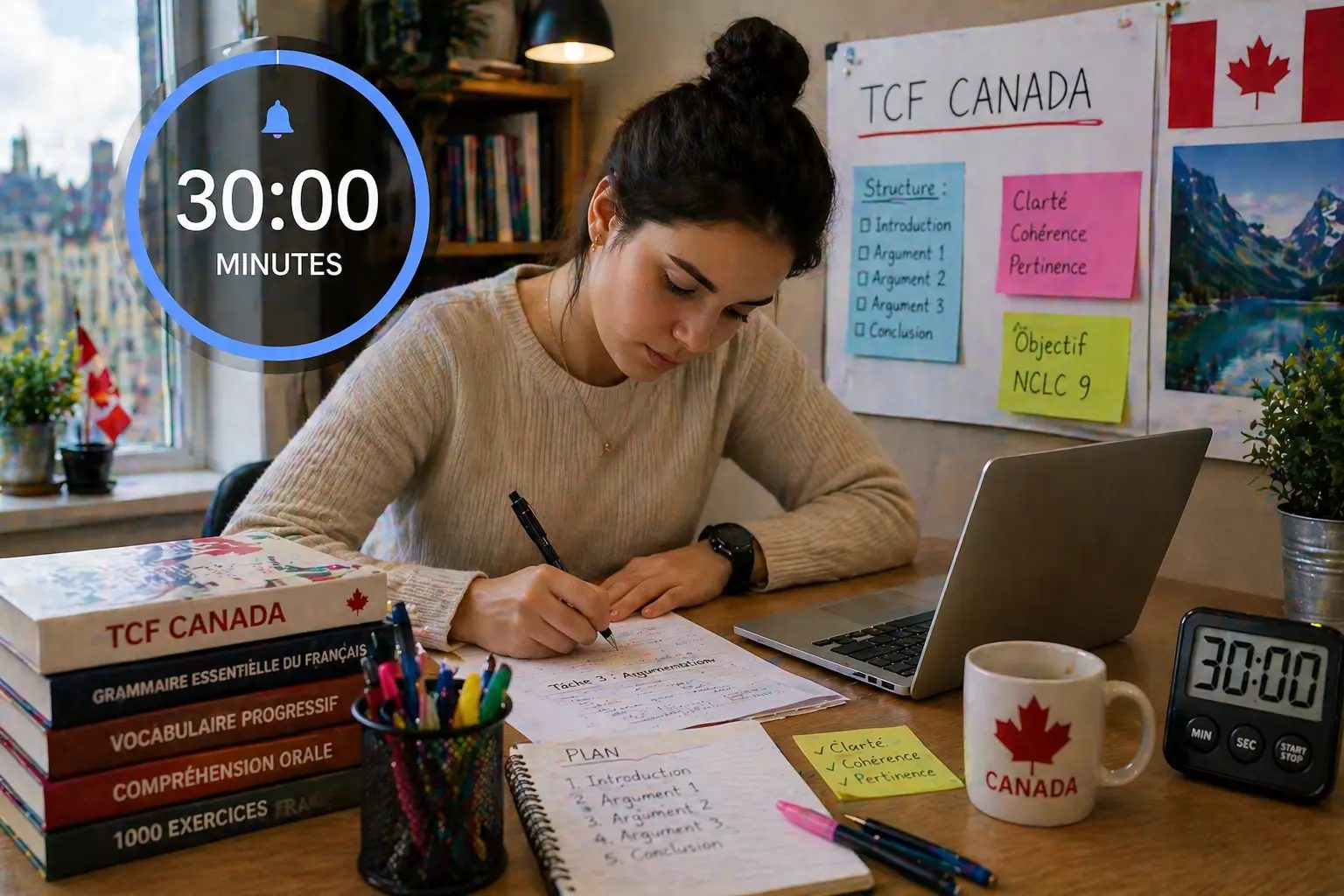
Of the three TCF Canada writing tasks, Task 3 generates the widest score spread between candidates who have prepared specifically and those who simply write well in general. Our guides on TCF Canada Writing: 7 Structures That Guarantee NCLC 9 and TCF Canada Writing Methodology establish the general framework. This article focuses exclusively on Task 3 — the argumentative essay — with a minute-by-minute 30-minute method that prevents the most common structural failures even under time pressure.
What Task 3 requires: An argumentative text of 120 to 150 words minimum (recommended 180–200 for NCLC 9), responding to a social or Canadian issue. The candidate must present a reasoned personal position with supporting arguments and examples. Official time recommendation: 25 to 35 minutes. The most effective single strategy: spend 10 minutes planning before writing a single complete sentence.
The Four Most Frequent Task 3 Topic Types
| Topic Type | Sample Formulation | What Markers Look For |
|---|---|---|
| Social issue | "Remote work: advantages and disadvantages for employees and employers" | Balanced argument with personal position clearly stated |
| Personal value choice | "Do you prefer living in the city or in the countryside? Justify." | Clear defence of one position with concrete reasoning |
| Canadian societal question | "Do you think immigration contributes positively to the Canadian economy?" | Factual arguments + Canadian contextual examples + nuance |
| Environmental or technological | "Should cars be banned from city centres to combat pollution?" | Structured argument + concrete alternative proposals |
The topic trap to avoid: Some Task 3 topics contain words like "seulement", "tous", "jamais" or "toujours" that implicitly require you to qualify the absolute claim. If the topic says "la technologie résoudra tous les problèmes environnementaux", the expected argumentative move includes a concession acknowledging limits — not an uncritical endorsement. Read every word of the prompt carefully before planning.
The CAFÉ Method: 30 Minutes, Minute by Minute
C — Comprehension (3 minutes)
What to do in these 3 minutes:
- Read the topic twice — not once, twice
- Underline the central keyword (e.g. "télétravail", "immigration", "alimentation")
- Identify the task type: choose a side? or present a nuanced analysis?
- Look for hidden assumptions or traps ("only", "all", "never" signal nuance is expected)
- Connect the topic to a Canadian context you know (housing crisis, healthcare shortages, environmental policy)
Write nothing in complete sentences. Only key words and the verb of your position ("je pense que le télétravail améliore... parce que...").
A — Argumentation: Draft the Skeleton (7 minutes)
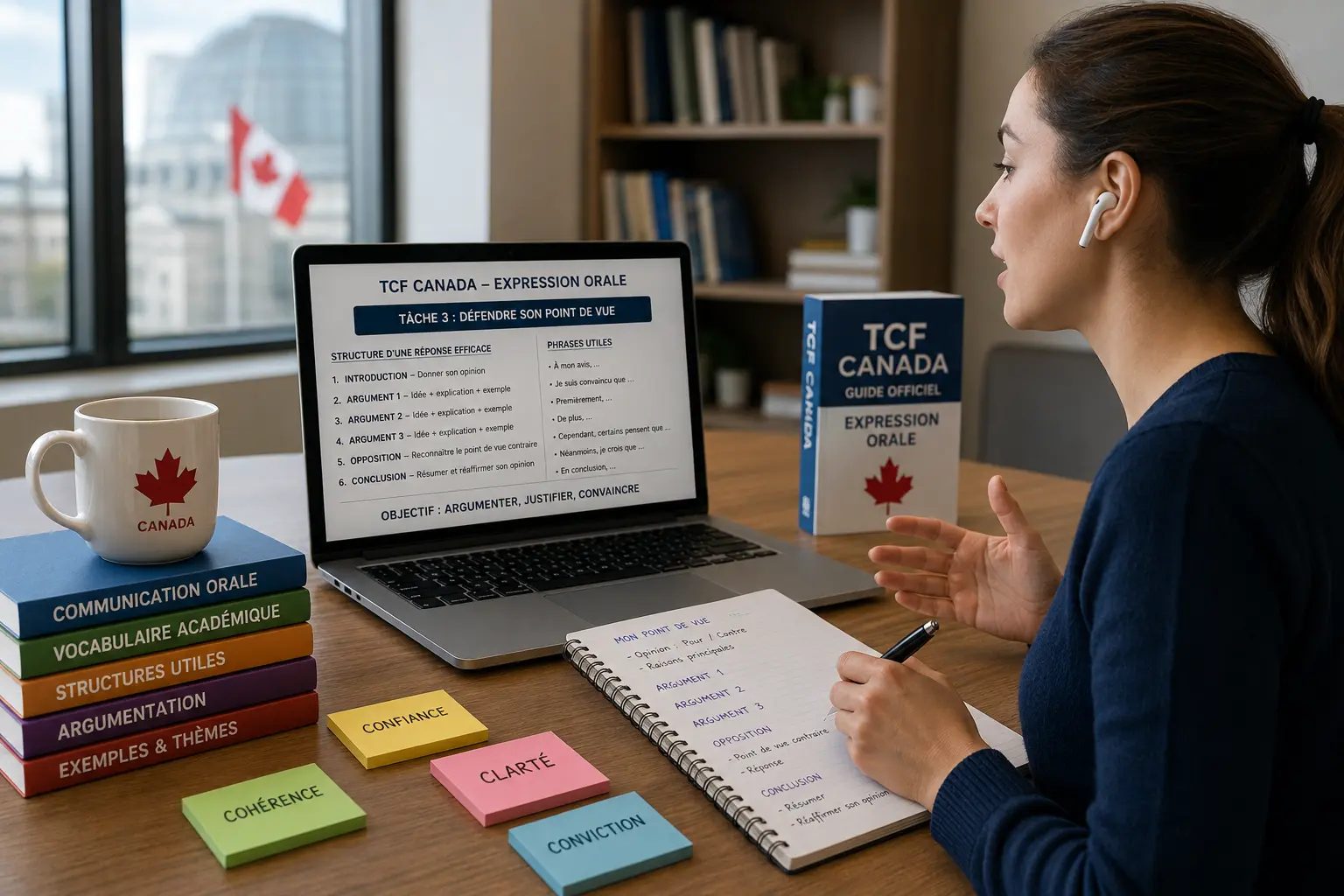
The universal skeleton that works for every Task 3 topic:
Introduction (2 sentences): Contextual hook relevant to Canada or the world → restatement of the question → announcement of your position in one clear verb phrase.
Argument 1: Main idea in one phrase → explanation in one sentence → concrete example (real or plausible). Total: 3 to 4 sentences.
Argument 2: Main idea (different angle from Arg. 1) → explanation → concrete example. Total: 3 to 4 sentences.
Concession: "Certes / Bien que / Il est vrai que [counter-argument]... / mais... / il n'en reste pas moins que [your position maintained]." Total: 1 to 2 sentences.
Conclusion: Reformulation of your position in different words → opening to a wider perspective or future dimension. Total: 2 sentences.
Total skeleton: 12 to 14 sentences → 180 to 200 words when fully written.
F — Formulation: Write the Full Text (17 minutes)
Complete worked example — Topic: "Le télétravail améliore-t-il la qualité de vie des travailleurs ?"
"L'essor du télétravail, accéléré par la crise sanitaire mondiale de 2020, a profondément modifié l'organisation du travail au Canada comme dans le reste du monde. Je considère que, dans l'ensemble, cette évolution contribue positivement à la qualité de vie des salariés.
En premier lieu, le télétravail supprime ou réduit considérablement les trajets quotidiens, source majeure de fatigue et de stress chronique. Un employé habitant à 40 kilomètres de son bureau récupère ainsi plusieurs heures chaque semaine, qu'il peut consacrer à sa famille ou à ses loisirs. Selon Statistique Canada, les travailleurs à distance déclarent une satisfaction professionnelle supérieure de 23 % à celle de leurs collègues en présentiel.
Par ailleurs, la flexibilité horaire qu'offre ce mode de travail favorise une meilleure conciliation travail-famille, en particulier pour les parents de jeunes enfants ou les proches aidants.
Certes, le télétravail présente des risques réels d'isolement professionnel et peut nuire à la collaboration créative entre équipes. Ces risques justifient de l'organiser en mode hybride plutôt que de l'imposer à temps complet.
En définitive, le télétravail représente une avancée significative pour le bien-être professionnel, à condition qu'il s'accompagne de politiques d'entreprise qui préservent le lien social et la cohésion d'équipe."
Word count: 202. Estimated score: 15–16/20 (NCLC 9). Structures used: nominalisation (l'essor, l'évolution), formal causality (en premier lieu, par ailleurs, en définitive), passive voice (a été accéléré), concession (certes... ces risques justifient).
É — Editing: Six-Point Grammar Check (3 minutes)
The 3-minute editing checklist — grammar only, not content:
- ☐ Is "être" present everywhere it belongs? (Never omitted)
- ☐ Are past participle agreements with "avoir" correct? (Check every one)
- ☐ Is there a capital letter after every full stop?
- ☐ Is "ne...pas" always complete in written formal register?
- ☐ Is the politeness conditional used where formality requires it?
- ☐ Are connectors varied? (No two identical connectors in adjacent sentences)
Do not re-read for ideas or reorganise. These 3 minutes are exclusively for the grammar checklist above.
The 15 Most Recurring Task 3 Topics — Pre-Prepare Your Skeletons
| Theme | Most Recurring Topic Formulations |
|---|---|
| Work | Remote work, 4-day work week, career change, robots replacing jobs, work-life balance |
| Environment | Electric vehicles, plant-based diet, renewable energy, single-use plastics, carbon pricing |
| Education | Screens and children, distance learning, university degrees vs practical skills, education reform |
| Society | Social media and youth, AI in everyday life, urban vs rural living, ageing population |
| Health | Preventive medicine, mandatory physical activity, healthy food policies, mental health at work |
Pre-exam skeleton preparation: For each of the 15 topics above, prepare a 10-line skeleton in note form (not a full essay) with your position, 2 arguments with examples, 1 concession and a conclusion opening. This skeleton preparation takes 3 to 4 hours total and saves 7 minutes on exam day when the topic matches one you prepared — 7 minutes you can invest entirely in formulation quality.




 TCF Canada Hub
0 Commentaires
aucun commentaire
Soyez le premier a partager votre avis !